
In the 2026 digital ecosystem, high-quality clinical skills are only half the battle. If you are starting a private practice in New York, whether in Manhattan, Brooklyn, or Queens, your first challenge is not therapy—it is visibility. With thousands of providers in the city, the only way to reliably capture new referrals without spending thousands on Google Ads is through mastering Local SEO.
Mastering Local SEO means more than just having a nice website; it means appearing in the “Local Map Pack” at the exact moment a client searches for “therapists near me.” Written by our marketing experts and reviewed by licensed clinicians, this 2026 roadmap will teach you how to dominate the New York search landscape and outrank the massive corporate directories.
The Map Pack: Your NYC Storefront
If you have registered your NY PLLC, your Google Business Profile (GBP) is effectively your virtual storefront. In NYC, over 60% of all organic clicks go to the top three results in the map pack. If you aren’t there, you are missing out on thousands of dollars in potential caseload revenue every single month.
Pro-Tip: Bookmark this guide to refer back to as you build your digital footprint.
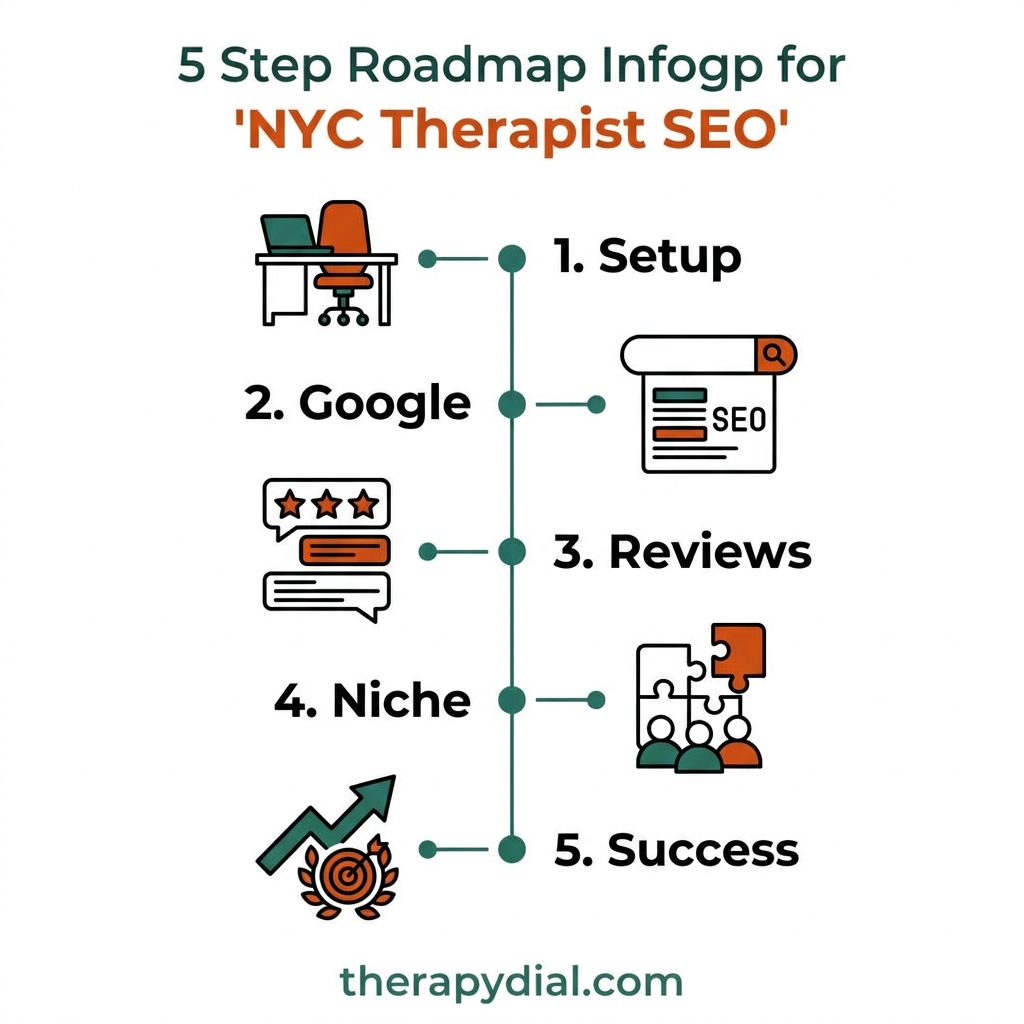
Step 1: The Google Business Profile (GBP) Strategy
Your Google Business Profile is the #1 ranking signal for local search. For NYC therapists, a generic profile with just your name and address is no longer enough to rank. You need consistent engagement to stay at the top of the stack.
Consistent NAP (Name, Address, Phone)
Your practice details must match exactly across all digital platforms. In NY, ensure your suite number on your GBP matches your NPI Type 2 registration exactly. Google uses this consistency as a primary trust signal.
Weekly Profile Updates
Posting one “update” or “offer” to your GBP per week signals to Google that your business is highly active. You can link these updates to your latest blog posts or specific service pages.
Photo Frequency
Data shows that profiles with 50+ photos (office interior, staff, waiting room, exterior building shots) outperform minimalist profiles by 40%. Keep adding authentic, non-stock photos regularly.
Step 2: Winning the “Platform War”
Many therapists rely solely on platforms like Alma or Headway for referrals. While these platforms have high domain authority, their internal directories are heavily saturated. To truly win, you must optimize your individual directory profiles to point back to your primary website.
On sites like Psychology Today, avoid the standard “License Blurb” where you simply list your credentials. Instead, use a client-centered approach that highlights your specific niche. Furthermore, if you are credentialed with Aetna or UnitedHealthcare, mention these prominently in your headings! In New York, insurance search intent is the highest converting traffic source.
Step 3: Niche Keyword Dominance
Stop trying to rank for “New York Therapist” or “Therapist in NYC.” Those terms are too broad, dominated by corporate directories, and too expensive for paid ads. Instead, you must target high-intent, long-tail keywords that your specific ideal client is typing into Google.
Step 4: Clinical Authority (E-E-A-T)
Google’s core algorithm updates heavily prioritize E-E-A-T (Experience, Expertise, Authoritativeness, and Trustworthiness) for healthcare sites (YMYL – Your Money or Your Life). This means your website content cannot just be generic SEO fluff; it must be clinically accurate and authoritative.
If you write a blog post about depression, ensure your content correctly references modern ICD-10 coding standards or evidence-based treatments. Trust is also built through administrative transparency. Showing your clients that you use modern, secure systems for note-taking, like structured SOAP notes, and clear intake processes can increase your conversion rates by signaling high-end professionalism.
Exclusive Provider Bundle:
Billing + Free Growth
$499/month
- Professional Medical Billing
- FREE Insurance Credentialing
- FREE TherapyDial Profile Listing (SEO Boost)
- Priority Practice Support
We verify your codes, submit your claims, and fight for your revenue.
HIPAA Compliant & Expertly Managed.
Master Your Practice Setup & Clinical Operations
Ensure your practice remains compliant and audit-ready as you scale with our related hubs:
Frequently Asked Questions About Local SEO
New York is the most competitive market in the US. For a brand new website domain, expect to see significant organic movement in 4–6 months of consistent work. However, optimizing your Google Business Profile can show results in the local map pack in as little as 30–60 days.
Yes. While therapists must be extremely careful with solicitation due to strict ethical standards and HIPAA, organic Google reviews left voluntarily by patients are a primary local ranking factor. Ensure you follow your state board rules regarding marketing and testimonials.
If you are a telehealth-only provider, you can rank as a “Service Area Business” on Google. However, you will generally find it much harder to appear in the top 3 of the map pack without a verified physical address where your business is registered.
Social signals (likes, shares) themselves aren’t direct ranking factors, but they drive traffic and brand mentions (citations) across the web, which Google eventually sees as a strong Trust signal for your clinical authority.
Scaling a full SEO strategy in NYC while maintaining a full clinical caseload is difficult. Many therapists use a managed service to handle their technical footprint, directory management, and billing, so they can focus on their patients.