Getting credentialed with Aetna is one of the most reliable ways for private practice therapists to build a steady caseload. With nearly 39 million members nationwide, being an in-network Aetna provider can significantly reduce your marketing efforts while allowing you to care for clients who rely on their behavioral health benefits.
However, navigating the credentialing paperwork can feel like an overwhelming bureaucratic maze. Written by our revenue cycle experts and reviewed by licensed clinicians, this comprehensive 2026 guide will break down the exact steps to successfully join the Aetna provider network, avoid common pitfalls that cause delays, and start seeing clients faster.
Why Consider Aetna Credentialing?
While insurance-based practice isn’t for everyone, Aetna has become increasingly competitive in the behavioral health space. Over the past few years, they have streamlined portions of their credentialing process and placed a heavier emphasis on expanding access to mental health care for their members. Getting in-network with Aetna can quickly fill your calendar, especially if you specialize in high-demand areas.
Prerequisites: What You Need Before You Apply
Aetna’s credentialing application requires that you have certain foundational items in place before they will even review you. Ensure you have the following ready:
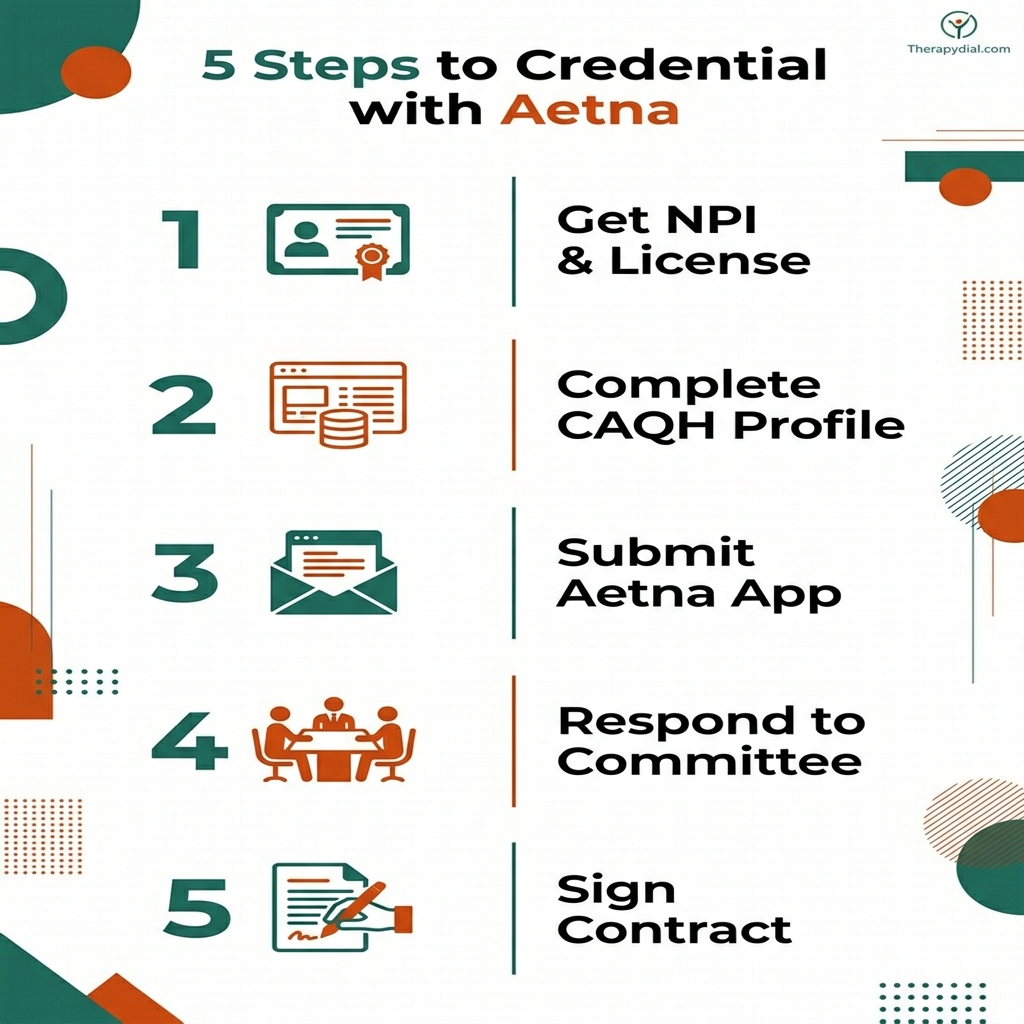
Your state license to practice independently must be fully active and in good standing. You must also have a Type 1 (Individual) NPI. If billing under a business entity, you need a Type 2 NPI. If you haven’t obtained one, read our NPI guide for therapists.
Aetna requires proof of adequate professional liability insurance coverage. Typically, you will need coverage limits of at least $1,000,000 per occurrence and $3,000,000 aggregate, matching your exact practice location and NPI data.
Step-by-Step Guide to Credentialing with Aetna in 2026
Complete and Attest Your CAQH ProView Profile
Aetna uses CAQH ProView as its primary source for verifying your credentials. You must create a CAQH profile, meticulously fill out all sections (education, work history, specialties, malpractice insurance, etc.), upload supporting documents, and officially “attest” that the information is accurate. Crucially: You must authorize Aetna to access your CAQH profile within the CAQH platform. If they can’t access it, your application will be immediately stalled.
Submit a Request for Participation to Aetna
Once your CAQH profile is 100% complete and attested, visit the Aetna Behavioral Health Provider portal. You cannot submit an application directly; instead, you must submit a “Request for Participation.” This form tells Aetna who you are, what your specialty is, and where you practice. Aetna reviews this request to determine if there is a “network need” for your specialty in your geographic area.
Wait for Network Need Evaluation
Aetna will evaluate your request against their current provider density. If they determine a need for your services, they will send you an invitation via email to officially apply for credentialing and contracting. Remember, submitting a request does not guarantee you will be invited to apply.
Primary Source Verification and Committee Review
After you formally apply (which often simply involves Aetna pulling data from your CAQH), Aetna begins primary source verification. They contact your degree-granting universities, state licensing boards, and verify your malpractice history. After verification, your file is sent to the Credentialing Committee. This process can take anywhere from 60 to 120 days.
Review and Sign the Aetna Contract
If approved, Aetna will send you a participation contract outlining your fee schedule and network terms. Review it carefully. Once signed and returned, Aetna will issue you an “Effective Date” — you are officially in-network and can begin billing for dates of service starting on or after that day!
Common Credentialing Delays and How to Avoid Them
Aetna processes thousands of applications, and any discrepancy will bump you to the back of the line.
Your CAQH work history must cover the past 5 years continuously. Aetna requires an explanation for any gap in employment spanning more than 30 days. Unexplained gaps will immediately pause your application.
You must re-attest your CAQH profile every 120 days. If your attestation expires while Aetna is processing your application, they will halt the process. Set a calendar reminder to check your CAQH status frequently.
When you reach the contracting phase, Aetna will cross-reference your business name and Tax ID against your W-9. If the information does not match IRS records precisely (or doesn’t match your NPI registration), your contract will be delayed.
Pro-Tip: Keep your CAQH profile updated every 120 days to avoid processing holds.
Alternatives to Direct Aetna Credentialing
If you don’t want to wait 90-120 days or handle the paperwork yourself, there are alternative paths to joining the Aetna network.
Therapy Aggregator Platforms: Companies like Alma and Headway hold large group contracts with Aetna. If you join these platforms, you are credentialed under their umbrella group, which usually takes 2-4 weeks instead of several months. The downside is that they dictate your reimbursement rate. Read our Alma vs Headway 2026 breakdown for more details.
Professional Credentialing Services: If you want to remain an independent practitioner and hold your own direct contract with Aetna (meaning you get to negotiate your own rates and are not tied to a third-party platform), hiring a professional medical billing and credentialing firm is the best option. They take over the CAQH management, application submission, and constant follow-ups.
What Happens After You Get Contracted?
From your “Effective Date” forward, you can confidently tell clients you accept Aetna. Next, you need to seamlessly integrate Aetna billing into your practice. This involves verifying benefits (checking deductibles, copays, and prior authorizations via proper ICD and CPT coding) before the first session.
You must also ensure your clinical documentation, like your SOAP notes, perfectly aligns with Aetna’s medical necessity criteria in case of an audit.
Exclusive Provider Bundle:
Billing + Free Growth
$499/month
- Professional Medical Billing
- FREE Insurance Credentialing including Aetna
- FREE TherapyDial Profile Listing
- Priority Practice Support
Stop fighting with CAQH and insurance portals. We handle your complete credentialing and ongoing billing.
HIPAA Compliant & Expertly Managed.
Frequently Asked Questions
On average, the Aetna credentialing process takes between 90 and 120 days from the moment your full application is submitted and accepted. Missing information in your CAQH profile or unexplained gaps in employment can delay the process by several additional months.
Yes. Aetna relies heavily on CAQH ProView to conduct primary source verification. Your CAQH profile must be 100% complete, fully attested, and you must explicitly authorize Aetna to access your information in the CAQH portal.
Common reasons for denial include an active state license suspension, a history of significant malpractice claims, failure to respond to Aetna’s requests for additional information, or because Aetna determines they do not have a “network need” for your specific specialty in your geographic zip code.
No. You can only bill Aetna for services rendered on or after your official “Effective Date,” which is established after your contract is signed. Any sessions conducted before this date will be processed as out-of-network, leaving the client responsible for the full fee based on their out-of-network benefits.
Yes. Because aggregator platforms like Alma and Headway hold existing group contracts with Aetna, you can often be added to their roster and commence billing Aetna clients in about 2 to 4 weeks. However, you will be paid their predetermined group rates, rather than negotiating an independent contract directly.