As a therapist, you spend extensive time mastering the onboarding process—from initial consultations to perfecting your intake notes. However, the end of the therapeutic relationship is just as critical. A successful client discharge process ensures clinical continuity, provides closure for the client, and protects your practice legally and ethically.
Whether a client has successfully met all the goals outlined in their treatment plan, or they have simply stopped showing up, completing a formal Discharge Summary is a non-negotiable part of your clinical documentation.
Planned vs. Administrative Discharge
A Planned Discharge occurs when you and the client mutually agree that treatment goals have been met, or they require a higher level of care. An Administrative Discharge (often called "ghosting") happens when a client repeatedly no-shows or violates practice policies. Regardless of how the relationship ends, your Electronic Health Record (EHR) must reflect a closed episode of care with a finalized discharge summary.
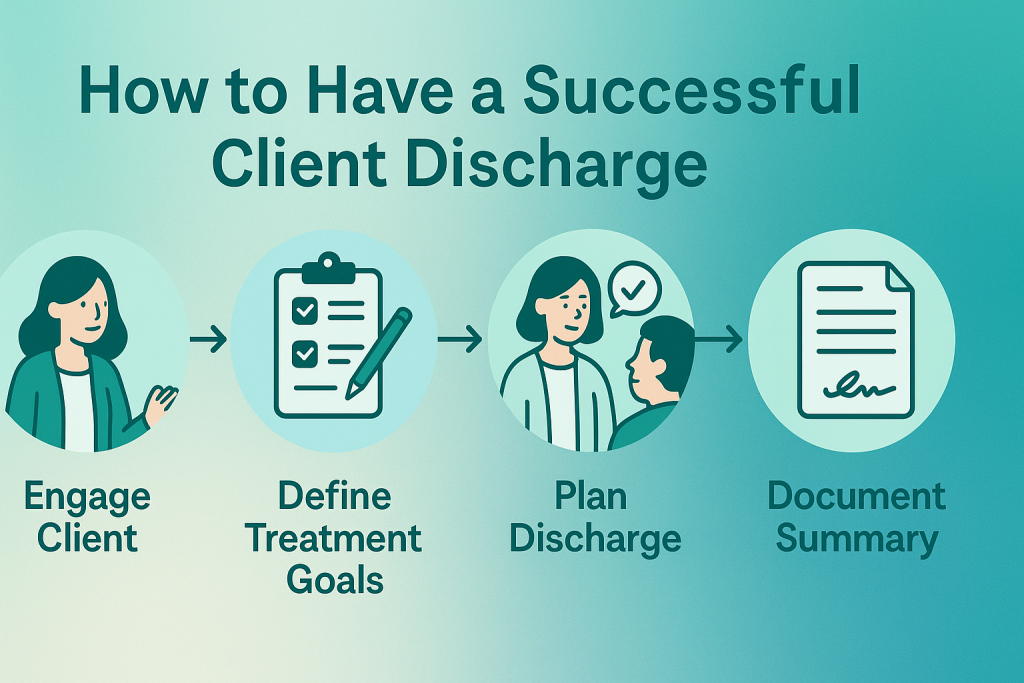
The 4 Steps to a Successful Client Termination
The Pre-Discharge Conversation
Termination shouldn't be a surprise. Ideally, the concept of discharge is introduced early in treatment. When approaching the final sessions, dedicate time to review the original presenting problems and celebrate the progress made. This is the time to transition from active therapy to maintenance mode.
Relapse Prevention & Maintenance Planning
Before closing the file, collaborate with the client on a relapse prevention plan. What coping skills will they use? What are their warning signs? Ensure that these final interventions are clearly documented in your final SOAP notes or DAP notes for the session.
Writing the Clinical Discharge Summary
The discharge summary is the capstone of the patient's medical record. It provides a high-level overview of the entire episode of care. If the client ever returns, or if their records are requested by another provider, this document tells the complete story of their time in your practice. (See our template below).
Finalizing Billing and Records
Once clinical closure is achieved, administrative closure must follow. Ensure all claims, including your final CPT codes, have been submitted and paid. Zero out patient balances, disable their active portal access if required by your EHR policy, and securely archive the file according to your state's retention laws.
The TherapyDial Discharge Summary Template
Copy and paste this standard template into your EHR. It is designed to be concise, compliant, and comprehensive.
Client Discharge Summary
Client Name: [Insert Name]
DOB: [Insert Date of Birth]
Date of Admission: [Insert Date]
Date of Discharge: [Insert Date]
Primary Diagnosis: [Insert ICD-10 Code and Description]
1. Reason for Admission / Presenting Problem:
Client initiated treatment seeking support for [insert primary symptoms]. Initial assessment indicated [brief summary of baseline severity and impairment].
2. Summary of Treatment & Interventions:
Client attended [X] sessions over the course of [X months/years]. Treatment modalities utilized included [e.g., CBT, EMDR, supportive counseling]. Primary focus areas were [insert 2-3 main treatment goals].
3. Client Progress and Outcomes:
Client demonstrated [significant/moderate/minimal] progress toward treatment goals. Specifically, the client achieved [list specific achievements, e.g., reduced panic attacks from daily to monthly, developed healthy boundaries].
4. Reason for Discharge:
[Select one:]
• Planned: Mutual agreement that treatment goals have been successfully met.
• Administrative: Client discontinued treatment / Did not return for scheduled appointments.
• Referral: Client requires a higher level of care or specialized treatment.
5. Recommendations & Referrals:
Client is encouraged to utilize their relapse prevention plan. Provided referrals for [e.g., psychiatry, specialized group therapy, community resources] if applicable. Client was informed they may reach out to re-initiate services in the future if needed.
Provider Signature: _______________________
Date: _______________________

Exclusive Provider Bundle:
Billing + Free Growth
- Professional Medical Billing
- FREE Insurance Credentialing (UHC, BCBS, Aetna)
- FREE TherapyDial Profile Listing
- Priority Practice Support
Stop fighting with insurance paperwork. We handle your complete credentialing and ongoing billing.
HIPAA Compliant & Expertly Managed.
Master Your Clinical Documentation
Ensure your practice is audit-proof from intake to discharge. Explore our complete documentation and coding hubs:
Frequently Asked Questions About Discharge
Yes. If a client stops showing up, you must perform an "administrative discharge." Document your attempts to contact them (e.g., email, phone call) and officially close the file in your EHR to protect yourself from liability regarding their ongoing care.
For a planned discharge, the summary should be completed within 72 hours of the final session. For client abandonment, most practice policies dictate sending a closure letter and writing the summary after 30 to 45 days of no contact.
Generally, no. Insurance companies consider clinical documentation (including intake notes, progress notes, and discharge summaries) to be part of the standard reimbursement rate for the therapy session itself. It cannot be billed separately.
If a client returns after a formal discharge, you will treat it as a new episode of care. You will need to conduct a new biopsychosocial assessment, create a new treatment plan, and potentially update their intake paperwork depending on how much time has passed.