As a mental health professional, finding the balance between thorough clinical documentation and administrative burnout is a constant struggle. Enter the DAP Note.
A DAP note is a three-section progress note format (Data, Assessment, Plan) used widely in behavioral health. It gives you a straight line through the session: what happened, what it means clinically, and what you’ll do about it. Many experienced clinicians prefer the DAP structure over SOAP notes for its speed, narrative flow, and clarity.
In this guide, we break down exactly how to structure your DAP notes, provide real-world examples across different modalities, and highlight the compliance pitfalls that trigger insurance audits.
DAP vs. SOAP vs. BIRP: Which Should You Use?
Choosing the right note format depends on your clinical setting and practice style.
- DAP Notes: Best for solo practitioners or small therapy practices seeking speed and consistency. It combines the Subjective and Objective parts of a SOAP note into a single "Data" narrative.
- SOAP Notes: Best for multidisciplinary settings where medical teams need explicit separation of subjective patient reports and objective clinical findings.
- BIRP Notes: (Behavior, Intervention, Response, Plan). Best for intensive behavioral programs or ABA therapy where measurable client responses to specific interventions are the primary focus.
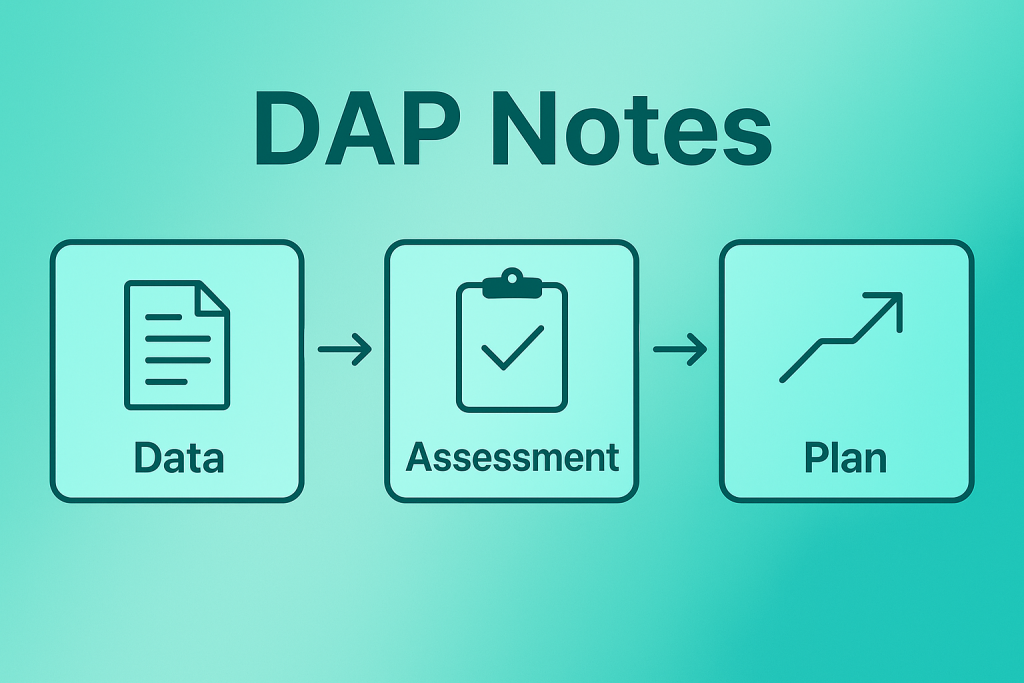
The DAP Note Flow (At-a-Glance)
A simple visual structure: What happened (Data) → What it means (Assessment) → What we’ll do next (Plan).
How to Write a Compliant DAP Note
Data (The Facts)
This section merges the subjective patient reports with your objective clinical observations. It should be a factual, unbiased record of what occurred during the session.
- Client Report: Symptoms, stressors, and current functioning. Include brief, meaningful direct quotes (e.g., "I haven't slept in three days").
- Observable Data: Appearance, affect, behavior, and elements of a Mental Status Exam (MSE).
- Interventions: What therapeutic techniques were used (e.g., CBT, EMDR processing, grounding exercises) and the client’s immediate reaction.
- Metrics: Include scores from standardized scales (PHQ-9, GAD-7) if administered.
Assessment (The Clinical Read)
This is where you synthesize the data into professional clinical judgment. This section justifies your ICD-10 diagnosis and proves the medical necessity of the session to insurance payers.
- Diagnosis & Formulation: Tie your clinical formulation directly back to the evidence in the Data section.
- Progress: Note whether the client is improving, stable, or worsening compared to prior visits. Tie this to their overarching treatment plan goals.
- Risk Assessment: Explicitly document any current risk levels (SI/HI), protective factors, and the status of their safety plan.
Plan (The Next Steps)
The Plan outlines the trajectory of care. It must be clear enough that another clinician could seamlessly pick up the case if you were unavailable.
- Next Steps: Modality to be used next session, frequency of visits, and assigned homework.
- Coordination: Any referrals made, labs requested, or medication consultations needed.
- Administrative: The date of the next appointment or the next formal treatment-plan review window.
DAP Note Examples
📝 Example 1: Individual Therapy (Anxiety)
💊 Example 2: Medication Management (Depression)
Tips & Common Mistakes
Draft Immediately
Block 5–7 minutes post-session to draft your DAP note while the Data is fresh. Finalize and sign it at the end of the day. Delaying notes leads to missing clinical nuances and increased audit risk.
Vague Assessments
Writing "Client is doing better" is not a clinical assessment. You must tie the improvement to a specific scale (like the PHQ-9) or a concrete behavior change (e.g., "Client reported zero panic attacks this week").
Adding "Response"
Some practices use the DARP variant (Data, Assessment, Response, Plan). This adds a specific section to capture exactly how the client responded to interventions during the session (e.g., "Used grounding in-session; HR decreased from 96 to 78; client rated distress dropping from 7 to 4").
Stop Guessing on Compliance.
Start Getting Paid.
- Professional Medical Coding & Billing
- Denial Management & Appeals
- FREE Insurance Credentialing
- FREE TherapyDial Profile Listing
We verify your codes, submit your claims, and fight for your revenue.
HIPAA Compliant & Expertly Managed.
Master Your Clinical Documentation
Ensure your practice remains compliant from intake to discharge with our related hubs:
Clinical Documentation
Diagnostic Coding Mastery
Frequently Asked Questions About DAP Notes
Yes. If your Data supports the diagnosis/medical necessity, the Assessment documents your clinical reasoning, and the Plan outlines treatment with specific timing/frequency, DAP notes meet commercial payer and Medicaid expectations.
Most standard DAP notes fit into three short, concise paragraphs (one per section). However, higher complexity presentations, crisis interventions, or new intake sessions will naturally warrant more detail.
Yes. You should document the client's current risk level (SI/HI) in the Assessment section, and detail any safety planning or crisis protocols initiated in the Plan section.
Document the no-show or late cancellation under the Data section. Detail your outreach actions (e.g., "Called client at 10:15 AM, left voicemail") and follow your specific practice and payer policies regarding missed visits.