Half of all claim denials in behavioral health come down to vague or incorrect anxiety coding. As a clinician, you diagnose using the DSM-5, but you get paid by billing the precise ICD-10 code. Choosing the wrong code—or failing to document the functional impact supporting that code—will trigger audits and delayed reimbursements.
Clear, compliant coding starts with picking the right anxiety code and documenting why. In this guide, we break down the most common F40–F41 anxiety codes, provide a visual diagnostic flow, and share real-world progress note examples so you can code with confidence.
Most Common ICD-10 Codes for Anxiety
Anxiety disorders are grouped under the F40–F41 block. Here are the primary codes you will use in daily practice:
F41.1 — Generalized Anxiety Disorder (GAD)
Excessive worry most days for ≥6 months with physical symptoms (restlessness, fatigue, tension).
F41.0 — Panic Disorder
Recurrent unexpected panic attacks with persistent concern or behavior change related to the attacks.
F40.1 — Social Phobias (Social Anxiety)
Marked fear of social/performance situations with avoidance or endured distress; interferes with function.
F41.9 — Anxiety Disorder, Unspecified
Use temporarily during intake when anxiety is clear but the exact type is not yet determined.
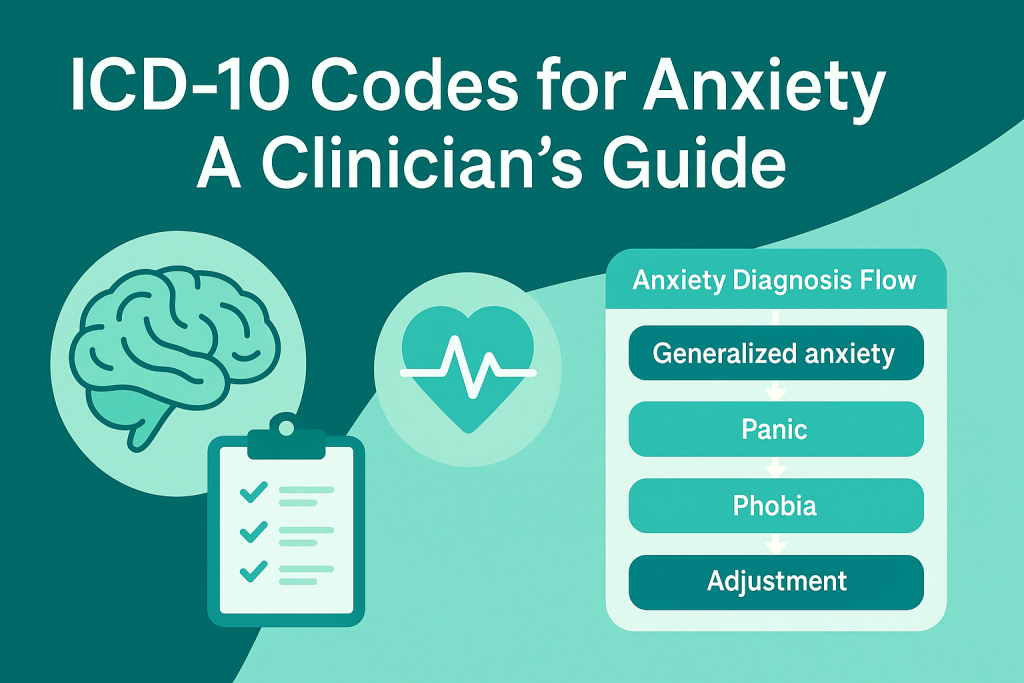
Anxiety Diagnosis Flow (Visual Guide)
Use this diagnostic tree to narrow down the F-series block before applying the DSM-5 criteria in your assessment.
Anxiety Diagnostic Code Estimator
Select the predominant symptom profile to estimate the correct ICD-10 code.
Suggested ICD-10 Code
F41.9Unspecified. Use temporarily until duration and criteria are met.
Documentation Essentials (What Payers Look For)
If you are audited, the insurance company isn't just looking at the code on the claim—they are reading your SOAP notes or DAP notes to see if the documentation justifies the code. Ensure your notes contain:
Symptom Cluster & Duration
You cannot code F41.1 (GAD) if your notes say the symptoms started 2 months ago (GAD requires 6 months). Be explicit about timelines.
Functional Impairment
Why is this a disorder and not just normal stress? Document how the anxiety is impacting the client's work, school, relationships, or physical health (e.g., insomnia).
Objective Measures
Incorporate tools like the GAD-7 into your treatment plans. A baseline GAD-7 score of 15, dropping to an 8 after 6 weeks of CBT, proves the medical necessity of your sessions.
Real-World Coding Examples
📝 Therapy Note: GAD
📝 Therapy Note: Panic Disorder
📝 Therapy Note: Adjustment Disorder
ICD-10 vs. DSM-5: How They Align for Anxiety
Remember: The DSM-5 provides the diagnostic criteria (how you assess the patient), while ICD-10 provides the billing code (how you get paid).
| Clinical Construct | ICD-10 Code | DSM-5 Term |
|---|---|---|
| Generalized anxiety | F41.1 | Generalized Anxiety Disorder |
| Panic disorder | F41.0 | Panic Disorder |
| Social anxiety | F40.1 | Social Anxiety Disorder |
| Specific phobia | F40.2 | Specific Phobia |
| Adjustment with anxiety | F43.22 | Adjustment Disorder w/ Anxiety |
| Unspecified anxiety | F41.9 | Unspecified Anxiety Disorder |
Stop Guessing on Coding.
Start Getting Paid.
- Professional Medical Coding & Billing
- Denial Management & Appeals
- FREE Insurance Credentialing
- FREE TherapyDial Profile Listing
We verify your codes, submit your claims, and fight for your revenue.
HIPAA Compliant & Expertly Managed.
Master Your Diagnostic & Clinical Skills
Ensure your practice remains compliant and audit-ready with our related clinical hubs:
Coding & Documentation Mastery
Clinical Practice Setup
Frequently Asked Questions About Anxiety Coding
Use temporarily during intake when the presentation is clearly anxiety, but the exact type is undetermined or documentation is still in progress. Update to a more specific code (like F41.1) once clarified.
Yes, if criteria for both are met and clinically addressed. List the principal diagnosis driving the current treatment first.
Code the medical condition first, and document the causal relationship. Consider "Anxiety disorder due to another medical condition" constructs per DSM-5 and payer guidance.
Use F41.0 for Panic disorder when full criteria are met. For isolated panic attacks without the disorder, many commercial payers expect a principal diagnosis (like GAD) driving treatment rather than just a symptom code.
Z codes (e.g., Z55–Z65 social determinants of health like housing instability or job loss) can be added as secondary codes to capture psychosocial factors influencing care. They do not replace your principal F-series anxiety diagnosis.