As a mental health professional, correctly coding for Attention-Deficit/Hyperactivity Disorder (ADHD) is crucial. Correct coding protects your claims from denial, keeps your charts audit-ready, and clarifies the trajectory of care for other providers.
Below is a quick, visual guide to the ADHD codes you’ll use most often in the F90 family—plus exclusions, DSM-5 differences, and real-world examples to help you document medical necessity efficiently in your progress notes.
The F90 Family: Hyperkinetic Disorders
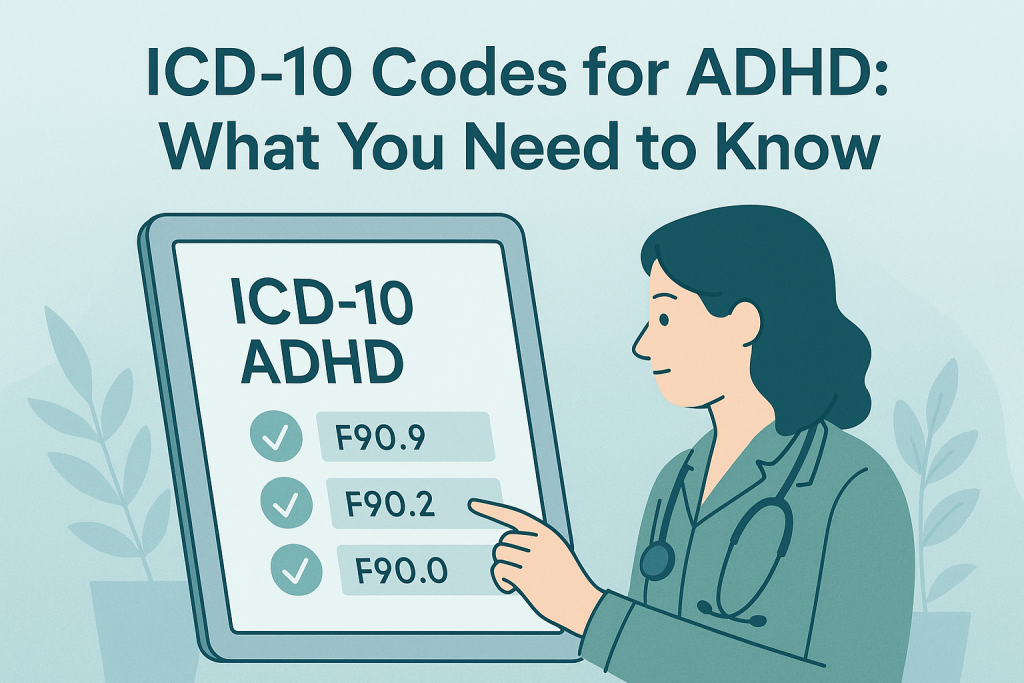
In the ICD-10, ADHD is classified under the F90 block, historically referred to as "Hyperkinetic disorders." Unlike older ICD versions, the current ICD-10-CM provides specific codes to delineate the predominant symptom presentation, mapping closely (though not perfectly) to DSM-5 criteria.
Most Common ICD-10 ADHD Codes
F90.0 — Predominantly Inattentive
- Inattention symptoms meet the clinical threshold.
- Hyperactive/impulsive symptoms are not prominent.
- Doc cue: Document functional impact on focus and task completion.
F90.1 — Predominantly Hyperactive
- Hyperactivity/impulsivity meets the clinical threshold.
- Inattention is not the predominant feature.
- Doc cue: Note behavioral dysregulation across different settings.
F90.2 — Combined Presentation
- Both inattentive and hyperactive domains are documented.
- Often the most specific and accurate code when full criteria are met.
- Doc cue: Strongly supports medical necessity for comprehensive treatment.
F90.8 / F90.9 — Other / Unspecified
- F90.8: Diagnosis confirmed, but atypical presentation. Describe the "other" spec in note body.
- F90.9: Use sparingly—subtype is unclear. Revisit once more data is gathered.
ADHD Coding Workflow (At-a-Glance)
Best practice: Document where symptoms show up, how they impair functioning, and why your chosen ICD code best fits.
Exclusions & Coding Caveats
Exclusion notes in the ICD-10 manual prevent overlap or miscoding. ADHD codes commonly require you to consider—and separately code—conditions that co-occur but are not part of the primary ADHD diagnosis. When coding F90.x, be mindful of:
Anxiety & Mood Disorders
Are the attention issues primarily driven by a mood episode? See our guides on Anxiety F41 codes and Depression F32 codes to ensure you are selecting the principal diagnosis driving the treatment.
Autism Spectrum (F84.x)
Historically, ICD-10 excluded coding ADHD if an Autism Spectrum Disorder was present. However, modern DSM-5 criteria explicitly allow them to co-occur when criteria for both are met. Document this clearly to avoid payer confusion.
Avoid "Rule-Out" Language
Insurance payers do not accept "Rule-out ADHD" as a final diagnosis code on a claim. If uncertain during an intake assessment, use F90.9 (Unspecified) temporarily, document your diagnostic reasoning, and detail the follow-up plans to refine the diagnosis.
ICD-10 vs. DSM-5: How They Align
Remember: The DSM-5 provides the diagnostic criteria (how you formulate the case), while ICD-10 provides the billing code (how you get paid for the session).
| ICD-10 Structure | DSM-5 Alignment |
|---|---|
| F90.0, F90.1, F90.2 act as fixed subtypes. | Uses "Presentations" (allows the symptom profile to evolve over time). |
| More static; requires a formal code change if the presentation shifts. | Acknowledges that hyperactive symptoms often wane in adulthood while inattention persists. |
| Historically strict on exclusions (e.g., ASD). | Permissive of co-occurring neurodevelopmental disorders if criteria are met. |
Real-World Coding Examples
📝 Case A: Combined Presentation (Pediatric)
📝 Case B: Inattentive Presentation (Adult)
Stop Guessing on Compliance.
Start Getting Paid.
- Professional Medical Coding & Billing
- Denial Management & Appeals
- FREE Insurance Credentialing
- FREE TherapyDial Profile Listing
We verify your codes, submit your claims, and fight for your revenue.
HIPAA Compliant & Expertly Managed.
Master Your Diagnostic & Clinical Skills
Ensure your practice remains compliant and audit-ready with our related clinical hubs:
Coding & Documentation Mastery
Frequently Asked Questions About ADHD Coding
Use F90.9 temporarily during intake when the presentation is clearly ADHD, but the exact subtype is undetermined or you are waiting on collateral forms (like Vanderbilt assessments). Update to a more specific code once clarified.
Yes. The F90 series applies across the lifespan. However, DSM-5 criteria require that several symptoms were present prior to age 12, even if the formal diagnosis is made in adulthood. Document this childhood history in your assessment.
You can code both if criteria for both are met independently (e.g., F90.0 and F41.1). However, be sure that the anxiety symptoms are not simply a manifestation of the ADHD struggles (e.g., anxiety purely about missing deadlines due to inattention).