After helping hundreds of mental health providers optimize their revenue cycles, one truth remains consistent: accurate documentation and coding for trauma-related disorders are highly scrutinized by insurance payers.
Post-traumatic stress disorder (PTSD) is grouped in ICD-10-CM under F43 — Reaction to severe stress, and adjustment disorders. While the DSM-5 guides your clinical diagnosis, your billing hinges on selecting the exact F43.1x subcode that reflects the duration and acuity of the patient's symptoms.
In this comprehensive clinician’s guide, we break down the specific ICD-10 codes for PTSD, how they map to DSM-5 criteria, and how to write progress notes that support medical necessity and prevent claim denials.
Quick Answer: The PTSD Code Family (F43.1x)
There are three primary, billable subcodes for Post-Traumatic Stress Disorder in the ICD-10 manual:
- F43.10 — Post-traumatic stress disorder, unspecified
- F43.11 — Post-traumatic stress disorder, acute (symptoms < 3 months)
- F43.12 — Post-traumatic stress disorder, chronic (symptoms ≥ 3 months)
Crucial Note: ICD-10 differentiates PTSD from related conditions such as F43.0 (Acute stress reaction) and F43.2x (Adjustment disorders). Choosing the correct code depends on the duration of symptoms and the specific symptom clusters present.
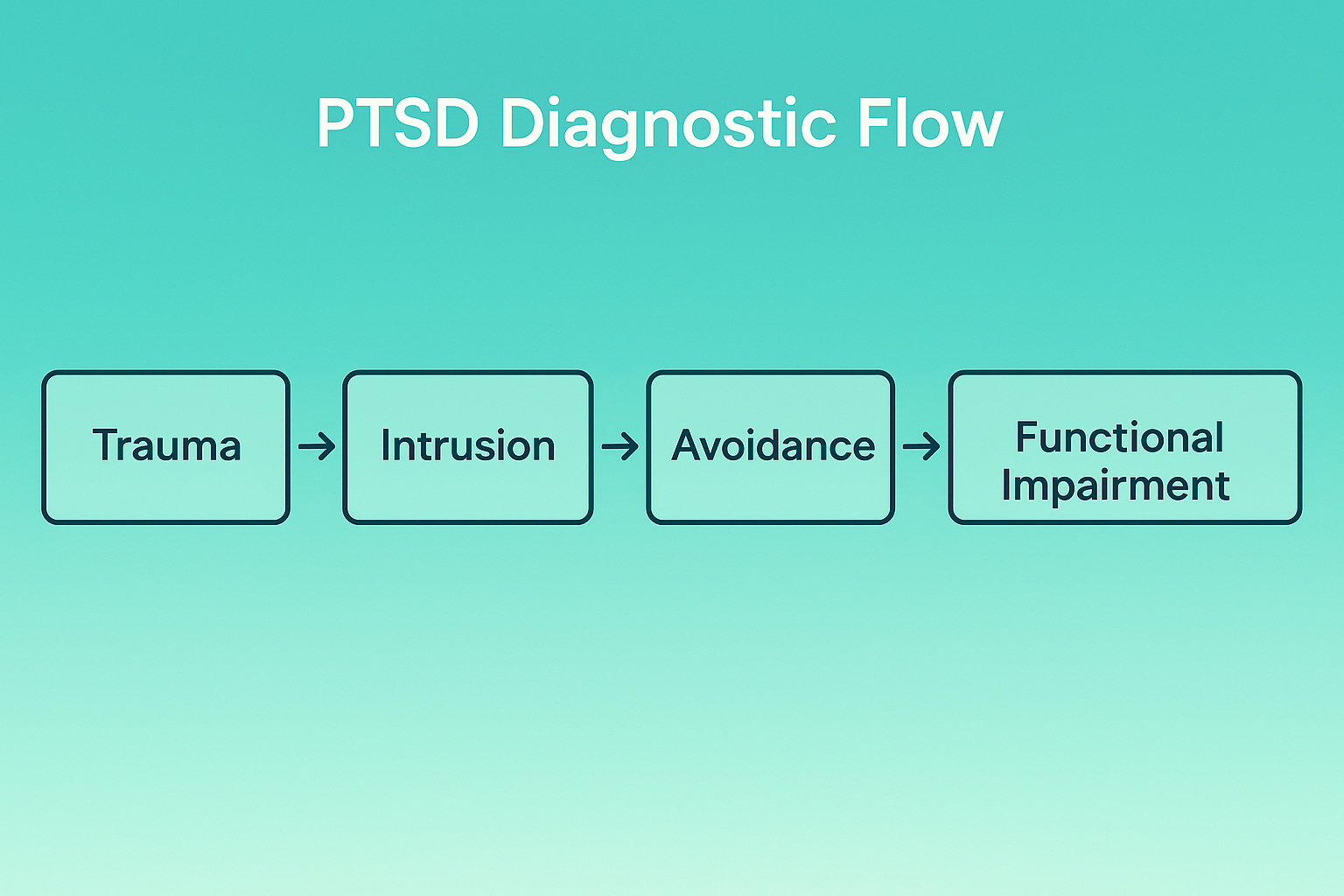
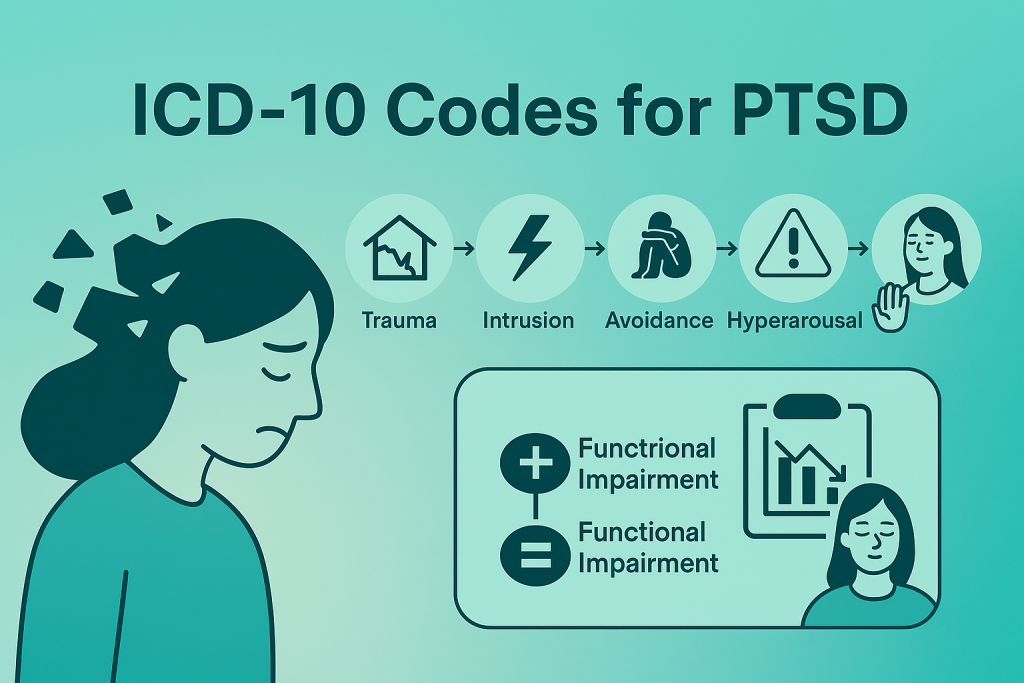
Map symptoms across DSM-5 clusters to support medical necessity and progress measures.
Deep Dive: ICD-10 Codes for PTSD
F43.10 — PTSD, Unspecified
Use this code when PTSD criteria are met (trauma exposure + core symptoms), but the acuity (acute vs. chronic) is not yet determined or is insufficiently documented in the initial intake.
Clinical Tip: This is helpful during the initial evaluation phase. However, to prevent audits, you should update the diagnosis to F43.11 or F43.12 once the timeline of the patient's symptoms becomes clear.
F43.11 — PTSD, Acute
Use F43.11 when PTSD symptoms have persisted for more than 1 month, but less than 3 months after the traumatic exposure.
Clinical Tip: If symptoms have been present for less than 1 month following the trauma, the correct diagnosis is typically Acute Stress Disorder (F43.0), not PTSD. Ensure your documentation clearly states the date of the stressor.
F43.12 — PTSD, Chronic
Use F43.12 when PTSD symptoms have persisted for 3 months or longer. This is the most common code used for ongoing psychotherapy or medication-management episodes.
Clinical Tip: Pair this code with objective outcome measures (like the PCL-5) in your treatment plans to justify the need for long-term, ongoing care.
PTSD Diagnostic Code Estimator
Determine the most appropriate ICD-10 code based on symptom duration and severity.
Suggested ICD-10 Code
F43.0Acute Stress Reaction. Symptoms have not persisted long enough for a PTSD diagnosis.
ICD-10 vs. DSM-5: How PTSD Coding Differs
ICD-10-CM is the billing and epidemiological standard required by insurance companies. DSM-5 provides the richer diagnostic criteria used for clinical assessment. Both require trauma exposure and symptom persistence beyond one month, with clinically significant distress or functional impairment.
| Category | ICD-10-CM | DSM-5 |
|---|---|---|
| Code Format | F43.1x (10/11/12) | 309.81 (Maps to F43.1x for billing) |
| Structure | Family by acuity (unspecified, acute, chronic) | Four symptom clusters (B–E): Intrusion, Avoidance, Negative Mood/Cognition, Arousal |
| Duration Rules | Must differentiate between < 3 months and ≥ 3 months | > 1 month + clinically significant distress/impairment |
| Primary Use Case | Payer/Billing compliance, Epidemiology | Clinical Assessment, Treatment Formulation |
Documentation Examples You Can Adapt
To pass an insurance audit, your clinical notes must connect the ICD-10 code to the specific interventions and the patient's functional impairment. Here is how that looks in practice.
For deeper note structures, see our guides on SOAP notes, DAP notes, and Intake assessments.
Practical Coding Tips to Reduce Denials
Document Duration Clearly
If symptoms are under 3 months, use F43.11; if 3 months or over, use F43.12. Update F43.10 as soon as the duration is clinically established.
Anchor to DSM-5 Clusters
Your notes should explicitly mention at least one intrusion symptom, one avoidance behavior, and changes in mood/cognition or arousal. Tie these directly to functional impact (e.g., missed work, strained relationships).
Pair ICD with the Right CPT Code
Intake and psychiatric evaluations should use CPT 99203 or 99204 depending on complexity. Standard psychotherapy uses 90832, 90834, or 90837. If the patient is actively triggered and in crisis, ensure you append the appropriate add-on crisis codes.
Clarify Your Differentials
If symptoms are sub-threshold or stressor-linked without meeting full PTSD criteria, code F43.2x (Adjustment disorder). If it is an immediate, transient reaction directly following a traumatic event, use F43.0 (Acute stress reaction).
Stop Guessing on Coding.
Start Getting Paid.
- Professional Medical Coding & Billing
- Denial Management & Appeals
- FREE Insurance Credentialing
- FREE TherapyDial Profile Listing
We verify your codes, submit your claims, and fight for your revenue.
HIPAA Compliant & Expertly Managed.
Master Your Diagnostic & Clinical Skills
Ensure your practice remains compliant and audit-ready with our related clinical hubs:
Frequently Asked Questions About PTSD Coding
Use the F43.1x family: F43.10 (unspecified), F43.11 (acute, < 3 months), F43.12 (chronic, ≥ 3 months). Ensure your clinical documentation supports the trauma exposure, symptom clusters, duration, and functional impact.
Yes. F43.10, F43.11, and F43.12 are fully billable codes in both psychotherapy and psychiatry. Pair them with the appropriate CPT codes (e.g., 90834, 90837, 99203) and justify the medical necessity with documented functional impairment.
DSM-5 defines four symptom clusters (B–E) and requires distress/impairment lasting > 1 month. ICD-10 provides the hierarchical billing code structure (F43.1x) with acuity specifiers. In short: use the DSM-5 criteria to diagnose the patient, but code with ICD-10 to bill the insurance company.
Use F43.0 (Acute stress reaction) for immediate, short-lived responses to trauma (less than 1 month). Use F43.2x (Adjustment disorders) when symptoms follow a stressor but do not meet the full diagnostic threshold required for PTSD.
The PCL-5 (PTSD Checklist) is the most widely used and validated self-report measure. Additionally, tracking sleep metrics, avoidance frequency, and specific functional outcomes (work attendance, school performance) strongly supports the medical necessity required for F43.12 (Chronic PTSD) claims.