As a prescriber in behavioral health—whether you are a Psychiatrist, PMHNP, or PA—your intake process is significantly more complex than a standard therapy session. You aren't just gathering history; you are evaluating medical risks, synthesizing complex data, and making critical decisions about medication management.
When assessing a new patient, many providers default to the psychiatric diagnostic evaluation code (90792). However, depending on payer policies and the nature of the visit, the Evaluation and Management (E/M) code 99203 is often a more accurate—and sometimes more lucrative—representation of your clinical work.
What is CPT 99203?
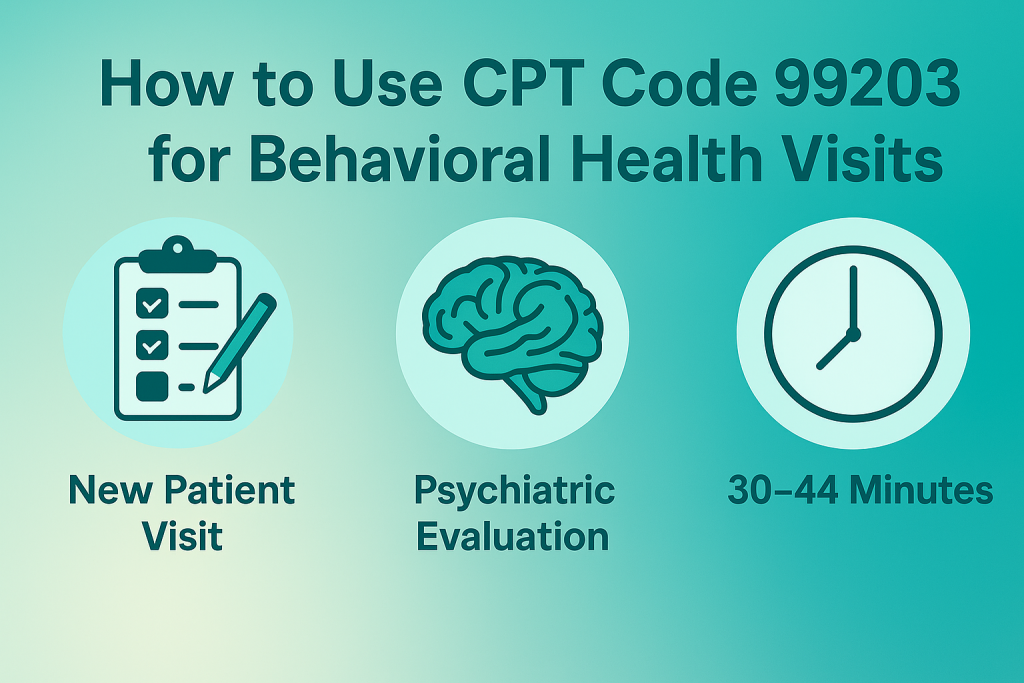
99203 is an E/M code used for a new patient office or outpatient visit. It requires a medically appropriate history and/or examination, and you select it based on either low medical decision making (MDM) OR a total time of 30–44 minutes spent on the date of the encounter.
E/M Code Selector (New Patient)
Select your MDM level or Total Time to see the correct CPT code.
Suggested E/M Code
--Select either MDM or Time to calculate the code.
90792 vs. 99203: Which Should You Use?
This is the most common point of confusion in psychiatric billing. Both codes represent a new patient evaluation, but they are viewed differently by payers.
| 90792 (Psychiatric Diagnostic Evaluation) | 99203 (New Patient E/M) |
|---|---|
| Includes medical services (prescribing/review). | Requires medically appropriate history/exam. |
| Not strictly time-based (though typically 45-60 min). | Strictly based on Time (30-44 min) OR MDM. |
| Cannot be billed with E/M codes on the same day. | Can be paired with a psychotherapy add-on (e.g., 90833) if distinct therapy is provided. |
| Preferred by many payers for the initial psychiatric visit. | Preferred when the visit focuses heavily on medical management rather than a full psychiatric biopsychosocial workup. |
Documentation Essentials for 99203
If you are audited, the payer is checking to see if your progress note justifies a level 3 visit (Low MDM) or supports the 30-44 minutes claimed.
New Patient Status
You must explicitly note that the patient has not received professional services from you (or a prescriber of the exact same specialty within your group practice) within the past 3 years.
Medically Appropriate History & Exam
Unlike old E/M guidelines, you no longer need to count "bullet points" in the review of systems. However, your note must contain a chief complaint, pertinent psychiatric/medical history, and a Mental Status Exam (MSE).
MDM or Time Justification
If coding by time, clearly state: "Total time spent on the date of the encounter was 35 minutes, including chart review, face-to-face assessment, counseling on medication side effects, and documentation."
Real-World Examples in Behavioral Health
📝 Scenario A: Coding by Time
💊 Scenario B: Coding by MDM
Common Denials and How to Avoid Them
- Time not supported: You billed 99203 based on time, but your note only says "30 minute session." E/M guidelines require you to state the total time on the date of the encounter, encompassing pre/intra/post-visit work.
- MDM mismatch: You selected 99203, but your note describes a highly complex patient with active suicidal ideation requiring crisis intervention. That should be a 99204 or 99205. Code to the highest level your documentation supports.
- Therapist Misuse: Non-prescribing therapists (LCSW, LMFT, LPC) generally cannot bill E/M codes. If you are a therapist, use 90791 for your intakes.
Stop Guessing on E/M Codes.
Start Getting Paid.
- Professional Medical Coding & Billing
- Denial Management & Appeals
- FREE Insurance Credentialing
- FREE TherapyDial Profile Listing
We verify your codes, submit your claims, and fight for your revenue.
HIPAA Compliant & Expertly Managed.
Frequently Asked Questions About 99203
No. Non-prescribing therapists generally do not bill E/M codes. Use psychotherapy codes (e.g., 90791 for an intake without medical services, or 90834/90837 for ongoing therapy).
Often yes—use a psychotherapy add-on code such as 90833 (30 minutes) when distinct psychotherapy is performed and documented in addition to the E/M service. Payer rules vary, so always check policies.
No. You select the code using either total time OR Medical Decision Making—whichever is most favorable and supported by your documentation—but not both.
Most payers allow E/M codes via telehealth when policy requirements are met. Ensure you include the telehealth modality, patient consent, and any payer-specific modifiers (like -95) or POS codes (like 02 or 10) on the claim.