Six things to get right every time you bill CPT 90791:
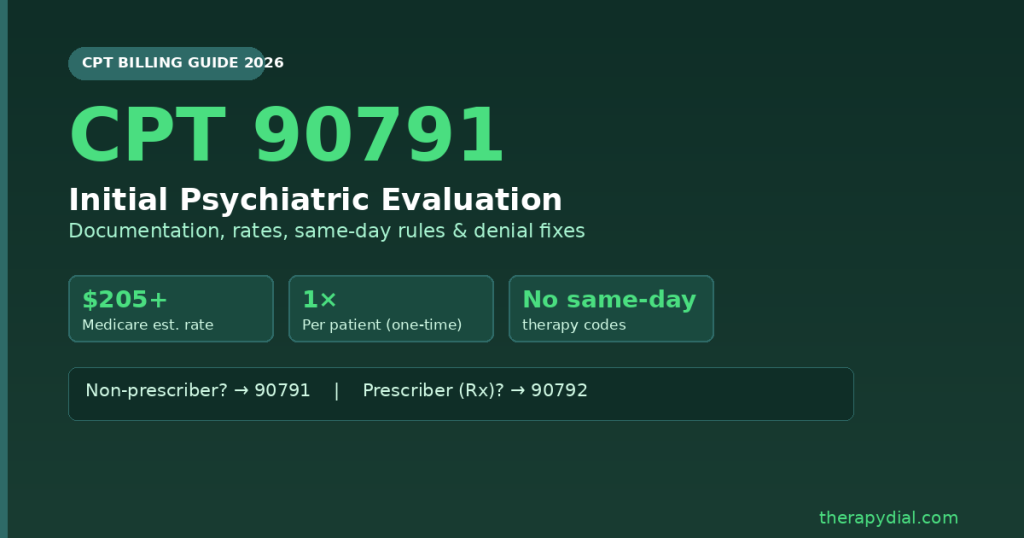
- Use 90791 for diagnostic evaluations performed by non-prescribers (LCSW, LPC, LMFT, psychologist)
- Switch to 90792 if you prescribe, order, or administer medication during the same encounter
- Document presenting problem, mental status exam, DSM diagnosis, and treatment plan — all four are required
- Never bill 90791 and a therapy code (90832/90834/90837) on the same date of service
- Check pre-authorization — many commercial payers require prior auth specifically for 90791
- Submit within your payer’s timely filing window — intake claims are commonly held and then filed late
Frequently Asked Questions: CPT 90791 Billing
CPT 90791 is the psychiatric diagnostic evaluation without medical services — used by therapists, counselors, and psychologists who do not prescribe medication. CPT 90792 is the psychiatric diagnostic evaluation with medical services — used by psychiatrists, PMHNPs, and other prescribers who evaluate and may initiate pharmacological treatment in the same session. Both cover the initial diagnostic evaluation; the distinction is whether medical services (prescribing, ordering labs, medication management) are provided. Using 90791 when 90792 applies — or vice versa — is a coding error that can trigger denials or audits.
Under estimated 2026 Medicare rates, CPT 90791 averages approximately $205–$225 nationally. Private payer rates typically run higher — $200–$350 depending on your contract, state, and specialty. CPT 90792 reimburses more (approximately $265–$290 under Medicare) because it includes the additional complexity of medical evaluation and management. Verify your exact locality rate using the CMS Physician Fee Schedule lookup tool.
No. CPT 90791 and any individual therapy code (90837 vs 90834 guide, 90832) are not billable on the same date of service. The diagnostic evaluation is considered a standalone service — therapy begins at a subsequent visit. If an intake runs long and you provide therapy in the same session, bill only 90791. Some payers will auto-bundle and pay one; others will deny the second code outright. This is one of the most common 90791 billing errors.
Getting CPT 90791 billing right is the foundation of a clean revenue cycle — every new client starts here, and an error on the intake claim ripples forward into authorization gaps, credentialing issues, and delayed payments for all follow-up sessions. The initial psychiatric evaluation (90791) is one of the highest-paying single codes in a therapist’s toolkit, yet it comes with a distinct set of rules that trip up even experienced billers: same-day restrictions, pre-auth requirements, and documentation standards that differ from standard therapy notes.
This guide covers everything — the exact difference between 90791 and 90792, 2026 reimbursement rates across major payers, the four required documentation elements, what you cannot bill on the same day, and the five most common denial reasons with fixes. For context on where 90791 fits within the broader code set, see our 2026 CPT code changes guide.
What Is CPT 90791? The Initial Psychiatric Evaluation Explained
CPT 90791 describes a psychiatric diagnostic evaluation without medical services. It is used for the first clinical encounter with a new patient where the primary purpose is to evaluate and diagnose a mental health condition — not to provide treatment. The session typically involves a clinical interview covering presenting symptoms, psychiatric history, social and family history, mental status examination, and formation of a DSM-5-TR diagnosis and preliminary treatment plan.
It is a one-time code per patient per provider. Once billed for a patient, it cannot be re-billed for subsequent sessions with that same provider (though it may be billable again if a patient returns after a significant gap and a new diagnostic evaluation is clinically appropriate — verify with your payer).
90791 vs 90792: Which Code Do You Use?
Without Medical Services
- LCSW, LPC, LMFT, Psychologist
- No prescribing or medication management
- No ordering of labs or medical tests
- Medicare est. ~$205–$225
- Most common for outpatient therapy practices
With Medical Services
- Psychiatrist (MD/DO), PMHNP
- Includes prescribing or medication review
- May include ordering labs or physical exam
- Medicare est. ~$265–$290
- Higher rate reflects added medical complexity
Your license and scope of practice determine the code — not the length or complexity of the session. An LCSW conducting a 90-minute intake always bills 90791. A psychiatrist conducting a 45-minute eval always bills 90792. Billing 90792 when you cannot prescribe is a compliance violation, not a billing upgrade.
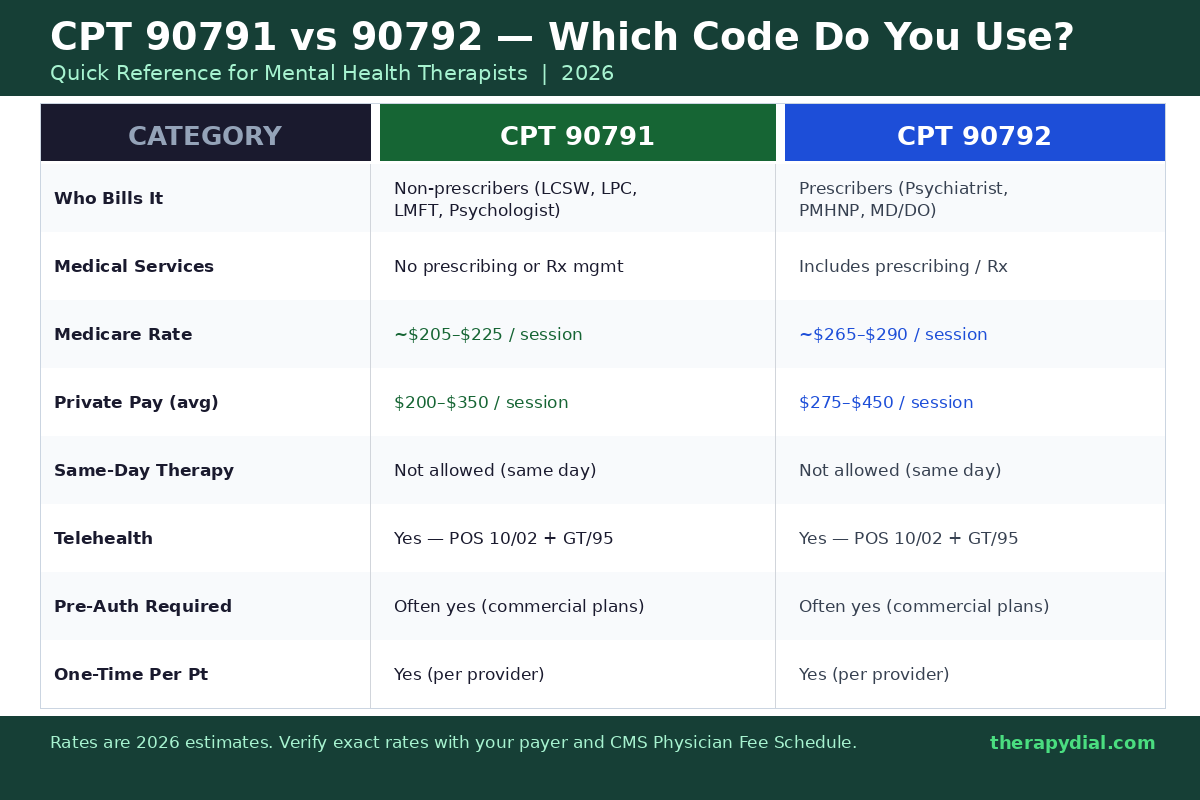
📌 Reference this chart when selecting the correct initial evaluation code for each new client.
CPT 90791 Reimbursement Rates in 2026
Rates below are estimated 2026 figures. Verify in your payer contracts and the CMS Fee Schedule for your locality.
| Payer | 90791 Rate | 90792 Rate | Notes |
|---|---|---|---|
| Medicare (national est.) | ~$205–$225 | ~$265–$290 | Verify locality via CMS PFS tool |
| Medicaid (state avg.) | ~$120–$180 | ~$160–$220 | Rates vary widely by state |
| Aetna | ~$220–$280 | ~$290–$360 | Auth may be required |
| UnitedHealthcare | ~$230–$290 | ~$300–$375 | Verify through Optum portal |
| Cigna / Evernorth | ~$215–$270 | ~$280–$340 | Evernorth Behavioral Health handles MH claims |
| BCBS (varies by plan) | ~$220–$295 | ~$285–$360 | Check individual state plan rate |
| Private / Self-Pay | $200–$350 | $275–$450 | Typically highest margin |
Documentation Requirements: Four Elements Every 90791 Note Must Have
A 90791 note is not the same as a progress note. Payers expect it to function as a standalone diagnostic document. Missing any of the four required elements is the second most common reason these claims are denied on audit.
📋 90791 Intake Note Template
Date of Service: [MM/DD/YYYY]
Service Type: Psychiatric Diagnostic Evaluation — CPT 90791
Session Duration: [e.g., 60 minutes] Delivery: [In-person / Telehealth + POS code]
1. PRESENTING PROBLEM:
[Chief complaint in patient’s own words. Onset, duration, severity, triggers.]
2. MENTAL STATUS EXAMINATION:
[Appearance, orientation, mood/affect, thought process, cognition, insight, judgment, safety]
3. DSM-5-TR DIAGNOSIS:
[Primary ICD-10 code + description. Secondary diagnoses if applicable.]
4. TREATMENT PLAN (full template guide):
[Goals, modality, frequency, estimated duration, referrals, safety plan if needed]
Clinician: [Name, credentials, NPI, signature, date]
Same-Day Billing: What You Cannot Bill With 90791
90832, 90834, 90837 (individual therapy) — 90846, 90847 (family therapy) — 90853 (group therapy) — 90839 (crisis). These are treatment codes; 90791 is diagnostic. Payers consider them mutually exclusive on the same date of service. The one combination that IS allowed: 90791 + 90792 are not billed together (they serve different provider types), but 90791 can be billed alongside psychiatric testing codes (96130–96133) if a full psychological battery is also administered.
Telehealth 90791: Rules, POS Codes & Modifiers
Several commercial payers restrict audio-only sessions specifically for the initial evaluation — they require a synchronous video visit for 90791. This is stricter than their rules for follow-up therapy sessions. Confirm video requirements before scheduling a telephone-only intake. If a patient cannot access video, document the clinical reason in the note and verify your specific payer’s audio-only policy.
Top 5 Denial Reasons for CPT 90791 Claims
-
1Billed same day as a therapy code (90837, 90834, etc.) Fix: Schedule therapy for a separate date. Bill only 90791 on the intake date.
-
2Missing pre-authorization for commercial plans Fix: Verify auth requirements before the session. Retro-authorization is rarely granted for intakes.
-
3Incomplete documentation — missing diagnosis or treatment plan Fix: Use the four-element template above. All four sections must be present in the note.
-
4Credentialing not yet effective with payer on date of service Fix: Confirm your effective date before seeing new insured patients. See our CAQH guide for credentialing timelines.
-
5Timely filing limit exceeded Fix: Submit intake claims within 90 days of service. Intake notes are commonly drafted late — set a billing reminder on the day of every intake.
🎯 Your Intake Sets the Tone for Every Claim That Follows
A clean 90791 claim — authorized, documented, billed correctly, submitted on time — opens the patient account correctly with the payer. Every subsequent therapy session builds on that foundation — see our treatment plan guide for the next step after 90791. Get the intake right and the rest of the revenue cycle flows. Get it wrong, and you’re chasing denials from session one. If your intake claims are failing at a higher rate than your follow-up sessions, a billing audit is the fastest way to find out why.
We Handle Every Intake Claim For You
Credentialing, billing, and authorization — all in one flat monthly fee
- Professional Medical Billing
- FREE Insurance Credentialing
- FREE TherapyDial Profile Listing
- Priority Practice Support
No setup fees • Cancel anytime
Talk to a Billing Specialist
We respond within 1 business day. No pressure, no obligation.
✓ Message sent! We’ll be in touch within 1 business day.