Here’s how to stay compliant and maximize reimbursement with 2026 mental health CPT codes:
- Audit your payer contracts and confirm updated 2026 fee schedules are in effect
- Match session duration to the correct code: 90832 (16–37 min), 90834 (38–52 min), 90837 (53+ min)
- For telehealth, use POS 02 (office-based patient) or POS 10 (patient at home)
- Apply the correct telehealth modifier: GT for Medicare, 95 for most commercial payers
- Use Modifier 25 when billing a same-day E/M code alongside a therapy CPT code
- Document session start and end times in every clinical note (see our progress notes guide) to support your code choice
Frequently Asked Questions: 2026 CPT Code Changes for Therapists
The 2026 updates most relevant to therapists include adjustments to Medicare Physician Fee Schedule (PFS) conversion factors affecting reimbursement across all E/M and psychotherapy codes, extended telehealth flexibilities keeping audio-only therapy codes accessible, and reinforced Place of Service (POS) requirements (POS 10 for patients at home, POS 02 for all other telehealth locations). Documentation standards for time-based codes have also been tightened — start and end times must appear in every clinical note for 90832, 90834, and 90837.
CPT 90837 (53+ minutes) consistently reimburses higher than 90834 (38–52 minutes) — typically 30–45% more per session. Under Medicare 2026 estimates, 90837 averages $175–$185 nationally versus $120–$135 for 90834. However, the extra session time must be clinically justified and documented — routinely billing 90837 without supporting documentation is a red flag for audits. Most private payers mirror this differential. If your average session runs 53+ minutes, ensure your notes reflect the full time to support the higher code.
Yes. Telehealth flexibilities remain in place through 2026 for most payers. The same psychotherapy CPT codes (90832, 90834, 90837, 90847, 90853) apply for telehealth — what changes is the modifier and POS code. For Medicare, use modifier GT (synchronous video) or 93 (audio-only when video is clinically inappropriate). For commercial payers, modifier 95 is most common. Always verify each payer’s telehealth policy individually as coverage rules vary.
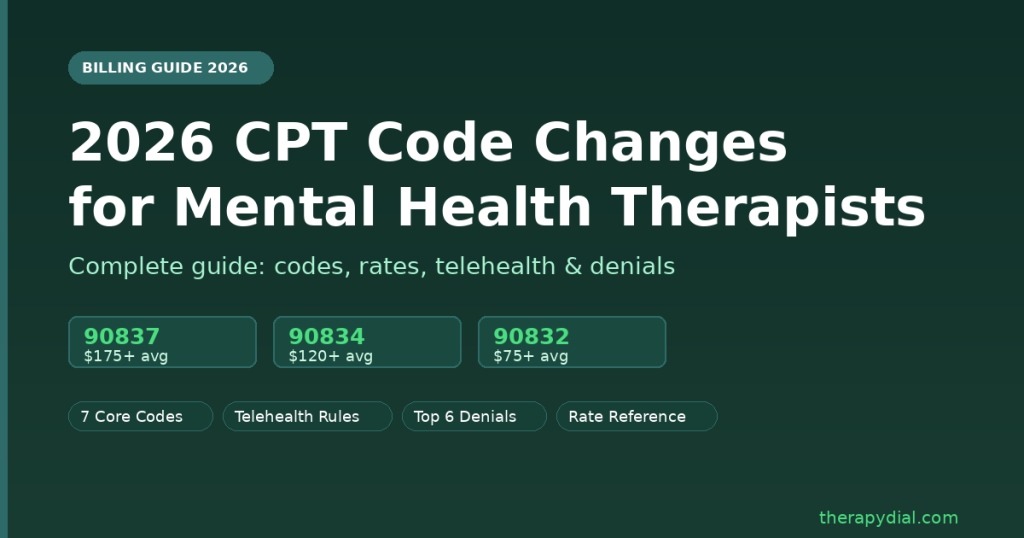
Understanding CPT code changes in 2026 for mental health is no longer optional — it’s the difference between a clean claim and a denial stack. The American Medical Association updates its Current Procedural Terminology (CPT) code set annually, and the Centers for Medicare & Medicaid Services (CMS) publishes corresponding Physician Fee Schedule (PFS) adjustments that directly determine what therapists get paid. For 2026, the most impactful updates center on telehealth POS requirements, time-based documentation standards, and reimbursement rate shifts across the core psychotherapy codes.
Whether you bill primarily through Medicare, Medicaid, or commercial payers like Aetna, UnitedHealthcare, or Cigna / Evernorth, this guide gives you the exact codes, rates, and modifiers you need to submit clean claims and get paid correctly every time.
Read on for a complete breakdown of every relevant code, a 2026 rate reference chart, telehealth billing rules, add-on code guidance, and the top denial reasons — plus how to fix each one.
What’s New: Mental Health CPT Code Changes in 2026
The 2026 updates do not introduce entirely new CPT codes for psychotherapy — the AMA’s core psychotherapy code set has been stable. What changed are the payment rules, telehealth policies, and documentation requirements that determine whether your claim for those codes gets paid.
| Area | 2025 Rule | 2026 Update |
|---|---|---|
| Conversion Factor (Medicare PFS) | $33.29/RVU (approx.) | Adjusted per final 2026 PFS rule — verify with CMS |
| Telehealth POS | POS 02 & POS 10 active | Both remain; POS 10 required for all home-based sessions |
| Audio-only therapy (93 modifier) | Extended through 2025 | Continued extension for Medicare — verify per payer |
| Time documentation (90832/90834/90837) | Start/end time recommended | Start and end times required in clinical note |
| CAQH re-attestation window | 120-day rule | 120-day rule enforced; more payers auto-terminating at 121 days |
| Credentialing verification (CAQH) | Quarterly attestation | Some payers moving to 90-day cycles — check payer bulletins |
The CMS conversion factor change affects every Medicare claim you submit. A drop of even $0.50/RVU compounds significantly across a full year of 90837 sessions. Verify the final 2026 rate directly on the CMS Physician Fee Schedule lookup tool for your locality.
Core Psychotherapy CPT Codes & 2026 Reimbursement Rates
These are the codes every outpatient mental health therapist uses. Rates shown are approximate national Medicare averages for 2026 — private payer rates typically run higher. Always verify current rates in your payer contracts.
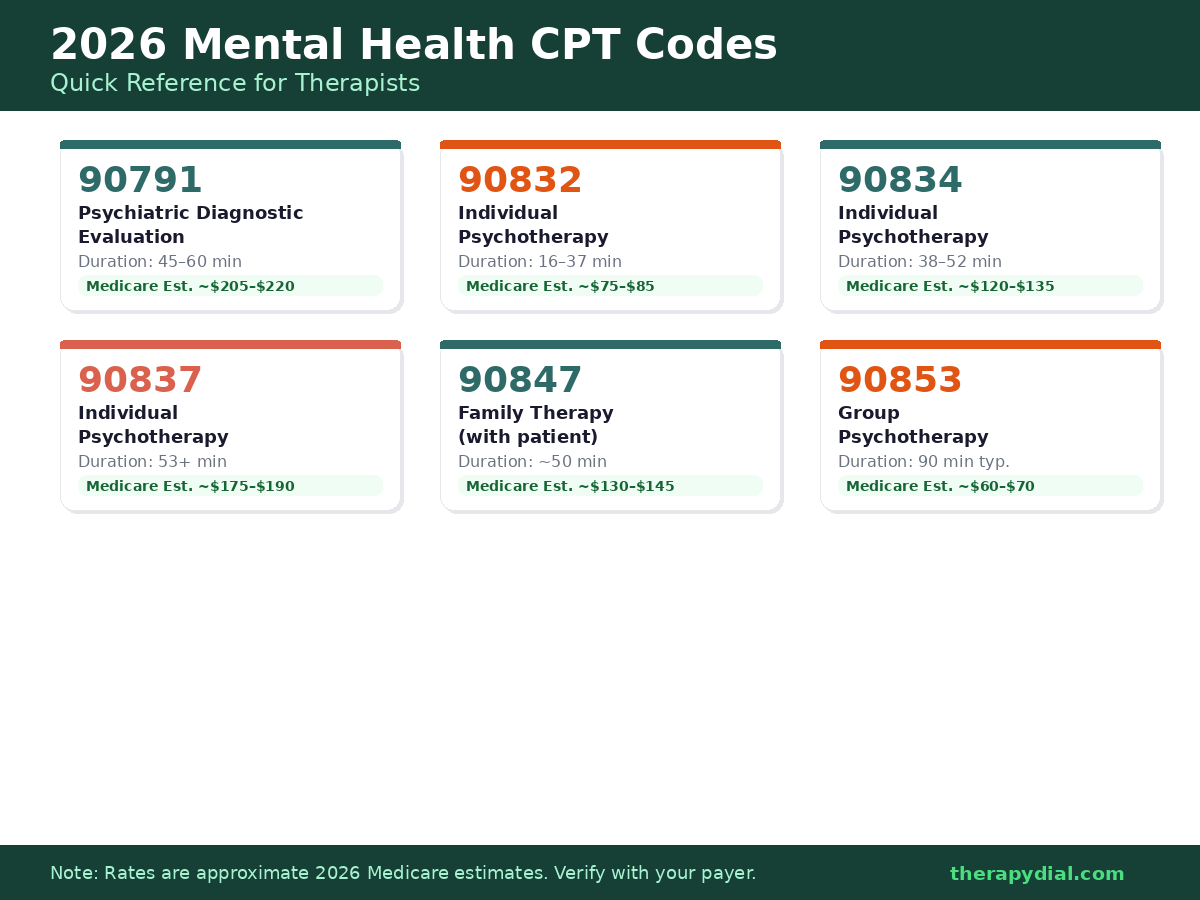
📌 Bookmark this chart — keep it open during your next billing session.
Telehealth Billing in 2026: Codes, POS & Modifiers
Telehealth remains one of the most common billing errors therapists make — not because the codes are wrong, but because the supporting modifier or Place of Service code is missing or incorrect. Here’s exactly what to use in 2026.
POS 02 — Telehealth (Non-Home)
- Use when patient is NOT in their home
- Applies to sessions from patient’s office, clinic, or any non-home location
- Most common for employer-based telehealth setups
- Medicare pays a facility rate for POS 02
POS 10 — Telehealth (Patient Home)
- Use when patient connects from their own home
- Most common scenario for outpatient telehealth
- Required since 2022; non-compliance triggers denials
- Medicare pays a non-facility rate for POS 10
Telehealth Modifiers Reference — 2026
| Modifier | When to Use | Payer |
|---|---|---|
| GT | Synchronous audio/video telehealth | Medicare (required) |
| 93 | Audio-only (telephone) when video not available | Medicare; some Medicaid |
| 95 | Synchronous telehealth via interactive audio/video | Most commercial payers |
| FQ | Audio-only telehealth | Medicare (alternative to 93) |
Add-On Psychotherapy Codes: 90833, 90836, 90838
If you are a prescriber (psychiatrist, PMHNP) or bill with a collaborating prescriber, add-on codes allow you to bill for psychotherapy performed in the same session as an E/M visit. These are NOT standalone codes — they must be billed alongside a primary E/M code.
16–37 min
38–52 min
53+ min
Add-on codes require a separately documented E/M note and a separate psychotherapy note in the same encounter. The E/M must be medically necessary and distinct from the therapy. Missing this documentation is the #1 reason add-on code claims are denied during audits.
Same-Day E/M + Therapy: The Modifier 25 Rule
If a licensed prescriber sees a patient for both a medical evaluation and psychotherapy on the same date of service, you can bill both — but you must append Modifier 25 to the E/M code to indicate it is a significant, separately identifiable service from the therapy session. Without Modifier 25, payers will bundle the two claims and pay only one.
| Scenario | Correct Billing | Common Mistake |
|---|---|---|
| Medication management + 53 min therapy | 99214-25 + 90838 (add-on) | Billing 90837 standalone, losing E/M revenue |
| Intake + therapy same day | 90791 + E/M (if applicable) | 90791 + 90837 (not separately payable same day) |
| Crisis intervention + follow-up | 90839 + 90840 (each additional 30 min) | Billing 90837 instead of crisis code |
Top 6 Denial Reasons for Therapy CPT Claims in 2026
-
Missing session start/end times in notes Time-based codes (90832/90834/90837) require documented session duration. Fix: Add start and end time to every progress note.
-
Wrong Place of Service code for telehealth Using POS 11 (office) for virtual sessions causes denials. Fix: Use POS 02 or POS 10 depending on patient location.
-
Missing or incorrect telehealth modifier GT, 95, or 93 must match the payer’s requirements exactly. Fix: Maintain a payer-specific modifier cheat sheet for your billing team.
-
CAQH attestation expired (120+ days) Payers auto-terminate providers at 121 days without attestation. Fix: Set a calendar reminder every 90 days. See our CAQH guide.
-
NPI-TIN mismatch with payer records Your individual NPI must be linked to your group’s Tax ID. Fix: Verify the NPI-TIN link on NPPES and in each payer’s provider portal.
-
Bundling 90791 with a same-day therapy code Most payers won’t pay 90791 and 90837 on the same date of service. Fix: If the intake runs long, bill only 90791 and schedule therapy for a separate date.
🎯 One Billing Rule That Pays for Itself
If you currently bill mostly 90834 but your sessions consistently run past 53 minutes, switching to 90837 (see our 90837 vs 90834 rate comparison) with proper documentation can increase your annual revenue by $10,000–$20,000 without seeing a single additional client. The documentation change takes 30 seconds — adding start and end time to your notes. That’s the highest-ROI billing update most therapists can make today.
Stop Leaving Money on the Table
Our billing specialists handle every CPT code, modifier, and denial — so you can focus on clients
- Professional Medical Billing
- FREE Insurance Credentialing
- FREE TherapyDial Profile Listing
- Priority Practice Support
No setup fees • Cancel anytime
Get Your Billing Sorted — Fast
Tell us about your practice and our credentialing specialists will reach out within 1 business day with a tailored plan.
✓ Message sent! We’ll be in touch within 1 business day.