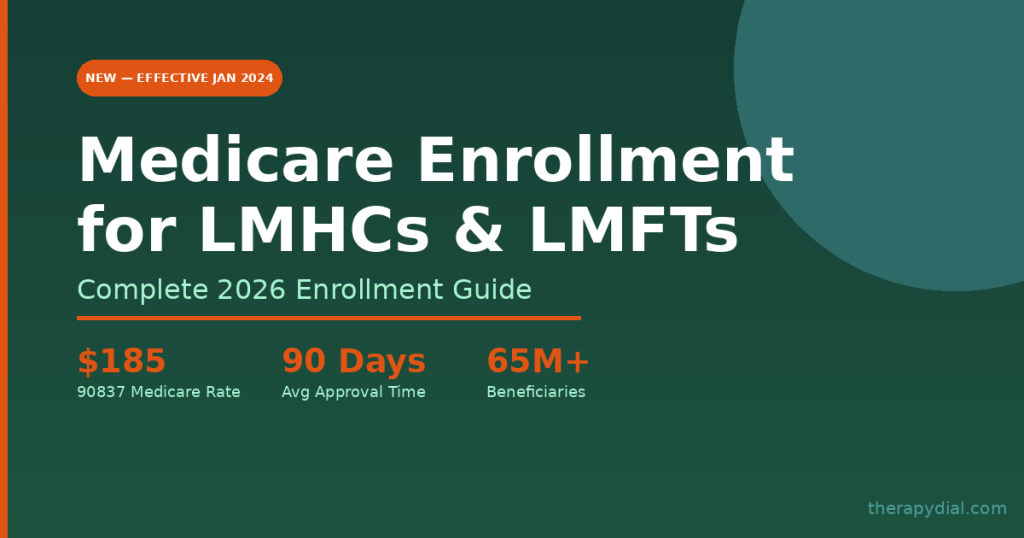
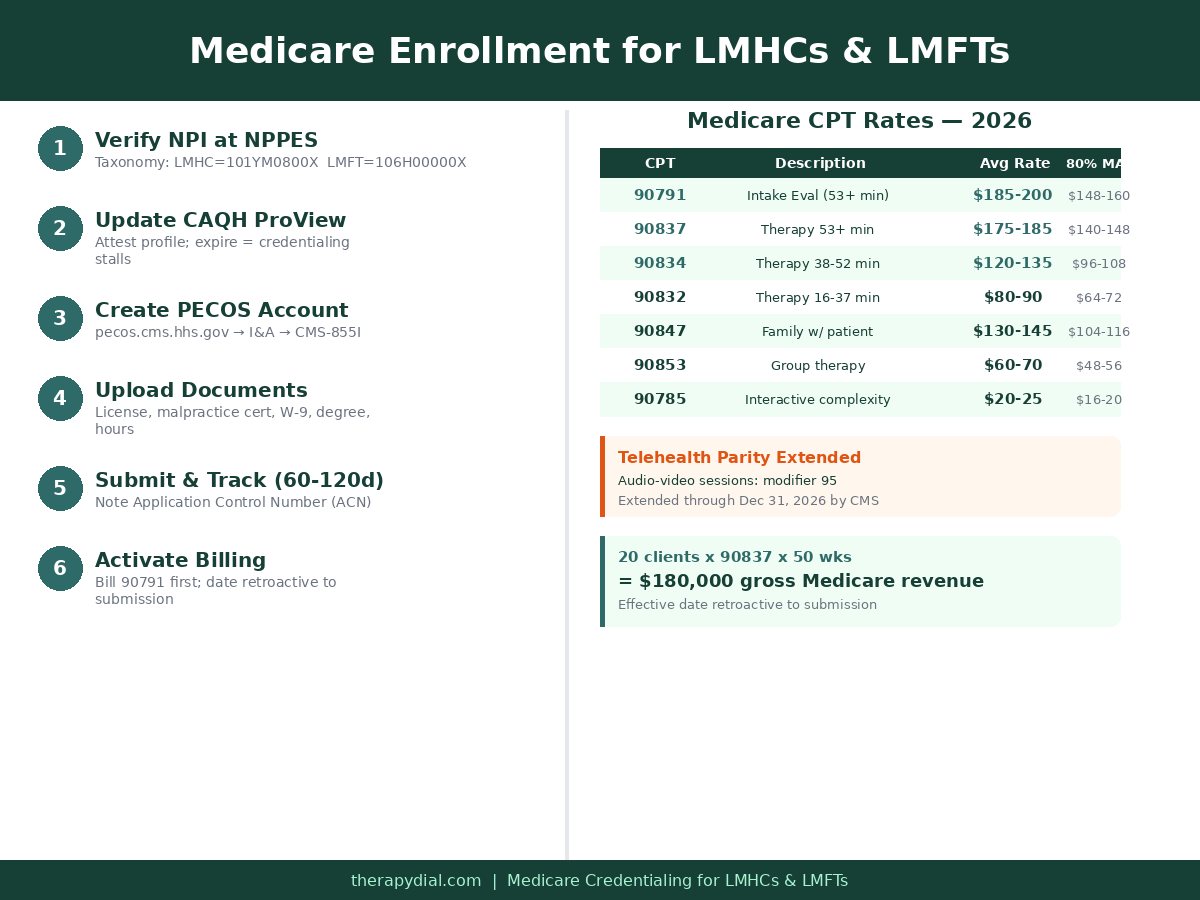
LMHCs and LMFTs can now enroll in Medicare as independent providers — effective January 1, 2024 under the Consolidated Appropriations Act. Here’s the six-step path:
- Obtain or verify your Type 1 NPI number at NPPES
- Complete or update your CAQH ProView profile
- Create a PECOS account and submit Form CMS-855I online
- Submit required supporting documents (license, malpractice, W-9)
- Await MAC approval (60–120 days typical)
- Activate your Medicare billing and submit your first 90791 or 90837 claim
For more than 50 years, Licensed Mental Health Counselors and Licensed Marriage and Family Therapists were locked out of Medicare. Their clients aged into the program, but the counselors who served them could not follow — leaving a critical gap in behavioral health access for the Medicare population.
The Consolidated Appropriations Act of 2023 changed that. Starting January 1, 2024, LMHCs and LMFTs became recognized Medicare providers for the first time. If you have not yet enrolled, you are leaving a substantial and growing revenue stream on the table. In 2026, approximately 65 million Americans are covered by Medicare, and mental health utilization among that population has never been higher.
This guide walks you through every step of the enrollment process — from confirming your NPI to submitting your first Medicare claim — along with 2026 reimbursement rates, documentation standards, and the most common denial reasons to avoid.
Who Is Eligible to Enroll as an LMHC or LMFT?
CMS sets specific minimum requirements for LMHC and LMFT Medicare enrollment. You must meet all of the following criteria before submitting your PECOS application:
- Active state license in good standing — your license must be current and unrestricted in the state where you will be providing services
- Master’s degree or higher in mental health counseling (LMHCs) or marriage and family therapy (LMFTs) from an accredited institution
- 2,000+ hours of supervised experience — this is a federal requirement for Medicare, separate from your state licensure hours
- Active NPI (Type 1) — your individual National Provider Identifier must be on file with NPPES (see our NPI number guide if you still need to register)
- No Medicare exclusions — you must not be excluded from federal healthcare programs (OIG exclusion list)
Step-by-Step Medicare Enrollment Process
Verify or Register Your NPI 15 min
Log in to NPPES and confirm your Type 1 Individual NPI is active and your taxonomy code is correct. LMHCs should use taxonomy 101YM0800X; LMFTs use 106H00000X. An incorrect taxonomy code is a top Medicare denial trigger.
Update Your CAQH ProView Profile 1–2 hrs
Even though CAQH is not a hard PECOS requirement, most commercial payers you’ll credential with later require it. Complete your CAQH profile now and attest it, so the data is current when you start commercial credentialing after Medicare approval.
Create a PECOS Account 30 min setup
Go to pecos.cms.hhs.gov and create an I&A (Identity and Access Management) account. Once approved (1–3 business days), log in to PECOS and begin Form CMS-855I — the Individual Practitioner application. Select “New Enrollment” and choose your enrollment type as LMHC or LMFT.
Gather and Upload Required Documents Most delays happen here
You will need to upload: copy of your state license, professional liability (malpractice) insurance certificate, completed W-9 form, documentation of 2,000+ supervised clinical hours, and a copy of your degree. All documents must be current — expired malpractice coverage will generate an automatic rejection.
Submit and Track Application 60–120 day wait
Submit your PECOS application and note your Application Control Number (ACN). Use the PECOS online portal to track status. Your MAC (Medicare Administrative Contractor) may contact you for additional documentation — respond within 30 days or your application will be closed and you will have to reapply.
Receive Approval & Activate Billing Retroactive date
Upon approval you will receive a Medicare ID and an effective date retroactive to your application submission date. Immediately verify your billing system (EHR) is configured with your Medicare payer ID, NPI, and the correct fee schedule. Bill your first claim using 90791 for the initial psychiatric evaluation.
🕑 Let Our Team Handle Your Medicare Enrollment →
Medicare Reimbursement Rates for LMHCs & LMFTs — 2026
Medicare reimburses LMHCs and LMFTs at 80% of the published fee schedule rate after the patient’s annual deductible is met. The patient is responsible for the remaining 20% co-insurance (or the Medigap supplemental policy covers it). Below are national average 2026 Medicare rates for the most commonly billed CPT codes:
Pro-Tip: Bookmark this guide for your Medicare enrollment cycle.
| CPT Code | Description | Medicare Rate (National Avg) | 80% Paid by Medicare |
|---|---|---|---|
| 90837 | Individual psychotherapy, 53+ min | $175–$185 | $140–$148 |
| 90834 | Individual psychotherapy, 38–52 min | $120–$135 | $96–$108 |
| 90832 | Individual psychotherapy, 16–37 min | $80–$90 | $64–$72 |
| 90791 | Psychiatric diagnostic evaluation (intake) | $185–$200 | $148–$160 |
| 90847 | Family psychotherapy with patient present | $130–$145 | $104–$116 |
| 90853 | Group psychotherapy | $60–$70 | $48–$56 |
| 90785 | Interactive complexity (add-on) | $20–$25 | $16–$20 |
Rates vary by geographic locality — high-cost metros like New York City, San Francisco, and Boston typically pay 15–25% above the national average. Always verify your specific locality rate on the CMS Physician Fee Schedule Lookup Tool. For a detailed comparison of 90837 versus 90834 revenue impact across a full caseload, see our 90837 vs 90834 rate comparison guide.
Medicare Telehealth for LMHCs and LMFTs in 2026
Telehealth parity for behavioral health has been extended by CMS through December 31, 2026. LMHCs and LMFTs enrolled in Medicare may provide psychotherapy sessions via synchronous audio-video technology from the same location types available to psychiatrists and licensed clinical social workers:
- Provider location: Any state-licensed office, clinic, or home office
- Patient location: Patient’s home is permitted — no need to travel to a clinic site
- Modifier requirements: Append modifier 95 for real-time audio-video sessions. Use GT only if required by your specific MAC. See our 2026 CPT code changes guide for telehealth modifier updates.
- Audio-only sessions: Covered for patients who cannot access video — must document clinical justification
- Cross-state telehealth: You must be licensed in the state where the patient is located at the time of the session
Medicare Documentation Requirements
Medicare audits are more rigorous than commercial payer reviews. Every session you bill must be supported by a progress note that meets medical necessity standards. Below is what must appear in every Medicare psychotherapy note:
📋 Medicare-Compliant Psychotherapy Note Template
Date of Service: [MM/DD/YYYY]
Session Start Time: [e.g., 10:03 AM] End Time: [e.g., 11:01 AM]
Total Face-to-Face Time: [e.g., 58 minutes — must support CPT code billed]
Diagnosis (ICD-10): [Primary diagnosis code + description]
Medical Necessity Statement: [Why is this session clinically necessary? How does it address the diagnosis?]
Session Summary: [Key themes, patient presentation, clinical observations]
Interventions Used: [CBT techniques, DBT skills, motivational interviewing, etc.]
Patient Response: [Engagement level, progress toward treatment goals]
Plan: [Next session goals, homework, medication coordination if applicable]
Provider Signature: [Your name, credentials, date]
Top Medicare Claim Denial Reasons for LMHCs & LMFTs
New Medicare providers see elevated denial rates in their first 6–12 months while billing teams calibrate to payer-specific rules. These are the most common denial reasons our clients encounter:
- Wrong taxonomy code on NPI record — LMHC (101YM0800X) or LMFT (106H00000X) must match exactly what’s in NPPES
- Session time does not support CPT code billed — billing 90837 when documented time is only 50 minutes
- Missing or inadequate medical necessity documentation in the progress note
- Rendering provider NPI not enrolled in Medicare (e.g., billing under a group NPI before individual enrollment is approved)
- Telehealth modifier missing or incorrect (95 vs GT confusion)
- Claim submitted beyond the 365-day timely filing window
- Patient deductible not met and claim submitted without the deductible amount
- ICD-10 diagnosis code not medically appropriate for the CPT code billed
After Medicare: Credential with Commercial Payers Next
Medicare approval is a credentialing anchor that makes every subsequent commercial payer application faster. Once you hold Medicare provider status, Aetna, UnitedHealthcare, Cigna, and BCBS treat your application with elevated credibility. Use the momentum:
- Submit your Aetna credentialing application within 30 days of Medicare approval
- Enroll with UnitedHealthcare / Optum — largest commercial payer by Medicare Advantage enrollment
- Keep your CAQH profile attested every 120 days to avoid commercial credentialing stalls
- Review the 2026 CPT code changes so your billing system is configured correctly across all payers from day one
Exclusive Provider Bundle
Everything your practice needs — one simple monthly investment
- Professional Medical Billing
- FREE Insurance Credentialing
- FREE TherapyDial Profile Listing
- Priority Practice Support
No setup fees • Cancel anytime
Start Your Medicare Application
Our credentialing specialists respond within 1 business day.