After helping hundreds of healthcare providers optimize their coding practices, I've found that intellectual disability coding presents unique challenges that go far beyond a simple code lookup. The question "What's the ICD-10 code for intellectual disability" actually has six different answers, and choosing incorrectly can lead to claim denials, compliance issues, and inadequate patient care representation.
In this comprehensive guide, we'll not only explore the complete ICD-10 code spectrum for intellectual disabilities but also provide clinical documentation strategies, coding pitfalls to avoid, and practical insights you won't find in basic code references. You'll learn how to accurately document severity levels, code associated conditions, and implement billing practices that withstand auditor scrutiny.
Quick Answer: It's Not One Code - It's a Spectrum
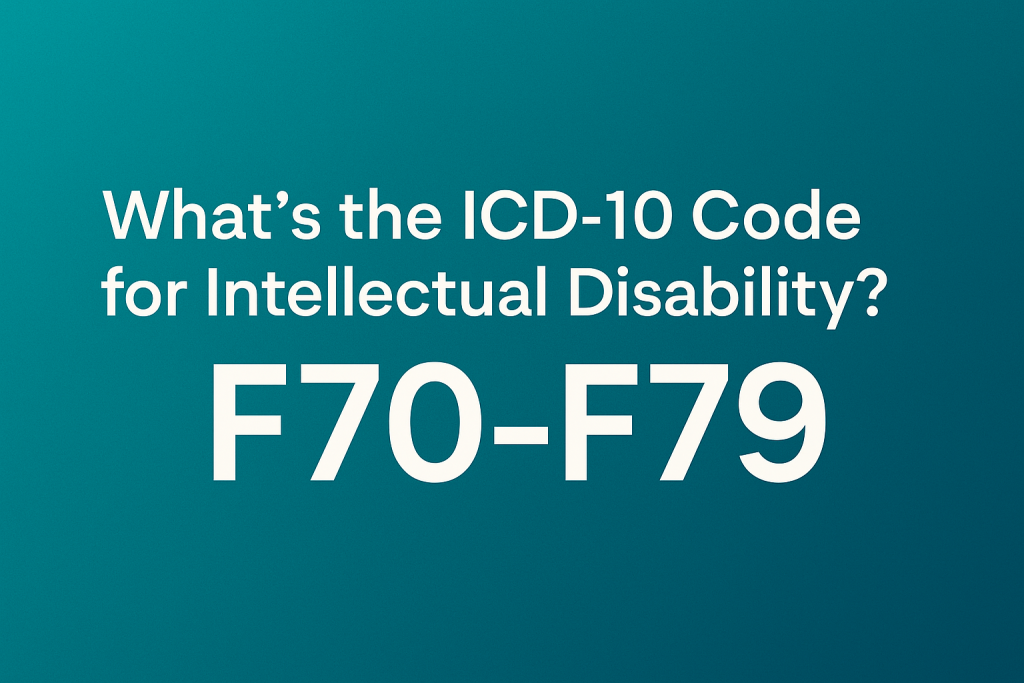
The ICD-10 code range for intellectual disability is F70-F79. The specific code depends heavily on severity: F70 (Mild), F71 (Moderate), F72 (Severe), F73 (Profound), F78 (Other), or F79 (Unspecified). Crucially: For borderline intellectual functioning (IQ 71-84), you must use R41.83 instead of an F-series code.
Complete ICD-10 Code Spectrum for Intellectual Disabilities
Intellectual disabilities are classified under ICD-10 chapter "Mental, Behavioral and Neurodevelopmental disorders" (F01-F99), specifically in the range F70-F79. Unlike many conditions that have a single code, intellectual disability requires careful severity assessment and code selection.
| ICD-10 Code | Severity Level | IQ Range | Key Characteristics |
|---|---|---|---|
| F70 | Mild Intellectual Disabilities | 50-69 | Can achieve academic skills to ~4th-5th grade level; often live independently with minimal support. (~75-90% of cases). |
| F71 | Moderate Intellectual Disabilities | 35-49 | Significant support needed; may develop basic self-care and communication skills. (~10% of cases). |
| F72 | Severe Intellectual Disabilities | 20-34 | Requires extensive daily support; limited communication skills. (~3.5% of cases). |
| F73 | Profound Intellectual Disabilities | Below 20 | Complete dependency for all activities of daily living. (~1.5% of cases). |
| F78 | Other Intellectual Disabilities | Varies | Includes genetic-related IDs like SYNGAP1-related intellectual disability (F78.A1). |
| F79 | Unspecified Intellectual Disabilities | Not specified | Used when severity cannot be reliably determined or assessed. |
F70-F79 Diagnostic Estimator
Estimate the most accurate ICD-10 code based on IQ scores and adaptive functioning deficits.
Estimated ICD-10 Code
F70*Note: This is an estimation tool. Diagnosis requires comprehensive clinical assessment.
Beyond IQ Scores: Understanding the Clinical Picture
While IQ scores provide important guidance for ICD-10 code for intellectual disability selection, they represent only one component of the diagnostic picture. Modern understanding and medical necessity emphasize adaptive functioning across multiple domains.
🧠 Conceptual Domain
Includes memory, reasoning, academic learning, and problem-solving. Deficits here might appear as difficulty understanding complex language or mathematical concepts.
🤝 Social Domain
Encompasses empathy, social judgment, communication skills, and friendship abilities. Those with intellectual disabilities often struggle with social cues and interpersonal relationships.
🔧 Practical Domain
Involves self-care, job responsibilities, money management, and organizing tasks. Limitations here directly affect independent living capabilities.
Documentation Requirements for Accurate Coding
Proper documentation isn't just good clinical practice—it's essential for accurate coding and reimbursement. If your SOAP notes are audited, they must include these critical elements:
Standardized IQ Testing Results
Document the specific assessment tool used (e.g., WAIS-IV, Stanford-Binet) and the exact IQ score. Avoid vague descriptions like "below average intelligence" or "slow learner."
Adaptive Functioning Assessment
Include specific deficits in at least two adaptive domains (conceptual, social, practical) with concrete examples of functional limitations based on standardized tools like the Vineland-3.
Age of Onset Confirmation
Document evidence that intellectual and adaptive deficits began during the developmental period (before age 18). If onset is in adulthood due to a TBI or illness, you are dealing with a neurocognitive disorder, not an intellectual disability.
Comorbid Conditions and "Code First" Rules
Intellectual disabilities frequently co-occur with other conditions that require additional coding for comprehensive patient representation and proper claim processing.
📋 Genetic Syndromes (Code First)
Code First the genetic condition (e.g., Down syndrome Q90.9, Fragile X syndrome Q99.2), then Use Additional Code for the intellectual disability severity (F70-F79). This sequencing ensures proper reimbursement.
🔄 Co-occurring Autism (ASD)
Approximately 30% of individuals with ASD also have intellectual disability. Code both conditions: F84.0 - Autism spectrum disorder and the appropriate intellectual disability code from F70-F79.
What to Exclude: Differential Diagnosis
Do not use F70-F79 for the following conditions:
- Borderline intellectual functioning → Use R41.83 (IQ 71-84 without significant adaptive deficits).
- Specific learning disorders → Use F81.- series (affect specific academic domains without global intellectual impairment).
- Major neurocognitive disorders → Use F01-F03 series (represent decline from a previous functioning level).
Stop Guessing on Coding.
Start Getting Paid.
- Professional Medical Coding & Billing
- Denial Management & Appeals
- FREE Insurance Credentialing
- FREE TherapyDial Profile Listing
We verify your codes, submit your claims, and fight for your revenue.
HIPAA Compliant & Expertly Managed.
Master Your Diagnostic & Clinical Skills
Ensure your practice remains compliant and audit-ready with our related clinical hubs:
Coding & Documentation Mastery
Frequently Asked Questions
F79 - Unspecified intellectual disabilities is used when an intellectual disability is confirmed but the severity level cannot be determined (e.g., due to assessment limitations). R41.83 - Borderline intellectual functioning applies to individuals with IQ 71-84 who do not meet criteria for intellectual disability and show no significant adaptive deficits. Using R41.83 when F70-F79 is appropriate (or vice versa) constitutes a coding error.
F78 - Other intellectual disabilities is used for specific situations not covered by the standard severity codes, particularly genetic-related intellectual disabilities like SYNGAP1-related intellectual disability (F78.A1). Use standard severity codes (F70-F73) when IQ and adaptive functioning clearly indicate a specific severity level.
No. While IQ scores provide important guidance, ICD-10 and DSM-5 both require documented deficits in adaptive functioning across conceptual, social, and practical domains. Coding based solely on IQ without adaptive behavior assessment represents incomplete clinical documentation.
The term "mental retardation" has been replaced with "intellectual disability" in clinical terminology and coding. For existing patients with this historical diagnosis, reassess using current criteria and code according to severity level (F70-F79). Do not use outdated terminology in current documentation.