
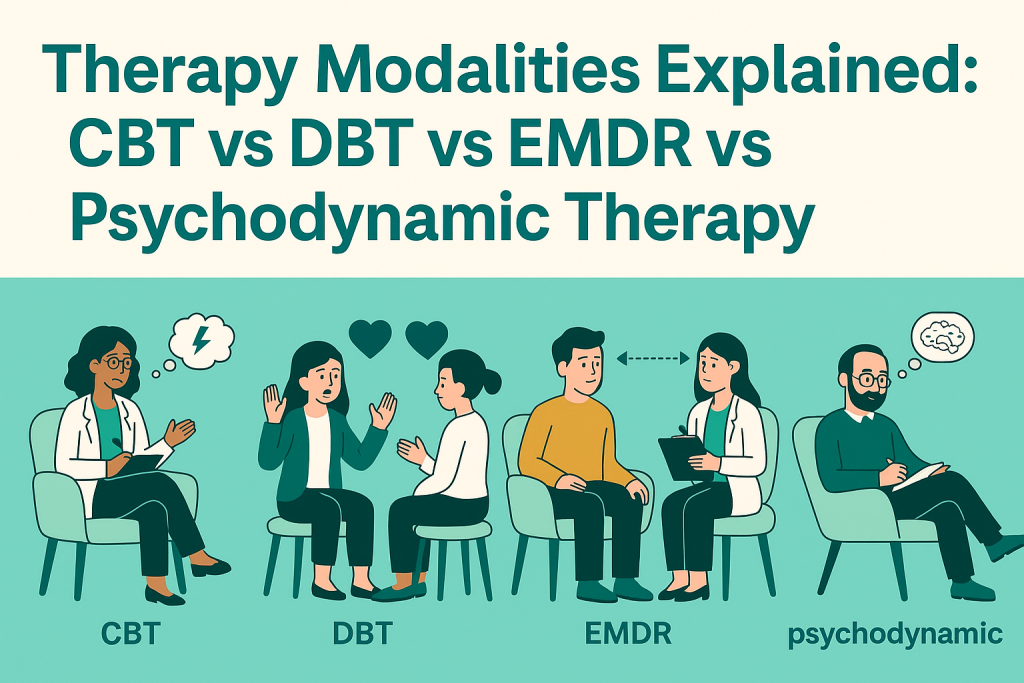
Have you ever left a therapy session wondering why your therapist asked you to track your thoughts, or why they focused on your childhood when you came in to talk about current anxiety? Understanding different therapy approaches—modalities—can transform your experience from confusing to empowering.
- CBT: Changing thoughts & behaviors.
- DBT: Emotional regulation & skills.
- EMDR: Processing traumatic memories.
- Psychodynamic: Exploring deep unconscious patterns.
As a clinical supervisor who has trained therapists in multiple modalities for over a decade, I've seen how understanding these approaches helps clients become active participants in their healing. The truth is, no single therapy approach works for everyone, and the best therapists often integrate techniques based on your unique needs.
Cognitive Behavioral Therapy (CBT): The Gold Standard
CBT is based on the fundamental principle that our thoughts, feelings, and behaviors are interconnected. Changing negative thought patterns can lead to changes in feelings and behaviors. It's typically short-term, structured, and goal-oriented, focusing on present problems rather than extensive exploration of the past.
Key Techniques in CBT
Cognitive Restructuring
Identifying and challenging negative automatic thoughts and cognitive distortions that contribute to emotional distress.
Behavioral Activation
Increasing engagement in positive activities to combat depression and improve mood through action.
Exposure Therapy
Gradual, controlled exposure to feared situations to reduce anxiety and avoidance behaviors.
Thought Records
Keeping written records of situations, thoughts, emotions, and evidence to challenge thinking patterns.
For example, if you are seeking help for anxiety, a CBT therapist might use exposure techniques. You can learn more about how this is applied specifically in our guide on ICD-10 Codes for Anxiety.
Dialectical Behavior Therapy (DBT): Skills for Emotional Regulation
DBT was originally developed for borderline personality disorder but has since proven highly effective for various conditions involving emotional dysregulation. It combines cognitive-behavioral techniques with mindfulness and acceptance strategies, emphasizing the "dialectical" balance between acceptance and change.
Core DBT Modules
Mindfulness
Learning to observe, describe, and participate without judgment in the present moment.
Distress Tolerance
Developing concrete skills to survive crisis situations without making things worse.
Emotion Regulation
Understanding and naming emotions, reducing vulnerability, and increasing positive emotions.
Interpersonal Effectiveness
Maintaining relationships and self-respect while achieving objectives in social situations.
DBT is particularly effective for complex emotional and behavioral issues where individuals feel overwhelmed. It is often used alongside treatments for repressed emotions.
EMDR Therapy: Processing Traumatic Memories
EMDR is a specialized approach designed specifically to process traumatic memories. Unlike traditional talk therapy, it uses bilateral stimulation (eye movements, taps, or sounds) to help the brain reprocess disturbing memories, reducing their emotional intensity and changing how the memory is stored.
The EMDR Process
History & Preparation
Comprehensive assessment of trauma history and establishing coping skills for emotional regulation.
Assessment
Identifying specific aspects of target memory including image, negative belief, and body sensation.
Desensitization
Using bilateral stimulation to process the memory until it no longer causes acute distress.
Installation
Replacing the negative belief associated with the trauma with a positive, adaptive belief.
The World Health Organization recommends EMDR as a first-line treatment for PTSD. To understand how this works in practice, read our guide on EMDR for Childhood Trauma.
Psychodynamic Therapy: Exploring Deep Patterns
Psychodynamic therapy focuses on understanding how unconscious processes and past experiences shape current behavior and relationships. Unlike the stereotype of lying on a couch for years, modern psychodynamic therapy can be time-limited, conversational, and focused on specific goals.
Key Psychodynamic Concepts
Transference
Exploring how feelings from past relationships are projected onto current relationships, including the therapist.
Defense Mechanisms
Identifying unconscious psychological strategies used to cope with reality and maintain self-image.
Free Association
Speaking freely without censorship to access unconscious thoughts and feelings.
Interpretation
Therapist helps the client understand unconscious meanings behind thoughts, feelings, and behaviors.
Comparative Analysis: Which Approach When?
| Modality | Session Structure | Therapist Role | Homework | Evidence Strength |
|---|---|---|---|---|
| CBT | Structured agenda, skill-building | Teacher, coach | Regular practice assignments | Strong |
| DBT | Skills group + individual therapy | Coach, validator | Daily diary cards, skill practice | Strong |
| EMDR | 8-phase protocol | Facilitator, guide | Minimal between sessions | Strong |
| Psychodynamic | Less structured, exploratory | Interpreter, observer | Reflection, not formal homework | Moderate |
Clinical Reality: Most skilled therapists today practice integration—blending techniques from multiple modalities based on client needs. A therapist might use CBT techniques for anxiety management while incorporating psychodynamic insights about relationship patterns. The best approach depends on your specific concerns, personality, and goals.
Matching Modalities to Specific Concerns
Anxiety Disorders
Generalized anxiety, panic disorder, social anxiety
Depression
Major depression, persistent depressive disorder
Trauma & PTSD
Post-traumatic stress, childhood abuse
Personality Disorders
Borderline, narcissistic, avoidant patterns
If you are a provider seeking to understand how these diagnoses are coded for insurance, refer to our clinical guides on ICD-10 Codes for PTSD or Depression ICD-10 Codes.
Ready to start your healing journey?
Finding the right approach matters. At TherapyDial, we connect you with skilled therapists who utilize evidence-based modalities tailored specifically to your needs.
Find a Therapist TodayFrequently Asked Questions About Therapy Approaches
Can I combine different therapy approaches?
Yes, many therapists practice integrative therapy, blending techniques from different modalities. Research shows that therapeutic integration can be highly effective when done skillfully by trained clinicians.
How long does it take to see results with each approach?
CBT often shows benefits within 5-10 sessions, while psychodynamic therapy may take longer as it explores deeper patterns. EMDR can produce rapid changes for single-event trauma. DBT typically requires 6+ months for full skill integration.
Are some approaches better for specific cultures or backgrounds?
Cultural considerations matter immensely in therapy. CBT's structured approach may appeal to some cultural backgrounds, while others may prefer relationship-focused or narrative approaches. A culturally competent therapist adapts their approach accordingly.
What if I don't like my therapist's approach?
It's completely appropriate and encouraged to discuss your preferences with your therapist. A good therapist will explain their approach and consider adjusting their style or referring you to a colleague if it's not a good fit for your learning style.