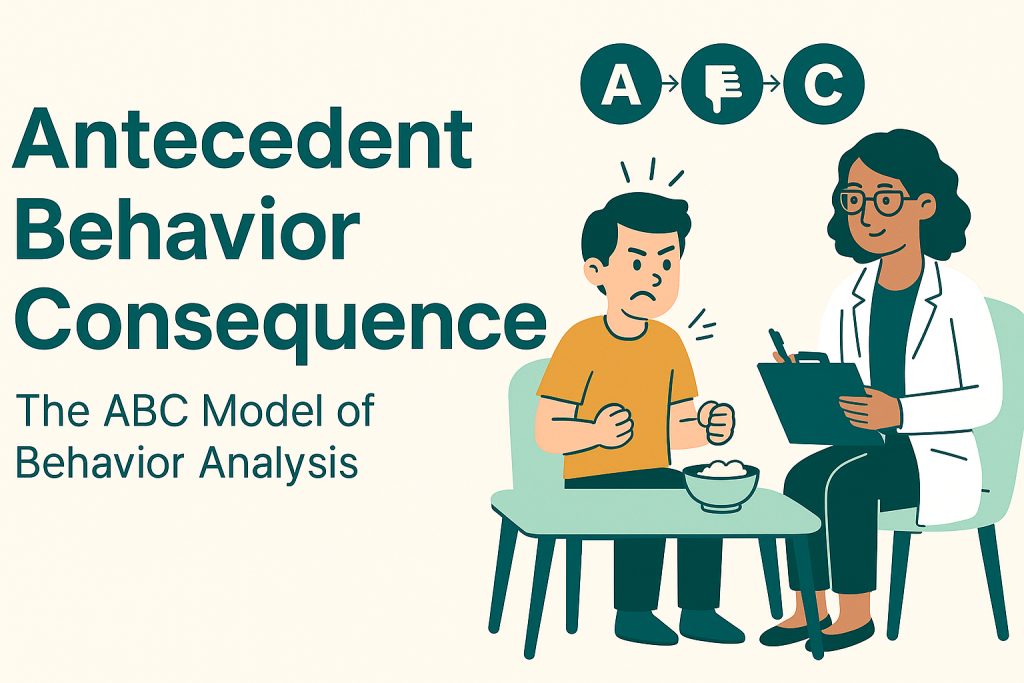
The ABC Framework at a Glance
- Antecedent (A) — What happens immediately BEFORE the behavior (triggers, cues, or setting events).
- Behavior (B) — The observable ACTION itself (what the person says or does in specific terms).
- Consequence (C) — What happens immediately AFTER the behavior (reinforcement or punishment).
- Data Collection — Record ABC events consistently for 1-2 weeks to find valid patterns.
- Intervention Focus — Modifying antecedents prevents behavior; changing consequences alters future likelihood.
- Broad Application — Used in parenting, classrooms, therapy, workplace management, and personal habit change.
- Common Mistake — Focusing only on consequences without addressing the antecedent triggers first.
For frequently occurring behaviors (several times per day), 3-5 days of consistent data collection is usually sufficient. For less frequent behaviors, you may need 1-2 weeks to identify reliable patterns. The key is collecting data on at least 10-15 instances of the behavior to ensure you’re seeing real patterns rather than coincidences.
Absolutely! ABC analysis is excellent for understanding what supports positive behaviors. By identifying the antecedents and consequences that maintain desirable behaviors, you can intentionally create conditions that make those behaviors more likely to occur. This proactive approach is often highly effective.
While triggers are similar to antecedents, ABC analysis provides a more comprehensive framework by explicitly examining the consequences that maintain behaviors. Many behaviors persist not because of their triggers, but because of their consequences. ABC analysis helps you understand the complete behavioral sequence rather than just the starting point.
In CBT, ABC analysis is often expanded to include thoughts and beliefs (creating the ABCDE model). The basic ABC framework helps clients understand connections between situations, their responses, and the outcomes that maintain patterns of thinking, feeling, and behaving. This helps with cognitive distortions.
Some behaviors may not have obvious immediate antecedents. In these cases, look for setting events (broader contextual factors), physiological states (hunger, fatigue, pain), or patterns related to time of day, specific activities, or social contexts. Sometimes expanding your definition of “antecedent” to include these broader factors reveals the patterns.
Not at all! ABC analysis applies to human behavior regardless of age. Adults can use it to understand their own habits, relationship patterns, work behaviors, and emotional responses. The principles are the same—we all respond to antecedents and consequences, though adult patterns are often more complex and influenced by longer learning histories.
Have you ever found yourself wondering why certain behaviors keep happening, despite your best efforts to change them? Whether it’s a child’s tantrums, a partner’s frustrating habits, or even your own automatic reactions, understanding the ABC model can be the key to creating meaningful, lasting behavior change.
As a behavioral specialist who’s used the ABC framework with hundreds of clients, I’ve seen how this simple yet powerful tool can transform confusing behavior patterns into understandable sequences. The antecedent behavior consequence model isn’t just for therapists—it’s a practical framework that anyone can use to better understand why we do what we do and how to make positive changes.
Quick Definition
The ABC model is a behavioral framework that breaks down any behavior into three components: Antecedent (what happens before), Behavior (the action itself), and Consequence (what happens after). This simple formula helps identify patterns and create effective intervention strategies.
What is the ABC Model?
The ABC model originates from applied behavior analysis (ABA) and forms the foundation of understanding how behaviors are learned, maintained, and changed. Developed by B.F. Skinner and other behaviorists, this approach has decades of research supporting its effectiveness across various settings—from classrooms and workplaces to therapeutic environments and homes. The American Psychological Association recognizes the ABC framework as a fundamental component of cognitive behavioral interventions.
Antecedent
What happens immediately BEFORE the behavior
Triggers, cues, or setting events
Behavior
The observable ACTION itself
What the person says or does
Consequence
What happens immediately AFTER the behavior
Reinforcement or punishment
Understanding Each Component in Detail
Antecedents: The Triggers
Antecedents are the events, situations, or stimuli that occur immediately before a behavior. They set the stage for the behavior to occur and can be categorized into several types:
Direct Triggers
Immediate events that prompt behavior, such as a request, denied access, or specific environmental cue.
Example: A parent saying “No” to a request for candy
Setting Events
Broader contextual factors that increase likelihood of behavior, like fatigue, hunger, or previous stressful experiences.
Example: A child who skipped naptime being more prone to tantrums
Environmental Factors
Physical surroundings that influence behavior, including noise levels, temperature, crowding, or available materials.
Example: A crowded store increasing anxiety and escape behaviors
Behavior: The Observable Action
Behavior refers to any observable and measurable action. When using the ABC model, it’s crucial to describe behaviors in specific, objective terms rather than using labels or interpretations.
Data Collection Tip: Instead of saying “he was aggressive,” note specific behaviors like “hit sibling with open hand,” “threw toy against wall,” or “screamed loudly within 2 feet of others face.” This specificity helps identify patterns and measure change.
Consequences: What Follows the Behavior
Consequences are the events that follow a behavior and determine whether that behavior is likely to occur again. Contrary to common understanding, consequences aren’t necessarily punishments—they can be positive, negative, or neutral.
Reinforcement
Anything that increases the likelihood of a behavior recurring. This can be positive (adding something desirable) or negative (removing something aversive).
Punishment
Anything that decreases the likelihood of a behavior recurring. Like reinforcement, this can be positive (adding something aversive) or negative (removing something desirable).
Extinction
When a previously reinforced behavior no longer receives reinforcement, leading to a gradual decrease in that behavior.
Real-World ABC Examples
Parent says “no” to buying candy at grocery store checkout
Child screams, cries, and falls to floor
Parent buys candy to stop the tantrum
Pattern: The behavior is reinforced because the child learns that tantrums lead to getting what they want.
Difficult project assignment with tight deadline
Employee scrolls social media instead of working
Immediate relief from project anxiety
Pattern: Procrastination is negatively reinforced because it removes the immediate stress of the difficult task.
Partner comes home from work looking tired
Other partner offers to cook dinner
Genuine appreciation and shared enjoyable meal
Pattern: The helpful behavior is positively reinforced through appreciation and connection.
How to Implement ABC Analysis
Using the ABC framework requires systematic observation and objective tracking. Mental health professionals use this approach alongside other tools like DAP notes and SOAP notes to track clinical progress.
Identify Target Behavior
Choose one specific behavior to analyze. Be precise—instead of “bad attitude,” note “rolls eyes when given instructions” or “speaks in sarcastic tone.”
Collect ABC Data
For 1-2 weeks, record each instance of the behavior along with what happened immediately before (antecedent) and after (consequence).
Look for Patterns
Review your data to identify common antecedents and consequences. Do certain triggers consistently lead to the behavior?
Develop Intervention
Create a plan that addresses antecedents (prevention), teaches replacement behaviors, and modifies consequences (changing reinforcement).
Pro Tip: When first learning ABC analysis, start with a low-stakes behavior that occurs frequently. This gives you plenty of opportunities to practice data collection without the pressure of addressing a crisis-level issue immediately.
Applications of ABC Analysis
Parenting & Child Behavior
Understand tantrums, non-compliance, sibling conflicts, and other challenging behaviors. ABC analysis helps parents move from reactive punishment to proactive teaching strategies.
Classroom Management
Teachers can use ABC data to address disruptive behaviors, improve student engagement, and create positive learning environments that prevent problem behaviors.
Therapeutic Settings
Mental health professionals use ABC analysis to understand body-focused repetitive behaviors (BFRB), anxiety responses, and other clinical concerns as part of CBT treatment.
Personal Habit Change
Individuals can use ABC analysis to understand their own patterns of procrastination, emotional eating, nail-biting, or other habits they want to change.
Case Study: ABC Analysis in Action
Initial Challenge: An 8-year-old student frequently hits peers during transition times, leading to safety concerns and academic disruption.
ABC Data Collection: Over two weeks, staff recorded 14 incidents of hitting. Analysis revealed:
- Antecedent Pattern: 12 of 14 incidents occurred during unstructured transitions between activities
- Behavior Pattern: Hitting primarily directed toward students who accidentally bumped into him or stood too close
- Consequence Pattern: Consistently resulted in adult attention (reprimands) and temporary removal from group
Intervention Strategy: Implemented visual schedule for transitions, taught “personal space” concept using physical boundaries, and provided positive reinforcement for appropriate transition behavior.
Results: Hitting incidents decreased by 80% within one month, with complete elimination after two months of consistent implementation.
Common Mistakes to Avoid
Focusing Only on Consequences
Many people jump straight to changing consequences without addressing antecedents. Prevention through antecedent modification is often more effective and less stressful than consequence-based approaches alone.
Vague Behavior Descriptions
Using judgmental labels like “disrespectful” or “lazy” instead of specific, observable descriptions makes pattern identification difficult and interventions less targeted.
Clinical Insight: The Power of Antecedents
In my practice, I’ve found that most people dramatically underestimate the power of antecedents. When clients feel stuck with persistent behaviors, we often discover untapped opportunities for change by carefully examining and modifying the triggers that precede those behaviors rather than just punishing the consequence.
When to Seek Professional Help
While ABC analysis is a powerful tool you can use independently, consider consulting a behavioral specialist or psychologist (find resources on the American Psychiatric Association website) if behaviors involve safety risks to self or others, multiple ABC analyses haven’t revealed clear patterns, your interventions haven’t produced meaningful change, or the behavior is associated with trauma responses (often billed using ICD-10 PTSD codes) or diagnosed conditions like autism (resources available via CDC Autism Treatments).
Are You a Behavioral Specialist?
Let TherapyDial handle the administrative burden of running your practice so you can focus entirely on clinical care.
- ✓ Professional Medical Billing
- ✓ FREE Insurance Credentialing
- ✓ FREE TherapyDial Profile Listing
- ✓ Priority Practice Support