Table of Contents
- Understanding Cognitive Distortions: Your Brain’s Faulty Wiring
- The Psychological Impact of Distorted Thinking
- 10 Common Types of Cognitive Distortions
- The Role of CBT in Tackling Negative Thoughts
- Struggling with this?
- Preparing Yourself for DIY CBT Work
- CBT Exercise 1: The Thought Record Sheet
- CBT Exercise 2: Socratic Questioning
- CBT Exercise 3: Behavioral Experiments
- Integrating CBT Exercises into Daily Life
- When to Seek Professional Help
- Frequently Asked Questions
Understanding Cognitive Distortions: Your Brain’s Faulty Wiring
Cognitive distortions are ingrained, automatic patterns of thinking that skew negatively, exaggeratedly, or irrationally. In clinical terms, they represent systematic errors in thinking that can lead to misinterpretations of reality. On a personal level, they are the faulty wiring in the brain—the mental shortcuts that sabotage your self-worth, alter your perception of others, and distort your worldview.
We all experience them occasionally. However, when these thought patterns become habitual, they can fuel chronic anxiety, depression, and low self-esteem. Recognizing that these thoughts are not immutable facts is the crucial first step toward lasting mental wellness. You may not have consciously chosen these thought patterns, but you possess the profound ability to consciously challenge them.
The Psychological Impact of Distorted Thinking
Living with unchecked cognitive distortions is akin to navigating life through a pair of cracked glasses; you simply aren’t seeing the world as it truly is. According to resources from the National Institute of Mental Health (NIMH), recognizing and restructuring these thought patterns is fundamental to effective psychotherapy and emotional regulation.
If you consistently filter out positive experiences while hyper-focusing on the negative, your self-confidence erodes over time. You might begin to internalize the belief that you are fundamentally inadequate, destined to fail, or disliked by your peers. These thoughts directly influence maladaptive behaviors—such as social withdrawal or procrastination—creating a self-fulfilling prophecy and reinforcing the negative cycle. Challenging them isn’t about forced “toxic positivity”; it is about restoring clinical objectivity to how you perceive yourself and your environment.
10 Common Types of Cognitive Distortions
To begin dismantling these negative patterns, you first need to be able to identify them. Here are some of the most widely recognized cognitive distortions in psychological literature:
- All-or-Nothing Thinking: Seeing things in absolute, black-and-white terms with no middle ground.
- Overgeneralization: Drawing broad, catastrophic conclusions based on a single isolated incident.
- Mental Filter: Fixating exclusively on a single negative detail while ignoring all positive context.
- Disqualifying the Positive: Rejecting positive experiences or compliments by insisting they “don’t count.”
- Jumping to Conclusions: Assuming negative intent (mind-reading) or predicting disastrous outcomes (fortune-telling) without empirical evidence.
- Magnification and Minimization: Exaggerating the severity of your mistakes while shrinking the importance of your achievements.
- Emotional Reasoning: Believing that because you feel a certain way, it must be an objective truth.
- “Should” Statements: Punishing yourself or others with rigid, uncompromising rules about how things “must” be.
- Labeling: Assigning global, absolute negative labels to yourself or others based on specific, isolated behaviors.
- Personalization: Inappropriately taking responsibility for external events that are completely outside of your control.
The Role of CBT in Tackling Negative Thoughts
Cognitive Behavioral Therapy (CBT) is an evidence-based, highly structured psychological treatment that explores the interconnectedness of your thoughts, feelings, and behaviors. The American Psychological Association (APA) recognizes CBT as a gold-standard intervention for a multitude of conditions, including depression, anxiety disorders, and PTSD.
What makes CBT exceptionally effective is its focus on the “here and now.” Rather than exclusively analyzing the distant past, CBT equips you with immediate, practical tools to intercept and reconstruct your current mental narrative. By fundamentally changing your thoughts, you directly alter your emotional state and subsequent behaviors. If you want to understand how CBT compares to other therapeutic approaches, check out our comprehensive guide on different therapy modalities.
Struggling with this?
You don’t have to navigate this alone. Connect with a licensed therapist today.
Book a Free 15-Minute ConsultationPreparing Yourself for DIY CBT Work
Before diving into self-guided CBT exercises, it’s vital to create a psychologically safe environment. You are about to challenge deeply ingrained beliefs, which can evoke feelings of vulnerability and discomfort. Find a quiet, grounding space where you won’t be interrupted. Give yourself grace, understanding that the goal is mindful awareness, not immediate perfection. Emotional safety is paramount—if things become overwhelming, grant yourself permission to step back.
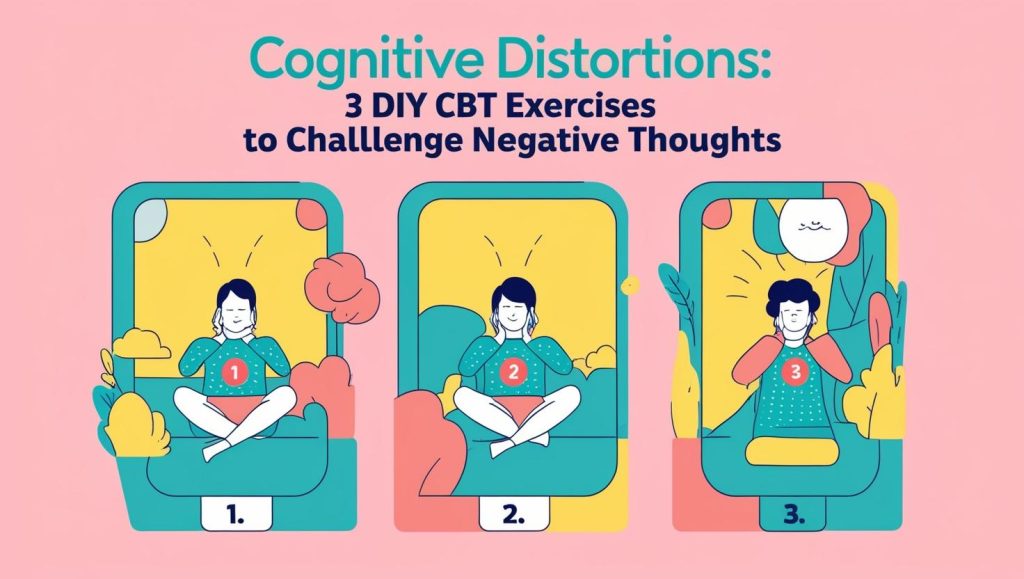
CBT Exercise 1: The Thought Record Sheet
The thought record is a clinical cornerstone of CBT. It acts as an objective log for your automatic thoughts, helping you transition from an emotional reaction to a logical reflection.
When you feel a sudden surge of anxiety or distress, pause and document the triggering situation. Note your exact emotional state and rate its intensity (e.g., Anxiety: 85%). Write down the automatic negative thought that surfaced. Next, step into the role of an impartial detective: what is the actual, tangible evidence supporting this thought? What is the evidence against it? Finally, synthesize this data into a balanced, alternative thought and re-rate your emotional intensity. If you struggle heavily with interpersonal interactions, practicing this tracking technique can be immensely helpful. You can find highly specific applications of this in our guide on CBT techniques for social anxiety.
CBT Exercise 2: Socratic Questioning
Originating from classical philosophy, Socratic questioning in CBT involves rigorously interrogating your own beliefs to test their clinical validity. When you feel trapped in a cognitive distortion, ask yourself objective, probing questions:
- Am I confusing a subjective thought with an objective fact?
- What is the worst that could realistically happen, and how likely is it?
- Am I jumping to conclusions without sufficient proof?
- If a loved one were in my exact situation, what compassionate advice would I give them?
- Is holding onto this thought helpful, or is it actively harming me?
This systematic process creates distance between your core self and the raw emotion, allowing you to rewrite your internal narrative based on empirical evidence rather than fear.
CBT Exercise 3: Behavioral Experiments
Behavioral experiments are empirical tests for your catastrophic predictions. Instead of simply ruminating on your fears, you actively test them in the real world to gather objective data.
Identify a limiting belief—for example, “If I set a boundary, my friend will abandon me.” Next, design a low-stakes experiment to test it: gently express a small preference or boundary. Observe the actual outcome without judgment. Often, you will find a stark contrast between your anxious prediction and the reality of the situation. This experiential learning is crucial for lasting cognitive restructuring, as it breaks the cycle of avoidance that keeps anxiety alive.
Integrating CBT Exercises into Daily Life
Consistency is the primary mechanism of change in CBT. Neuroplasticity—the brain’s remarkable ability to form new neural connections—requires repetition. You don’t need hours; just 10 to 15 minutes of daily, focused reflection can yield profound results.
Integrate these practices into your routine by doing a quick thought record after stressful events, or by ending your day reframing one distorted thought. Track your progress meticulously in a journal. Over time, you will notice the heavy lifting of cognitive reframing slowly transforming into an automatic, subconscious habit. What initially feels like therapeutic “homework” eventually becomes second nature.
When to Seek Professional Help
While self-guided CBT is an incredibly powerful tool for self-discovery and emotional regulation, it is not a substitute for professional clinical care when symptoms become severe or debilitating. If you are experiencing overwhelming panic attacks, deep depressive episodes, intrusive trauma memories, or suicidal ideation, it is imperative to connect with a licensed mental health professional.
A trained therapist provides a secure, guided clinical container to process profound emotional pain that self-help simply cannot address. Reaching out for professional help is a profound act of self-advocacy and strength.
Frequently Asked Questions
Can I really do CBT on my own?
Yes. For mild to moderate symptoms of anxiety or low mood, self-guided CBT can be highly effective. Utilizing structured worksheets and exercises helps build fundamental cognitive awareness. However, more complex or entrenched psychological distress often requires the nuanced, personalized guidance of a trained therapist.
How quickly can I expect results from these exercises?
Psychological change is inherently gradual. Some individuals notice a reduction in distress and improved mental clarity within a few weeks of consistent practice. For others, rewriting deep-seated neural pathways may take months. The clinical emphasis should always be on consistent practice rather than immediate mastery.
What if I feel worse before I feel better?
This is a widely recognized clinical phenomenon. Confronting long-avoided negative core beliefs can temporarily increase psychological distress. If this occurs, pace yourself and prioritize self-compassion and grounding techniques. If the distress becomes unmanageable or interferes with daily functioning, it is a clear clinical indicator to seek professional therapeutic support.
Ready to Start Healing?
Request a free consultation with a licensed therapist.
Message Sent!
Thank you for contacting TherapyDial. We will get back to you within 24 hours.