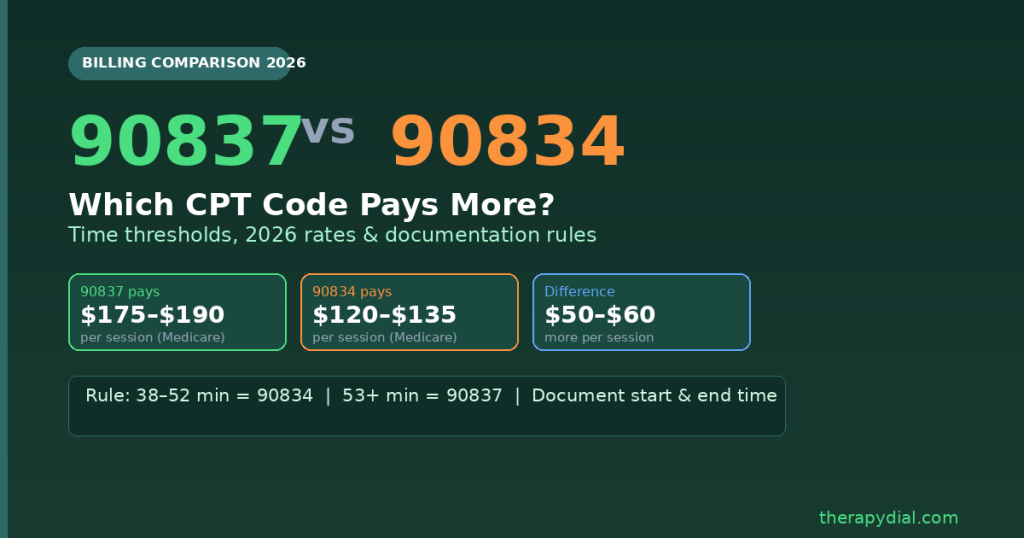
The single rule that determines whether to bill 90837 or 90834:
- 90834 = 38–52 minutes of face-to-face therapy — the cutoff is strictly time-based
- 90837 = 53+ minutes of face-to-face therapy — pays 30–45% more per session
- Document the exact start AND end time in every note — this is required for both codes
- Count only direct therapy time — not documentation, travel, or admin minutes
- Never upgrade to 90837 unless the session genuinely ran 53+ minutes — audit risk is real
- If your sessions do run 53+ minutes already, switching codes can add $10K–$20K per year
Frequently Asked Questions: 90837 vs 90834 Reimbursement
CPT 90834 covers individual psychotherapy sessions lasting 38–52 minutes. CPT 90837 covers sessions of 53 minutes or more. The cutoff is strict — a 52-minute session is 90834, a 53-minute session is 90837. There is no overlap or gray area. The AMA defines these as time-based codes, so session duration is the sole determining factor. Both codes cover the same type of service (individual psychotherapy); only the time spent differs.
Under estimated 2026 Medicare rates, CPT 90837 averages approximately $175–$190 nationally versus $120–$135 for 90834 — a difference of roughly $50–$60 per session, or 30–45% more. Private payer rates follow a similar differential, often wider. If you see 20 clients per week and all sessions genuinely run 53+ minutes, the annual difference between billing 90834 vs 90837 is approximately $52,000–$62,000 at private pay rates. Rates vary by locality — verify your exact rate in the CMS Physician Fee Schedule lookup tool.
To support a 90837 claim, your clinical note must contain: (1) session start time and end time showing 53+ minutes elapsed; (2) a description of the psychotherapy provided during that time; (3) the patient’s diagnosis and medical necessity for the session; (4) your signature and credentials. The start/end time requirement is the most commonly missed element. Notes that say only “Session: 60 minutes” without specific clock times are increasingly rejected by payers during post-payment audits. See the documentation template further down this page.
The question of 90837 vs 90834 is one of the highest-stakes billing decisions a private practice therapist makes — and most get it wrong by defaulting to 90834 out of habit rather than clinical accuracy. These two codes cover identical services; the only difference is session duration. Yet that single time threshold translates to a difference of $50–$60 per session under Medicare and even more under most commercial plans. Across a full year of 20-client weeks, that gap compounds to $10,000–$20,000 in uncollected revenue — money you earned but never claimed.
This guide gives you the exact time thresholds, 2026 rate comparisons across major payers, the documentation language that protects you during an audit, the annual revenue math laid out clearly, and a plain-English answer to when 90834 is actually the right choice. For a broader overview of every psychotherapy billing code, see our 2026 CPT code changes guide.
The Core Difference: Time Thresholds for 90834 vs 90837
Only direct, face-to-face therapy time counts toward the session duration. Time spent writing notes, reviewing records before the session, or coordinating care does not count. If your actual therapy contact was 50 minutes but you spent 10 minutes on admin, the correct code is 90834, not 90837.
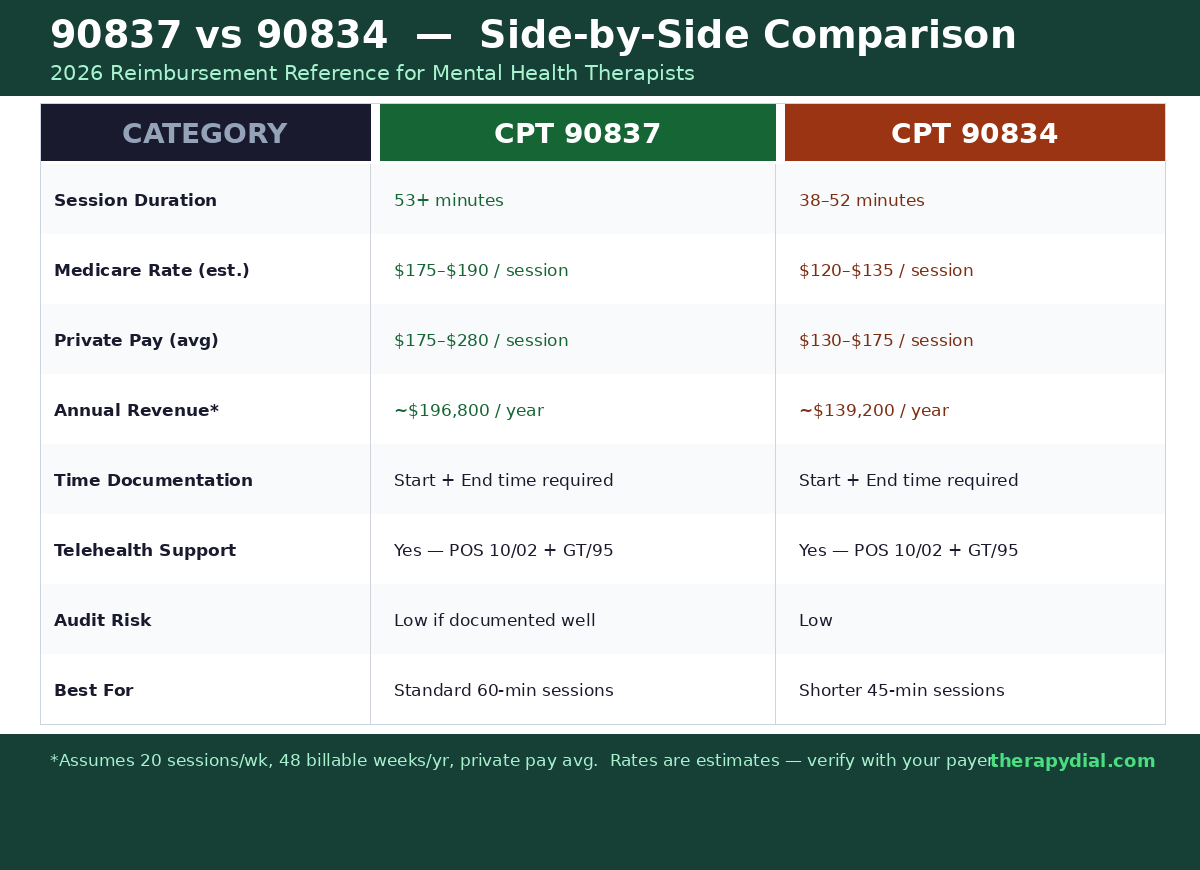
📌 Save this chart — refer to it every time you choose a therapy billing code.
How Much More Does 90837 Pay? 2026 Rate Comparison
Rates below are estimated 2026 figures. Medicare rates are approximate national averages — your exact locality rate may vary. Private payer rates are typical commercial ranges; verify in your individual payer contracts.
| Payer Type | 90834 (38–52 min) | 90837 (53+ min) | Difference |
|---|---|---|---|
| Medicare (national est.) | ~$120–$135 | ~$175–$190 | +$50–$60 |
| Medicaid (varies by state) | ~$80–$110 | ~$115–$160 | +$35–$50 |
| Aetna (commercial) | ~$130–$155 | ~$190–$220 | +$60–$65 |
| UnitedHealthcare | ~$135–$160 | ~$195–$230 | +$60–$70 |
| Cigna / Evernorth | ~$125–$150 | ~$185–$215 | +$60–$65 |
| BCBS (varies by plan) | ~$130–$160 | ~$190–$235 | +$60–$75 |
| Private / Self-Pay | $150–$200 | $200–$300 | +$50–$100 |
Documentation Rules: What Must Be in Your Notes
Missing or vague documentation is the single biggest reason 90837 claims are recouped during audits. Payers have tightened requirements significantly — here is what every progress note must contain when billing either code.
📋 Documentation Template — 90837 & 90834
Date of Service: [MM/DD/YYYY]
Session Start Time: [e.g., 2:03 PM] End Time: [e.g., 3:02 PM]
Total Face-to-Face Time: [e.g., 59 minutes]
CPT Code Billed: 90837 (or 90834)
Diagnosis: [ICD-10 code + description]
Session Content: [Brief clinical summary — presenting issues, interventions used, patient response]
Progress Toward Goals: [Objective update on treatment plan goals]
Plan: [Next session date, homework, referrals if any]
Clinician: [Name, credentials, NPI, signature]
Notes that say only “60-minute session” without specific clock times are increasingly flagged. Payers want to see a start time and an end time — not just a round number. Round numbers like “60 minutes” or “90 minutes” on every single claim can themselves be a statistical outlier trigger. Vary your documented times naturally as they actually occur.
Audit Risk: Is 90837 More Likely to Get You Flagged?
The short answer: correctly documented 90837 claims carry no more inherent risk than any other code. The risk comes from patterns that stand out to automated claims analytics. Here is what is low-risk vs high-risk.
✓ Lower Audit Risk
- 90837 rate consistent with your specialty average
- Start and end times documented in every note
- Gradual transition from 90834 to 90837 over several months
- Session time varies naturally (58 min, 61 min, 55 min)
- Documentation matches the code billed on every claim
- CAQH attestation current — clean provider profile
✕ Higher Audit Risk
- Sudden 100% switch to 90837 overnight
- All sessions documented as exactly 60 or 90 minutes
- 90837 rate far above your specialty peer average
- No start/end times — only “60-minute session” in notes
- High 90837 volume combined with expired CAQH or NPI errors
- Same code billed regardless of actual session length
What the Major Payers Require for 90837 in 2026
CMS / Medicare
Start and end time required in clinical note. POS 10 or POS 02 for telehealth. Modifier GT or 93 for telehealth. LCD policies vary by MAC region — check your local coverage determination.
Aetna
Time-based documentation required. Aetna’s behavioral health division (now part of CVS Health) follows AMA time thresholds strictly. See our full Aetna credentialing guide for provider portal access.
UnitedHealthcare / Optum
UHC requires start/end times and flags claims where 90837 volume exceeds regional peer averages by >20%. Submit through Optum’s provider portal. See our UHC credentialing guide.
Cigna / Evernorth
Evernorth Behavioral Health handles mental health claims. Time documentation required. Telehealth sessions use modifier 95. Pre-authorization may be required after session 8 for ongoing treatment. See our Cigna / Evernorth credentialing guide.
The Annual Revenue Impact: 90834 vs 90837 Side-by-Side
Assumes a solo therapist, 20 client sessions per week, 48 billable weeks per year (allowing for vacation/holidays). Private pay blended rate used.
| Scenario | Code Billed | Rate / Session | Sessions / Year | Annual Revenue |
|---|---|---|---|---|
| All 90834 | 90834 | $145 avg | 960 | $139,200 |
| 50% 90834 / 50% 90837 | Mixed | $175 avg blended | 960 | $168,000 |
| All 90837 (sessions justify) | 90837 | $205 avg | 960 | $196,800 |
| Revenue difference: all 90834 vs all 90837 | +$57,600/yr | |||
This revenue difference requires zero new clients. It requires only accurate code selection matching your actual session duration, and 30 extra seconds per note to log a start and end time. That is one of the highest-ROI changes any private practice therapist can make today. If you want a specialist to audit your current billing mix and identify opportunities, our team can review your claims within one business day.
When 90834 Is Actually the Right Code
Billing the correct code protects you. Here are the situations where 90834 is the clinically and legally appropriate choice:
Bill 90834 when…
- Your session genuinely ends before the 53-minute mark — any session from 38 to 52 minutes
- You ran over 53 minutes but cannot document exact start/end times in the note
- The extra time was spent on documentation or coordination, not face-to-face therapy
- You are working with a payer that requires pre-authorization for 90837 and authorization is pending
- Your session notes do not yet have the clock-time documentation format in place — fix notes first, switch codes after
- Your practice management system auto-populates a default code — always override to match actual time
🎯 One Rule, One Change, $57K/Year
If your sessions consistently run past 53 minutes, the only thing standing between you and a 40% revenue increase is a two-line addition to your clinical note: session start time and session end time. Everything else — the code, the rate, the claim — follows automatically. The documentation change takes 30 seconds. The revenue impact lasts all year.
Let Our Billing Team Handle the Codes
We audit your claims, apply the right codes, and maximize every session you bill — all included in one flat monthly fee
- Professional Medical Billing
- FREE Insurance Credentialing
- FREE TherapyDial Profile Listing
- Priority Practice Support
No setup fees • Cancel anytime
Get Your Billing Optimized
Tell us about your practice and we’ll identify exactly where you’re leaving money on the table — response within 1 business day.
✓ Message sent! We’ll be in touch within 1 business day.