What Is a Lobotomy? History, Effects & Modern Mental Health Alternatives
- Definition — A lobotomy (leucotomy) was a psychosurgical procedure that severed nerve pathways in the prefrontal cortex to reduce severe psychiatric symptoms such as psychosis, mania, and OCD.
- Origins (1935) — Portuguese neurologist António Egas Moniz introduced prefrontal leucotomy in 1935, later winning a controversial 1949 Nobel Prize in Physiology or Medicine for the work.
- U.S. popularisation — Neurologist Walter Freeman and neurosurgeon James Watts popularised it in the U.S.; Freeman later developed the rapid transorbital “ice-pick” technique performed through the eye socket without a surgical theatre.
- Scale of use — An estimated 40,000–50,000 lobotomies were performed in the United States alone between the mid-1930s and early 1960s, with hundreds of thousands worldwide.
- Diagnoses targeted — Patients with schizophrenia (ICD-10 F20), major depressive disorder (F32–F33), bipolar disorder (F31), and OCD (F42) were most frequently subjected to the procedure, often without meaningful informed consent.
- Effects and harms — Common outcomes included permanent personality change, emotional blunting, cognitive impairment, loss of executive function, seizures, incontinence, and death from surgical complications.
- Decline — Lobotomy fell out of favour after chlorpromazine (the first antipsychotic) was introduced in 1954, combined with bioethics scrutiny, patient-rights movements, and damning long-term outcome data.
- Legal status today — Classic lobotomy is prohibited or so tightly restricted in most countries that it is effectively obsolete; any modern brain-based intervention (e.g., deep brain stimulation) requires independent ethics review and full informed consent.
- Modern evidence-based alternatives — CBT, DBT, EMDR, psychodynamic therapy, and FDA-approved medications now treat the same conditions lobotomy once targeted — safely, reversibly, and with patient autonomy central.
- Diagnostic clarity today — Conditions once loosely grouped now carry precise ICD-10-CM codes (e.g., F32.1 moderate depression, F20.9 schizophrenia) guiding targeted, evidence-based treatment plans.
- Find a specialist — Clinicians and patients can connect with trauma-informed, licensed providers through TherapyDial’s directory.
❓ Frequently Asked Questions
A small number of patients showed measurable reductions in agitation and psychotic episodes after lobotomy, which initially fuelled its global adoption. However, these apparent gains almost universally came at the cost of severe personality flattening, loss of initiative, and impaired cognitive capacity — outcomes that today’s standards of care would classify as serious adverse events. The DSM-5 framework and modern outcome measurement tools (e.g., PHQ-9, GAF scale) make clear that reducing symptom severity while destroying quality of life is not acceptable treatment.
Classic prefrontal and transorbital lobotomies are no longer practised in standard psychiatric care globally. In the U.S., psychosurgery is governed by strict IRB (Institutional Review Board) oversight and requires full informed consent under federal regulations. Some countries (including the U.K. and most of Europe) ban the procedure outright. Rare modern alternatives such as deep brain stimulation (DBS) for treatment-resistant OCD (ICD-10 F42) bear no resemblance in method or intent — they are reversible, millimetre-precise, and subject to multi-centre ethics review before any use.
Chlorpromazine (Thorazine), introduced in 1954, was the first antipsychotic and the most important single factor in ending lobotomy for schizophrenia (F20) and mania (F31). For depression (F32–F33), tricyclic antidepressants arrived in the late 1950s, followed by SSRIs in the 1980s. These were accompanied by the rise of structured psychotherapy — CBT (Aaron Beck, 1960s), DBT (Marsha Linehan, 1991), and EMDR (Francine Shapiro, 1989) — all now recognised as first-line treatments. See our therapy modalities comparison guide for a full breakdown.
Ethical modern care features transparent informed consent (explaining all options, risks, and the right to refuse), shared decision-making, regular outcome monitoring, and reversibility — the direct opposite of lobotomy. Your provider should discuss your diagnosis using recognised criteria (DSM-5 or ICD-10-CM), present the evidence for recommended treatments, and honour your right to a second opinion. Regulatory bodies such as your state’s licensing board and the APA Ethics Code (2017) set the minimum standards your clinician must meet. If you feel pressured, shamed, or kept uninformed, seek a different provider.
Yes. Complex trauma (ICD-10 F43.1 PTSD; ICD-11 Complex PTSD) can produce dissociative symptoms, perceptual disturbances, and identity disruption that superficially resemble psychosis — conditions historically misdiagnosed and mistreated, including with lobotomy. Modern trauma-informed care uses structured clinical interviews (e.g., SCID-5) to distinguish trauma responses from primary psychotic disorders. Treatments include trauma-focused CBT, EMDR (see our EMDR for trauma guide), and somatic approaches. For complex presentations involving identity, our guide on Dissociative Identity Disorder provides clinical context.
Historical records and academic analyses consistently show that women — particularly those labelled “hysterical,” emotionally disruptive, or institutionalised for non-conforming behaviour — were lobotomised at higher rates than men, comprising 55–65% of recipients in most national datasets. This reflected broader societal structures in which women had less legal autonomy and fewer rights to refuse medical treatment. Today, feminist and trauma-informed frameworks in mental health explicitly address these legacies, recognising how social context shapes both diagnosis and treatment — a perspective directly relevant when reviewing depression ICD-10 coding and understanding treatment disparities.
The diagnoses that lobotomy historically targeted now have precise ICD-10-CM coding: schizophrenia (F20.x), bipolar disorder (F31.x), major depressive disorder (F32.x single episodes; F33.x recurrent), OCD (F42.x), and PTSD (F43.1x). Accurate coding is essential for insurance reimbursement, treatment authorisation, and outcomes research. Our coding resources — including guides on ICD-10 depression codes and the top ICD-10 mental health codes — help clinicians and practices bill accurately and ethically.
The word lobotomy carries a weight that few medical terms can match — conjuring images of cold operating theatres, coerced patients, and personalities erased in the name of “treatment.” But to understand why lobotomy happened, and why it matters today, we need to look honestly at the desperate circumstances that made it seem like a solution, the extraordinary harm it caused, and how modern mental health care has transformed in response. This guide covers the history, the neuroscience, the human cost, and — most importantly — the evidence-based, ethical alternatives that exist today for every condition lobotomy once targeted.
Whether you are a clinician seeking historical and coding context (see our guides on ICD-10 depression codes and the top ICD-10 mental health codes), a patient researching a diagnosis you find unsettling, or simply curious about this chapter in psychiatric history, this resource is written to inform — not alarm. Mental health care has evolved profoundly, and the standards of transparency, consent, and evidence that guide it today are a direct response to the failures of the lobotomy era.
For readers dealing with dissociation, identity fragmentation, or trauma responses that were historically misunderstood, our clinical article on Dissociative Identity Disorder offers an empathic, DSM-5-grounded overview of how these experiences are now understood — not pathologised and surgically erased.
⚠️ Clinical Perspective: Why Lobotomy Is a Cautionary Tale, Not Just History
The lobotomy era demonstrates what happens when three conditions converge: (1) a vulnerable patient population with limited legal rights, (2) an unproven intervention with no long-term safety data, and (3) institutional pressure to prioritise “manageability” over patient wellbeing. Today’s FDA approval process, IRB oversight, APA Ethical Principles of Psychologists and Code of Conduct (2017), and CMS billing compliance frameworks all exist, in part, because of the catastrophic failures of this period. Understanding this history helps clinicians and patients alike recognise the importance of evidence, consent, and reversibility in every treatment decision.
What Is a Lobotomy? A Clinical Definition
A lobotomy — formally called a prefrontal leucotomy — was a form of psychosurgery in which nerve pathways connecting the prefrontal cortex to deeper limbic and thalamic structures were surgically severed or destroyed. The prefrontal cortex governs executive function, emotional regulation, decision-making, planning, and personality expression. By disrupting these connections, surgeons hoped to reduce what they perceived as “overactive” emotional circuits driving psychosis, mania, depression, or compulsive behaviour.
The theoretical basis — primitive by today’s neuroscience standards — was that mental illness resulted from self-reinforcing, pathological circuits that could be interrupted by physical disruption. This ignored the complexity of neural networks, the role of trauma and environment in shaping mental states, and the devastating consequences of destroying healthy brain tissue. Severing prefrontal connectivity does not selectively remove “bad” emotions — it globally impairs the brain’s capacity for planning, motivation, social cognition, and self-awareness.
| Feature | Lobotomy Era (1935–1960s) | Modern Psychiatry (2020s) |
|---|---|---|
| Mechanism | Irreversible surgical destruction of prefrontal pathways | Reversible therapy and medication; targeted neuromodulation |
| Informed consent | Rarely obtained; often coerced or bypassed | Mandatory, legally protected, and documented |
| Evidence base | Anecdote and institutional convenience | RCT data, DSM-5/ICD-10 criteria, validated outcome measures |
| Patient autonomy | Minimised or eliminated | Central to all treatment planning |
| Reversibility | None — permanent brain damage | Therapy and medications can be stopped, adjusted, or changed |
| Goal of treatment | “Manageability” in institutional settings | Quality of life, recovery, and community integration |
The History & Procedure of Lobotomy: A Six-Stage Timeline
The rise and fall of lobotomy unfolded over roughly three decades. Each stage reveals not just surgical evolution, but shifting cultural attitudes toward mental illness, patient rights, and the limits of medical authority.
1935 — Egas Moniz Introduces Prefrontal Leucotomy
Portuguese neurologist António Egas Moniz and surgeon Almeida Lima performed the first prefrontal leucotomy in Lisbon, injecting alcohol into frontal white matter of a patient with schizophrenia. Moniz theorised that mental illness arose from fixed “pathological synaptic connections” — a concept without supporting histological evidence. He reported subjective improvement in a small case series and published results in Tentatives Opératoires dans le Traitement de Certaines Psychoses (1936).
Historical Note
Moniz was awarded the 1949 Nobel Prize in Physiology or Medicine — an award that remains scientifically and ethically contested because no randomised controlled trial was ever conducted and the full extent of harms was documented only decades later.
1936–1945 — Freeman & Watts Bring Lobotomy to the U.S.
Neurologist Walter Freeman and neurosurgeon James Watts performed the first U.S. prefrontal lobotomy in September 1936 at George Washington University Hospital. Their “Freeman-Watts standard lobotomy” involved drilling burr holes in the skull, then using a spatula to sweep through frontal white matter in a fan-shaped arc. They popularised the procedure through medical lectures, press coverage, and their 1942 textbook Psychosurgery. By the mid-1940s, hundreds of hospitals across the U.S. were performing lobotomies.
Consent Crisis
Many patients were institutionalised adults whose consent was legally held by family members or the state — a conflict of interest that modern bioethics frameworks (and the Belmont Report, 1979) explicitly prohibit. IRB review did not yet exist.
1945–1950 — The Transorbital “Ice-Pick” Technique
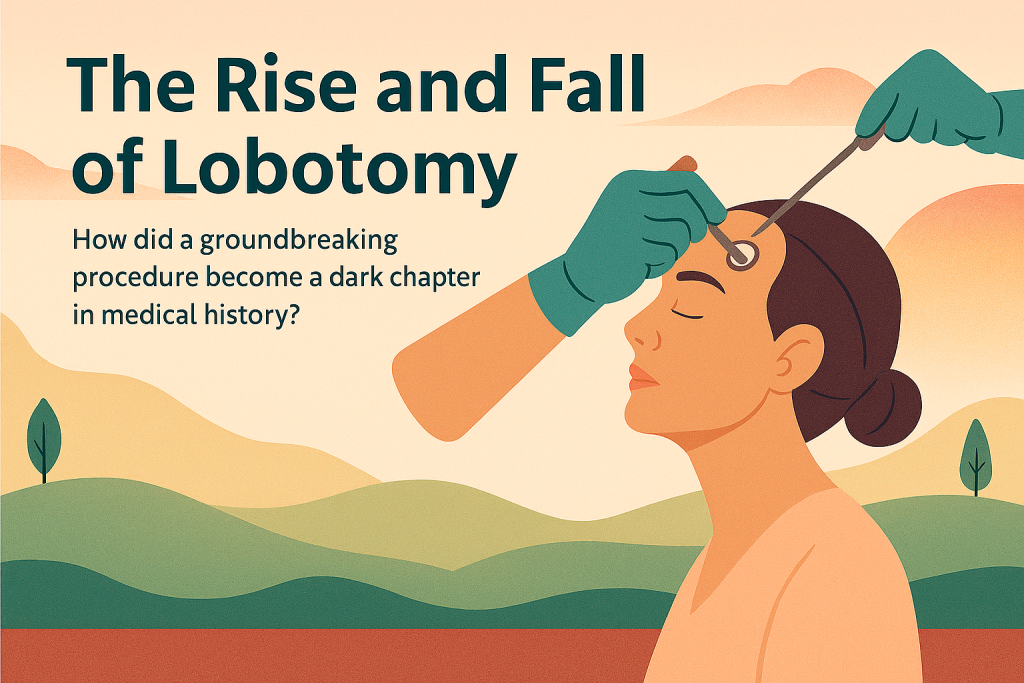
Freeman, wanting to bypass the need for neurosurgeons and operating theatres, developed the transorbital lobotomy: a leucotome resembling an ice pick was inserted through the upper eyelid orbit, tapped through the thin orbital bone with a mallet, then swept laterally to sever frontal connections. The procedure took minutes and could be done in Freeman’s office. He toured institutions across the country in a van — the “lobotomobile” — performing approximately 3,500 lobotomies over his career.
Who Was Targeted
Patients with schizophrenia (ICD-10 F20), depression (F32–F33), OCD (F42), and bipolar disorder (F31) were most commonly operated on — often women, children as young as 12, and patients who were “disruptive” in institutional settings rather than clinically appropriate candidates.
1949–1954 — Peak Use: 40,000–50,000 U.S. Cases
Lobotomy reached its peak in the early 1950s. The American Medical Association endorsed it; mainstream media portrayed patients returning to “normal life.” The procedure spread globally — U.K., Scandinavia, Japan, Brazil, and beyond. Rosemary Kennedy, sister of President John F. Kennedy, underwent a lobotomy at age 23 in 1941 and spent the rest of her life requiring full-time care after the operation went catastrophically wrong. Most long-term harm went undocumented in the medical literature.
Global Reach
An estimated 70,000–80,000 lobotomies were performed worldwide, with the U.K. performing approximately 17,000. Women consistently made up 55–65% of recipients across national datasets.
Read: How Trauma and Dissociation Are Understood Today →1954–1960s — Chlorpromazine Changes Everything
The introduction of chlorpromazine (Thorazine) in 1954 — the world’s first antipsychotic — demonstrated that psychosis could be reduced pharmacologically without surgery. Antidepressants (imipramine, 1957) and mood stabilisers (lithium, formalised in the 1960s) followed. Simultaneously, landmark publications began documenting lobotomy’s catastrophic long-term outcomes. James Watts publicly broke with Freeman over the transorbital technique’s recklessness. Neurosurgical societies withdrew support, and by the mid-1960s, lobotomies had largely ceased across most of the Western world.
The Turning Point
The passage of the National Research Act (1974) and the resulting Belmont Report (1979) formally codified the ethical principles of beneficence, non-maleficence, and respect for autonomy that lobotomy had systematically violated. IRB oversight became mandatory for all human subjects research in the U.S.
Today — Precision Neuromodulation vs. Modern Psychotherapy
In rare, treatment-resistant cases (e.g., severe OCD unresponsive to SSRIs, CBT, and clomipramine), deep brain stimulation (DBS) and stereotactic anterior capsulotomy may be considered — but these bear no resemblance to lobotomy. They are reversible, millimetre-precise, and require FDA investigational device approval, multi-disciplinary review, independent IRB approval, and documented failure of all evidence-based alternatives. For the vast majority of people, conditions once targeted by lobotomy are now treated with CBT, DBT, EMDR, antidepressants, antipsychotics, and mood stabilisers — all reversible and evidence-based.
Modern Alternatives
Explore evidence-based therapy options for the same conditions lobotomy once targeted.
CBT vs DBT vs EMDR vs Psychodynamic: Full Comparison →Who Was Affected & What Were the Long-Term Effects?
Historical records across the U.S., U.K., and Scandinavia consistently show that women were lobotomised at higher rates than men — comprising 55–65% of all recipients in some national datasets. Children and adolescents were also subjected to the procedure, with some reports of patients as young as 12 undergoing transorbital lobotomy. People institutionalised for reasons that had little to do with genuine psychiatric disorder — including grief reactions, LGBTQ+ identities (then classified as pathological), and non-conforming behaviour — were also targeted.
The long-term neurological and psychological effects were profound and permanent:
- Emotional blunting and frontal lobe syndrome: Loss of spontaneous affect, motivation, empathy, and social insight — the exact capacities the prefrontal cortex governs.
- Executive dysfunction: Inability to plan, initiate tasks, sustain attention, or regulate impulses — consistent with modern understanding of prefrontal damage.
- Personality change: Families frequently described recipients as “no longer themselves” — more passive, less curious, emotionally distant.
- Incontinence and seizures: Neurological complications were common, reflecting the crude and non-selective nature of the surgical disruption.
- Dependency and institutionalisation: Many patients who were supposed to “return to normal life” instead required lifelong full-time care.
- Death: Freeman’s transorbital procedure carried an estimated mortality rate of 1–3%, with higher rates reported in some institutional series.
🧠 The Neuroscience Perspective
Modern neuroimaging (fMRI, DTI tractography) allows us to map the exact pathways lobotomy destroyed. The dorsolateral prefrontal cortex, orbitofrontal cortex, and anterior cingulate — all disrupted by lobotomy — are now known to be central to working memory, reward processing, emotional regulation, and theory of mind. Destroying these connections does not remove suffering; it removes the brain’s capacity to process, communicate, and respond to experience. This understanding forms the neuroscientific foundation for why EMDR (which facilitates prefrontal-limbic integration) and CBT (which builds prefrontal regulatory capacity) are so effective for trauma and mood disorders. Learn more in our EMDR for trauma guide.
From Lobotomy to Collaborative, Trauma-Informed Care
The most important lesson of the lobotomy era is not simply that “we used to do harmful things.” It is that clinical authority without patient autonomy is dangerous, and that treatment efficacy must be measured by the patient’s own experience of wellbeing — not by whether they are quieter or easier to manage institutionally. Every major reform in mental health care since the 1960s has been a direct response to this lesson.
Modern evidence-based treatments for the conditions lobotomy once targeted include:
- Cognitive Behavioural Therapy (CBT): First-line for depression (F32–F33), OCD (F42), and anxiety disorders. NICE Guidelines and APA Practice Guidelines designate CBT as a primary treatment with robust RCT support. CBT works with the prefrontal cortex — teaching it to regulate the very limbic responses that lobotomy tried to destroy.
- Dialectical Behaviour Therapy (DBT): Developed by Marsha Linehan for borderline personality disorder (F60.3) and emotional dysregulation; equally effective for chronic suicidality and eating disorders.
- EMDR (Eye Movement Desensitisation and Reprocessing): WHO-endorsed treatment for PTSD (F43.1); facilitates bilateral hemispheric processing of traumatic memories without suppression. See our EMDR therapist guide for clinical context.
- Psychodynamic therapy: Evidence-based for personality disorders, chronic depression, and relational trauma — addressing unconscious patterns with insight and attunement rather than behavioural suppression.
- Pharmacotherapy: SSRIs, SNRIs, atypical antipsychotics (aripiprazole, quetiapine), mood stabilisers (lithium, lamotrigine), and anxiolytics — all with documented mechanisms of action, reversibility, and informed-consent frameworks.
For a full comparison of modern therapy approaches, see: Therapy Modalities Explained: CBT vs DBT vs EMDR vs Psychodynamic.
For further reading on the history of psychosurgery and its ethical implications, the National Institute of Mental Health (NIMH) provides a detailed overview of how brain stimulation therapies are regulated and applied today. The APA Ethics Code (2017) sets the informed consent and beneficence standards every licensed psychologist in the U.S. must meet.
Find Evidence-Based, Ethical Mental Health Care
The lobotomy era shows what mental health care looks like without ethics, evidence, or patient autonomy. TherapyDial connects you with licensed, trauma-informed therapists who use CBT, DBT, EMDR, and psychodynamic approaches — with full transparency, informed consent, and your wellbeing at the centre.
Find a Mental Health Specialist on TherapyDial
Browse therapists specialising in trauma, depression, OCD, bipolar disorder, dissociation, and more — all evidence-based, all ethical, all committed to your autonomy.
📚 Clinical & Coding Resources for Conditions Lobotomy Once Targeted
The diagnoses lobotomy was applied to — schizophrenia, depression, OCD, bipolar disorder — now have precise ICD-10-CM codes and evidence-based treatment pathways. These resources support both clinicians and patients in navigating diagnosis and care.
ICD-10 Depression Codes
F32.0–F33.9 major depressive disorder codes, billing guidance, and documentation tips for providers.
View Depression Coding Guide →Top Mental Health ICD-10 Codes
The most frequently billed psychiatric codes — F-series overview for clinicians and practices.
View Top Mental Health Codes →EMDR for Trauma
How EMDR works for PTSD, trauma, and dissociation — the evidence-based alternative to suppression.
View EMDR Guide →Dissociative Identity Disorder
DSM-5 criteria, trauma-informed understanding, and modern psychotherapy approaches for DID.
View DID Clinical Guide →Medical Disclaimer: This article is for educational purposes only and does not constitute medical or psychiatric advice, diagnosis, or treatment. If you are experiencing a mental health crisis, please contact the 988 Suicide & Crisis Lifeline (call or text 988), your local emergency services, or a licensed mental health provider immediately. All treatment decisions should be made collaboratively with a qualified healthcare professional.