
How to Start a Private Practice in North Carolina
- Verify Licensure — Confirm full, unrestricted clinical licensure (LCMHC, LCSW, LMFT) via your respective state board like the NCBLCMHC.
- Form a PLLC — Under NC law (Chapter 55B), you must obtain a Certificate of Registration from your board before filing Articles of Organization with the Secretary of State to form a Professional Limited Liability Company.
- Obtain EIN & Banking — Get a free federal Employer Identification Number from the IRS and open a dedicated business checking account.
- Register NPI Numbers — Secure your Type 1 (Individual) and Type 2 (PLLC/Organization) NPIs through the NPPES portal.
- Secure Malpractice Insurance — Obtain coverage (e.g., $1M/$3M) through carriers like HPSO or CPH & Associates.
- Complete CAQH ProView — Build and attest your mandatory provider profile to prepare for commercial payer credentialing.
- Join Insurance Panels — Credential with major networks like Blue Cross and Blue Shield of North Carolina (BCBSNC), Aetna, and UnitedHealthcare/Optum.
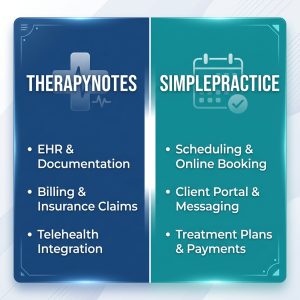
- Choose Software Tools — Implement HIPAA-compliant platforms like SimplePractice for EHR/billing and Spruce Health for secure communications.
- Set Up Office or Telehealth — Decide between a physical office (e.g., in Raleigh or Charlotte) or a telehealth-only model.
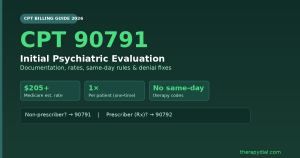
- Understand Coding & Billing — Familiarize yourself with exact diagnostic ICD-10 codes and procedural CPT codes (e.g., 90837, 90834).
Frequently Asked Questions
No. Under Chapter 55B of the North Carolina General Statutes, professional counseling and social work require the formation of a Professional Limited Liability Company (PLLC) or a Professional Corporation (P.C.). You must gain your board’s approval before filing.
No. Mental health therapists (such as LCMHCs, LCSWs, and LMFTs) cannot prescribe medications and do not require a DEA number. If a client needs medication management, you must refer them to a licensed psychiatrist, psychiatric nurse practitioner, or primary care physician.
Blue Cross and Blue Shield of North Carolina (BCBSNC) is the most critical panel, as it covers the vast majority of commercially insured residents and state employees. Follow up with Aetna, UnitedHealthcare/Optum, and Cigna.
You need 3,000 hours of supervised professional practice. This must include at least 2,000 direct counseling hours and 100 hours of clinical supervision by a board-approved LCMHCS.
Yes, the NCBLCMHC requires a Jurisprudence Exam. It is an open-book, online test focusing on North Carolina counseling laws and ethical codes, and you must achieve a perfect score by retaking missed questions.
North Carolina has a flat income tax rate of 4.5% (as of 2024), which is scheduled to decrease over the coming years. Note that PLLCs are also subject to an annual Franchise Tax.
North Carolina is home to a booming population and thriving metro areas like Charlotte, Raleigh-Durham, and Asheville, making it a prime market for private therapy practices. However, its legal and licensing landscape has distinct quirks. For instance, mental health counselors are licensed as LCMHCs (not LPCs), and forming a business requires a two-step approval process starting with your licensing board.
This guide walks you through each step — from navigating the mandatory Professional Limited Liability Company (PLLC) rules, to obtaining proper state licensing, and credentialing with major players like Blue Cross and Blue Shield of North Carolina (BCBSNC).
Exploring other states? See our guides for New York, Texas, Florida, Georgia, and Pennsylvania.
How North Carolina Compares to Other States
| Factor | North Carolina | Georgia | Texas | New York |
|---|---|---|---|---|
| Entity Type | PLLC / P.C. | LLC / P.C. | LLC / PLLC | PLLC only |
| Board Approval for Entity? | Yes (Required before filing) | No | No | Yes |
| State Income Tax | 4.5% flat (decreasing) | 5.49% flat | 0% | Up to 10.9% |
| Supervision Hours | 3,000 | 3,000 | 3,000 | Varies |
| Jurisprudence Exam | Yes | Yes | Yes | No |
| Franchise Tax | Yes | None | Yes | None |
The Complete North Carolina Private Practice Roadmap
Confirm Your North Carolina License
Verify your active license with your respective state board:
- LCMHCs: North Carolina Board of Licensed Clinical Mental Health Counselors (NCBLCMHC)
- LCSWs: North Carolina Social Work Certification and Licensure Board (NCSWCLB)
- LMFTs: NC Marriage and Family Therapy Licensure Board
You must hold a full, unrestricted license to practice independently. If you hold an Associate license (e.g., LCMHCA, LCSWA), you cannot practice completely solo without board-approved supervision parameters in place.
Need a North Carolina License?
Whether you’re applying for initial licensure or transferring from another state, we handle the paperwork and Board communications for you.
Let Us Help with Licensing →Complete Supervised Hours & Exams
For LCMHCs, North Carolina requires 3,000 total hours of supervised professional practice (including 2,000 hours of direct counseling) under an LCMHCS.
Additionally, the NCBLCMHC requires two exams for full LCMHC licensure: the NCE or NCMHCE, and the mandatory Jurisprudence Exam — a no-fail, open-book online exam covering the NCBLCMHC Practice Act and ethical codes.
Form Your PLLC (Two-Step Process)
By law (Chapter 55B), North Carolina requires mental health professionals to form a Professional Limited Liability Company (PLLC) or a Professional Corporation (P.C.). You cannot form a standard LLC.
- Get Board Approval: Apply for a Certificate of Registration from your specific licensing board (e.g., NCBLCMHC).
- File with Secretary of State: Only after receiving the Board’s Certificate can you file your Articles of Organization with the NC Secretary of State ($125 fee). The name must end in “PLLC”.
Get Your EIN & Register NPIs
Apply for a free federal EIN at the IRS website. Then, register for your Type 1 (Individual) and Type 2 (Organization/PLLC) National Provider Identifiers via the NPPES portal. Your Type 2 NPI is required for billing through your new PLLC.
Complete CAQH ProView
The CAQH ProView database is mandatory for credentialing with North Carolina commercial payers. Create your account, thoroughly input your education, licensure, NPIs, and malpractice info, and re-attest every 120 days to ensure there are no delays in credentialing.
Secure Malpractice Insurance
Obtain professional liability insurance before seeing clients. Standard coverage is $1M per occurrence / $3M aggregate. HPSO and CPH & Associates are highly trusted providers for counselors and social workers in North Carolina.
Begin Insurance Credentialing
The North Carolina insurance market is heavily dominated by one major player, but has key managed care networks:
- Blue Cross and Blue Shield of North Carolina (BCBSNC): The largest commercial payer and administrator of the State Health Plan (SHP). This panel is essential for an NC practice.
- Aetna, UnitedHealthcare/Optum, Cigna/Evernorth
- NC Medicaid (NCTracks): Medicaid enrollment goes through NCTracks, engaging Standard Plans and Behavioral Health Tailored Plans.
Set Up Practice & Tech Stack
Whether you choose a telehealth-only model or physical office in Charlotte or Raleigh, ensure your tech stack is HIPAA-compliant. Consider SimplePractice or TherapyNotes for your EHR and claims submissions, and Spruce Health or Doxy.me for secure telehealth and communication.

Pro-Tip: Save this checklist to ensure you never miss a PLLC deadline.
North Carolina Break-Even Calculator
Estimate sessions per week to cover overhead and reach your income goal. Assumes flat 4.5% NC state tax.
Clinical Resources & Compliance
Exclusive Provider Bundle:
Licensure + Billing + Growth
- Professional Medical Billing
- FREE Insurance Credentialing
- FREE TherapyDial Profile Listing
- Priority Practice Support
Whether you need help with your NC board applications or managing BCBSNC claims.
HIPAA Compliant & Expertly Managed.