How to Write SOAP Notes: A Practical Clinician’s Guide
Clear, insurance-ready documentation that protects your practice and respects your time. Discover the exact structure, workflow, and templates to finish faster without sacrificing nuance.
Progress notes don’t have to be a grind. With a reliable SOAP structure, you can document efficiently, stay insurance-ready, and still capture the “why” behind your work.
If you’re building goals alongside your notes, see our companion guide on How to Write a Mental Health Treatment Plan for a step-by-step approach to goals, objectives, and interventions.
What is a SOAP note?
SOAP stands for Subjective, Objective, Assessment, Plan. It’s a simple structure that helps other providers, payers, and auditors quickly understand the session, your reasoning, and the next steps. Done well, it’s concise and powerful—a consistent way to turn the session’s story into clinical documentation.
The goal isn’t verbosity; it’s clarity. When you learn how to write SOAP notes with purpose, you’ll protect your schedule and your chart.
Why SOAP works for compliance & continuity
Payers expect to see the client’s report (S), observable findings (O), your professional interpretation (A), and the plan (P). SOAP mirrors these exact requirements. It also helps colleagues orient quickly when covering your caseload—a critical continuity-of-care benefit.
How to write SOAP notes — step-by-step
Subjective
Capture the client’s own report—mood, symptoms, stressors, and relevant quotes. Keep it tied to diagnosis and treatment. In practice, finding one short quote per session adds authenticity and reduces denials (e.g., “I wake up anxious and can’t get back to sleep.”).
- Summarize the presenting concern and changes since last session.
- Document relevant self-report scales or screening items.
- Avoid interpretation here—that belongs in Assessment.
Objective
Record what you observe and measure: affect, appearance, speech, behavior, and any scores (PHQ-9, GAD-7). Include risk indicators and modality (e.g., telehealth) if relevant to billing and care.
- Include specific observations (e.g., “tearful, limited eye contact”).
- Record scores and vitals/side effects if in scope.
- Note barriers (e.g., tech issues) that affected care delivery.
Assessment
Synthesize S + O into your clinical impression: diagnosis, progress, risk, and rationale. Be explicit about why the diagnosis fits (e.g., “MDD, single episode, moderate — anhedonia, low mood most days, PHQ-9 = 14”).
- If the trajectory is shifting, update the treatment plan.
- Provide clinical justification for ongoing care.
Plan
Spell out what happens next: interventions, frequency, homework, referrals, care coordination, and risk/safety steps. Specificity matters for medical necessity.
- Include follow-up timeframes (e.g., “next session in 1 week”).
- Note provider coordination and rationale for changes.
- Align with the active treatment plan goals.
SOAP examples you can adapt
These examples balance brevity and specificity so they remain clinically useful and insurance-ready. Adapt the phrasing to your voice and the session’s content.
📝 Individual Therapy Example
💊 Med Management Example
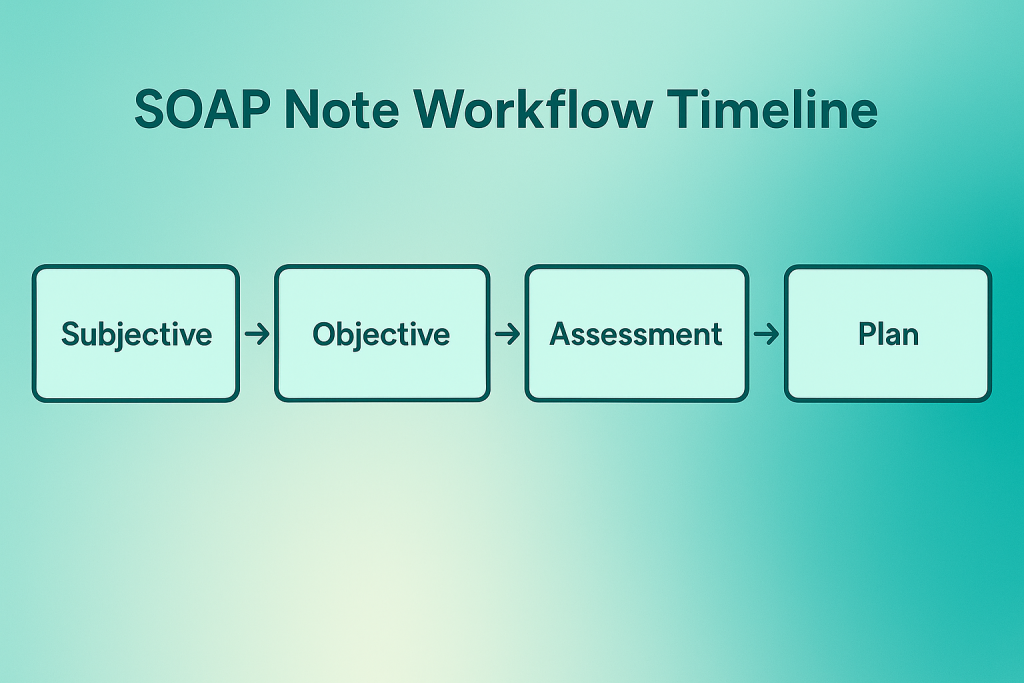
SOAP workflow timeline (visual)
A simple cadence keeps documentation timely: a quick note immediately after session, then a brief end-of-day finalize. This avoids backlogs and improves accuracy.
I coach teams to calendar a single 20–30 minute “finalize block” daily. It’s short enough to be sustainable and long enough to keep charts audit-ready.
Templates & shortcuts
S: Increased anxiety this week; sleep ~5h/night.
O: Affect anxious; GAD-7 = 12; no SI/HI; engaged.
A: GAD, moderate — worsened with work stress.
P: Teach paced breathing; weekly therapy; sleep routine; track anxiety episodes.
S: Themes: isolation, boundary difficulty; members report mixed success with homework.
O: Active participation; peer feedback observed; affect modulation attempts.
A: Improving interpersonal skill use; several members show increased insight.
P: Continue role-play; assign boundary-setting homework; monitor risk individually.
Practical tips that save time (and audits)
- Quick note first, polish later: 2–3 lines immediately post-session; finalize once daily.
- Be specific, not verbose: Keep every sentence tied to diagnosis, progress, or plan.
- Add one direct quote: Authenticates the session and supports medical necessity.
- Track outcomes: Use the same measures payers recognize (PHQ-9, GAD-7); trend them.
- Reuse short templates wisely: Start from a tight pattern, then personalize.
- Document risk precisely: Record statements, context, and safety steps in the chart.
- Schedule a daily “finalize block”: Prevents backlog and improves quality control.
Stop Stressing Over Documentation.
Start Getting Paid.
- Professional Medical Coding & Billing
- Audit-Proof Documentation Templates
- FREE Insurance Credentialing
- FREE TherapyDial Profile Listing
We verify your codes, submit your claims, and fight for your revenue.
HIPAA Compliant & Expertly Managed.
Frequently asked questions
Often two to four short paragraphs. Focus on relevance to diagnosis, progress, and plan. Do not write a novel; keep it strictly clinical.
One short, representative quote is usually enough to increase authenticity and clearly capture the client's subjective state.
Yes, when used. It strengthens the Objective section and clearly shows medical necessity and change over time to insurance payers.
Use structured templates, but avoid cloning the exact same note week over week. Auditors flag repetitive "copy/paste" notes. Ensure each note reflects the unique session.
TherapyDial Editorial Team
Clinical Documentation & Compliance Experts
This guide was developed and reviewed by licensed therapists and compliance officers to ensure accuracy, clarity, and adherence to 2026 insurance and state board standards.