
Pennsylvania is a tale of two markets. Philadelphia anchors the east with one of the densest therapist populations in the country, while Pittsburgh’s growing healthcare ecosystem dominates the west. In between, rural PA faces severe mental health shortages — creating significant opportunity for solo practitioners willing to serve underserved communities via telehealth.
This guide, written by Jason Roy and reviewed by licensed clinicians, walks you through every step of launching a private therapy practice in Pennsylvania — from the Restricted Professional LLC entity requirement to credentialing with Highmark BCBS, UPMC Health Plan, and Independence Blue Cross.
Already exploring other states? See our guides for New York, Texas, California, Florida, and New Jersey.
How Pennsylvania Compares to Other States
| Factor | Pennsylvania | New York | New Jersey | Texas | Florida |
|---|---|---|---|---|---|
| Entity Type | Restricted Prof. LLC | PLLC only | LLC | LLC / PLLC | LLC / PLLC |
| State Income Tax | 3.07% flat | Up to 10.9% | Up to 10.75% | 0% | 0% |
| Supervision Hours | 3,000 | Varies | 4,500 | 3,000 | 1,500 |
| Publication Required | No | Yes (6 weeks) | No | No | No |
| Credentialing Time | 90–120 days | 90–120 days | 90–120 days | 60–120 days | 90–120 days |
| Franchise Tax | None | None | None | Yes (report) | None |
The Complete Pennsylvania Private Practice Roadmap
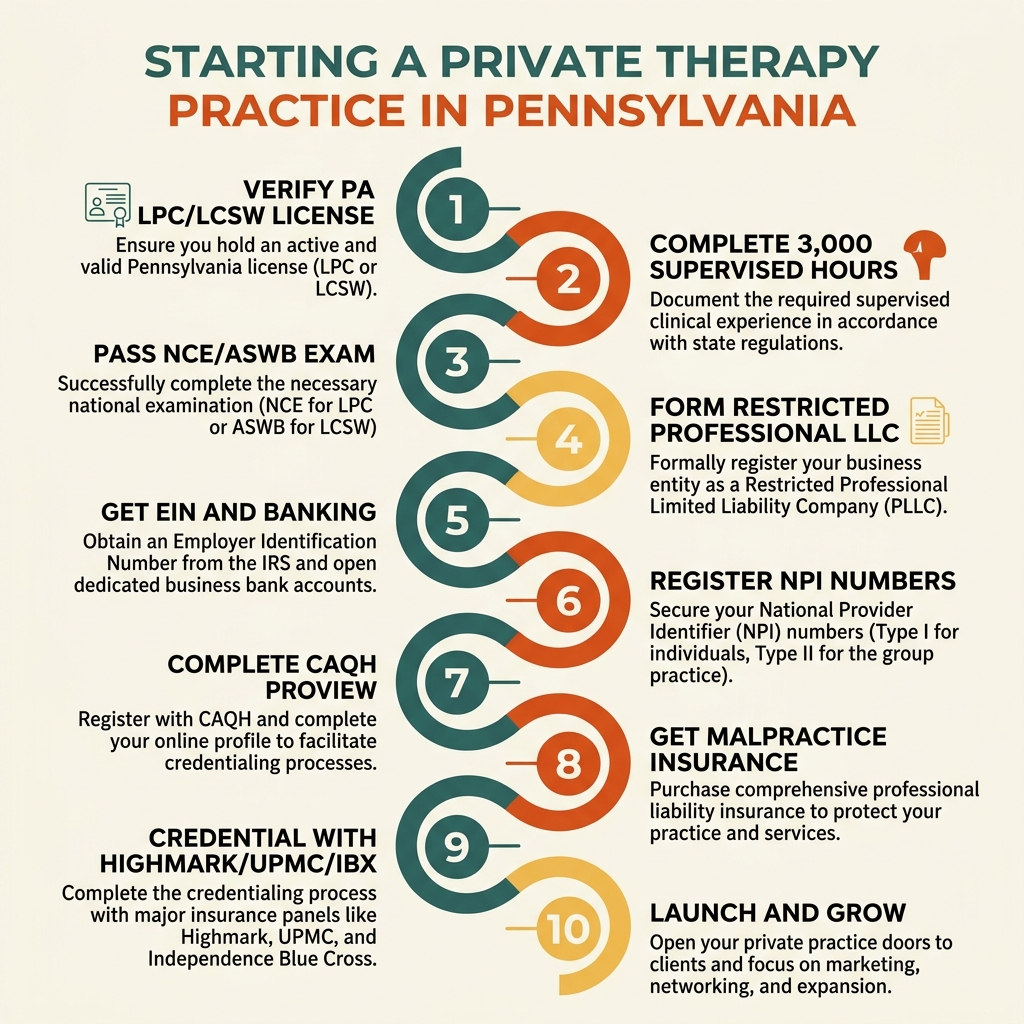
Confirm Your PA License (Or Get Help Obtaining One)
Verify your license is active and unrestricted through PALS (PA Licensing System). You must hold a full independent license — LPC, LCSW, or LMFT — to operate a solo private practice in PA.
Key Point: If you hold a Licensed Associate Professional Counselor (LAPC) credential, you cannot practice independently. You must complete 3,000 supervised hours under an approved supervisor first.
Need a Pennsylvania License?
Whether you’re applying for initial licensure, transferring from another state via endorsement, or navigating the LAPC-to-LPC pathway, we can handle the paperwork and board communications for you.
→ Ask About Our Licensure Assistance ProgramsComplete Your 3,000 Supervised Hours (LAPC to LPC)
As a Licensed Associate Professional Counselor, you must accumulate:
- 3,000 total hours of post-degree supervised clinical experience (master’s level).
- 150 hours of supervision (2 hours of supervision per 40 hours of clinical work).
- At least 50% of supervision must be individual (one-on-one).
- Hours must be completed in no less than 2 years, no more than 6 years.
- At least 1,500 hours must be direct client contact (assessment, therapy, group work).
Supervisor Requirements: Your supervisor must hold an active LPC (or equivalent) with at least 5 years of post-licensure clinical experience within the last 10 years. At least half of your supervision must come from an LPC supervisor specifically.
Pass Your Licensing Exams
CE Requirements: LPCs must complete 30 continuing education hours every two years, including mandatory credits in ethics.
Form Your Restricted Professional LLC
Pennsylvania requires therapists to form a Restricted Professional LLC under 15 Pa. C.S. §§ 8995–8998. This is similar to New York’s PLLC requirement — all members must hold valid professional licenses.
- File a Certificate of Organization with the PA Department of State (~$125).
- Your filing must state it is a “restricted professional company.”
- Designate a physical registered office in PA (no PO boxes).
- File an Annual Registration to keep your LLC active.
No Publication Requirement: Unlike New York, PA does not require newspaper publication, saving you $500–$2,000.
Get Your EIN & Open Business Banking
Apply for a free Employer Identification Number from the IRS at irs.gov. Open a dedicated business checking account. Register with the PA Department of Revenue for state tax obligations.
Register Your NPI Numbers
The National Provider Identifier (NPI) is required for all HIPAA-covered billing.
- NPI Type 1: Your individual clinician ID.
- NPI Type 2: Your LLC’s organizational ID (if applicable).
Register at NPPES. Free, same-day processing.
Complete Your CAQH ProView Profile
CAQH ProView is mandatory for credentialing with both Highmark and UPMC. Grant access to all payers you plan to credential with. Re-attest every 120 days or your claims will freeze.
Secure Malpractice Insurance
Expect $100–$500/year for a solo practitioner policy. Providers like HPSO and CPH & Associates are popular in PA. If you hold dual PA/NJ licenses, confirm your policy covers both states.
Begin Insurance Credentialing
PA’s insurance market is split geographically. You need different panels depending on where your clients are:
- Highmark BCBS — Dominant in western PA (Pittsburgh)
- Independence Blue Cross — Dominant in Philadelphia region
- UPMC Health Plan — Major in Pittsburgh, expanding statewide
- Aetna
- UnitedHealthcare / Optum
- PA Medicaid (HealthChoices)
Expect 90–120 days per panel. While waiting, Alma, Headway, or Grow Therapy can provide faster panel access through their group NPI.
Choose Your Practice Setting
Set Up Your HIPAA-Compliant Tech Stack
SimplePractice or TherapyNotes
Scheduling, billing, telehealth, and HIPAA portal.
Spruce Health
HIPAA-compliant phone, fax, and messaging.
Heidi Health or Upheal
AI-powered notes. Requires a signed BAA.
Essential Clinical Resources:
Lock Down Your Billing Strategy
Accurate medical billing is the lifeline of any insurance-based practice. Key coding resources:
Grow Your Practice with Local SEO
- Google Business Profile: Post weekly, upload photos, respond to reviews.
- Local SEO Strategy: Local SEO for Therapists: How to Be #1.
- Directory Listings: Psychology Today, Zencare, TherapyDen.
Ongoing Compliance
- Annual Registration: File with the PA Department of State annually to keep your LLC active.
- CAQH Attestation: Re-verify every 120 days.
- CE Hours: 30 hours biennially for LPCs (including ethics).
- License Renewal: Biennial via PALS.
- Tax Planning: PA has a flat 3.07% state income tax, but local earned income taxes vary (0.5%–3.88%). Philadelphia residents pay 3.75%. Make quarterly estimated payments to both the IRS and PA Department of Revenue.
Pennsylvania Break-Even Calculator
Estimate how many sessions per week you need to cover PA overhead and hit your income goal. PA state income tax is a flat 3.07%.
Exclusive Provider Bundle:
Licensure + Billing + Growth
- PA Licensure Application Support
- Professional Medical Billing
- FREE Insurance Credentialing (Highmark, UPMC, Aetna)
- FREE TherapyDial Profile Listing
- Priority Practice Support
Whether you need help getting a PA license or managing your claims. We handle the paperwork.
HIPAA Compliant & Expertly Managed.
More State Practice Guides
Building a multi-state practice or considering relocating? Explore our comprehensive guides:
Frequently Asked Questions
No. PA requires therapists to form a Restricted Professional LLC under 15 Pa. C.S. §§ 8995–8998. All members must hold valid professional licenses. Filing costs approximately $125 through the PA Department of State.
3,000 hours of post-degree supervised clinical experience, including 150 hours of supervision. At least 50% of supervision must be individual. Hours must be completed within 2–6 years.
Telehealth-only: $500–$1,500 (LLC filing ~$125, malpractice ~$100–$500/yr, EHR ~$30–$100/mo). Office space in Philadelphia adds $1,200–$2,500/mo; Pittsburgh is $800–$1,800/mo.
The LAPC is PA’s pre-licensure credential. You hold a master’s degree and have passed the NCE, but haven’t completed 3,000 supervised hours. LAPCs cannot operate an independent private practice.
PA has a flat 3.07% state income tax — one of the lowest in the Northeast. However, local earned income taxes vary by municipality (0.5%–3.88%). Philadelphia residents pay an additional 3.75% wage tax.
Yes, but you must hold a valid, active license in each state. Many Philadelphia-area therapists maintain dual PA/NJ licensure to serve clients across the Delaware River. See our NJ Practice Guide for NJ-specific requirements.