New Jersey sits at the crossroads of the largest therapy corridor in the country. Thousands of clinicians hold dual NY/NJ licenses, serving the massive NYC metro population that stretches from Bergen County to Princeton and beyond. Whether you’re building a telehealth-first practice from Hoboken or opening a physical office in Cherry Hill, launching a private therapy practice in NJ offers enormous potential — if you navigate the regulations correctly.
This guide, written by Jason Roy and reviewed by licensed clinicians, walks you through every step. It covers NJ’s unique 4,500-hour supervision requirement for Licensed Associate Counselors, the LLC formation process, NPI registration, and the complete insurance credentialing pipeline.
Already exploring other states? See our sister guides for New York, Texas, California, and Florida.
Why NJ is a Strategic Market: New Jersey ranks among the top 10 states for therapist density per capita, yet demand continues to outpace supply in many specialties. According to SAMHSA, NJ consistently reports high unmet mental health needs, particularly in adolescent services, substance use disorders, and geriatric counseling. For private practitioners, this translates to shorter client waitlists and better negotiating leverage with insurance panels.
Niche Opportunities: The NJ market rewards specialization. Clinicians focused on OCD and anxiety disorders, perinatal mental health, bilingual therapy (particularly Spanish and Korean-speaking communities in North Jersey), and executive burnout coaching for NYC commuters are seeing the fastest practice growth. If you are building your practice from scratch, defining a niche from day one significantly accelerates your referral pipeline and your ability to charge premium private-pay rates.
How New Jersey Compares to Other States
| Factor | New Jersey | New York | Texas | California | Florida |
|---|---|---|---|---|---|
| Entity Type | LLC | PLLC only | LLC / PLLC | Prof. Corp only | LLC / PLLC |
| State Income Tax | Up to 10.75% | Up to 10.9% | 0% | Up to 13.3% | 0% |
| Supervision Hours | 4,500 | Varies | 3,000 | 3,000 | 1,500 |
| Publication Required | No | Yes (6 weeks) | No | No (DBA in paper) | No |
| Credentialing Time | 90–120 days | 90–120 days | 60–120 days | 90–120 days | 90–120 days |
| Franchise Tax | None | None | Yes (report) | $800/yr min | None |
The Complete New Jersey Private Practice Roadmap
Confirm Your NJ License (Or Get Help Obtaining One)
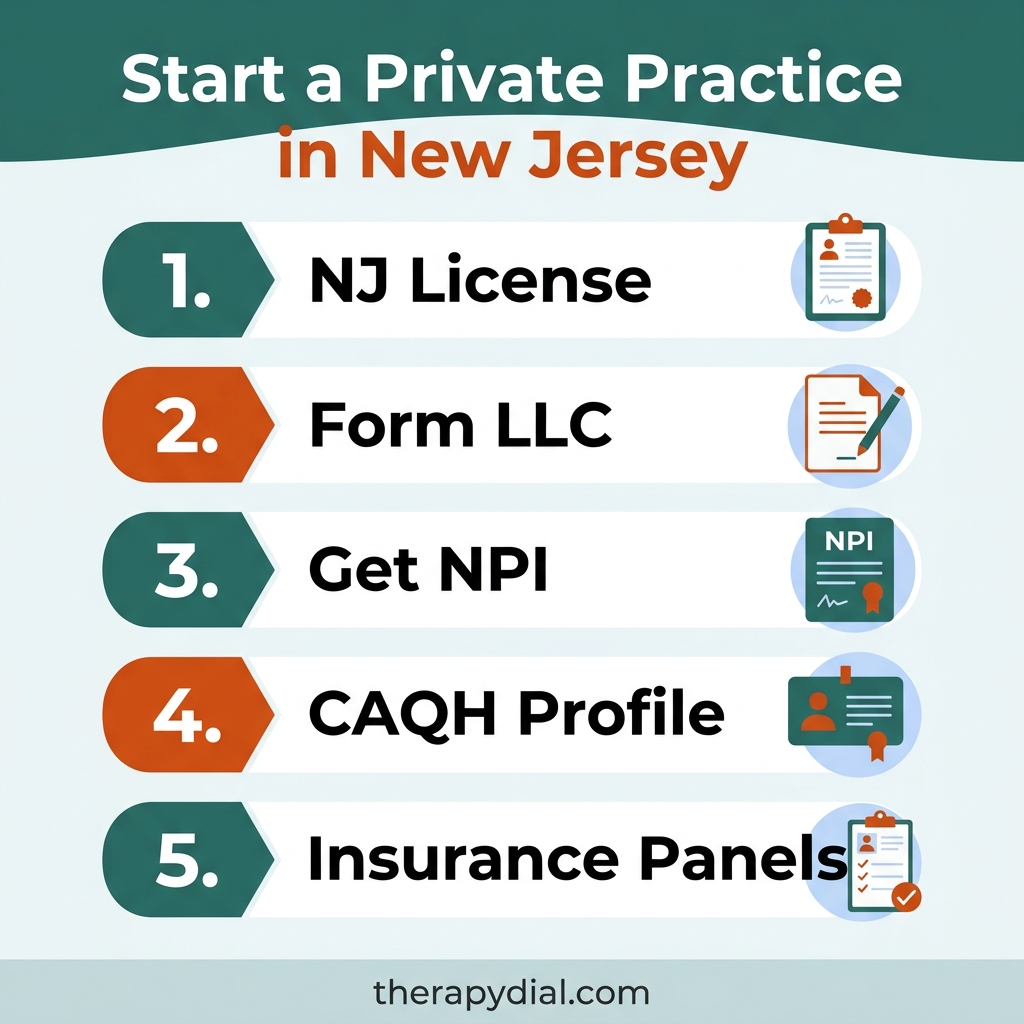
Verify your license is active and unrestricted with the New Jersey Division of Consumer Affairs (DCA). You must hold a full independent license — LPC, LCSW, or LMFT — to operate a solo private practice.
Key Point: If you are a Licensed Associate Counselor (LAC), you cannot practice independently. You must complete 4,500 supervised hours first (see Step 2).
Need a New Jersey License?
Whether you’re applying for initial licensure, transferring from another state via endorsement, or navigating the LAC-to-LPC pathway, we can handle the paperwork and board communications for you.
→ Ask About Our Licensure Assistance ProgramsComplete Your 4,500 Supervised Hours (LAC to LPC)
New Jersey has one of the most rigorous supervision requirements in the country. As a Licensed Associate Counselor, you must accumulate:
- 4,500 total hours of supervised counseling experience.
- At least 1 hour of supervision every two weeks with a board-approved supervisor.
- A minimum of 50% of supervision must be in-person (face-to-face, same room).
- You must document your hours meticulously; the NJ board is known for detailed audits.
For LCSW candidates, requirements are governed by a separate board under the DCA, with similar rigor but different clinical hour breakdowns. LCSW candidates must accumulate supervised clinical social work experience under an approved LCSW supervisor, and the specific hour requirements may differ from LPC expectations. Always verify the exact breakdown for your discipline with the DCA before beginning your post-graduate work.
NJ vs. Other States: For context, Texas requires 3,000 hours, California requires 3,000 hours, and Florida requires only 1,500 hours. NJ’s 4,500-hour requirement is among the highest in the nation, which is why many NJ clinicians pursue dual licensure with New York to expand their client base while completing hours.
Finding a Supervisor: Start your search through the NJCA (New Jersey Counseling Association), NASW-NJ chapter, or university alumni networks. Ask prospective supervisors about their experience with the DCA audit process. A supervisor who already has multiple associates is likely more experienced in navigating the paperwork. Confirm they hold an active, unrestricted NJ license and have completed the required supervisor training before signing any supervision agreement.
Pass Your Licensing Exams
New Jersey requires passing a national clinical examination appropriate to your discipline:
CE Requirements: Once licensed, LPCs must complete 40 continuing education hours every two years, including mandatory credits in ethics and cultural competency.
Choose Your Business Entity (LLC Is Fine in NJ)
Unlike New York (which mandates PLLCs) or California (which bans LLCs entirely), New Jersey allows therapists to form a standard Limited Liability Company (LLC).
No PLLC in NJ: New Jersey does not have a separate “Professional LLC” designation like Texas or Florida. A standard LLC is the correct vehicle for licensed mental health professionals here.
No Publication Requirement: Unlike New York, you do not need to publish your LLC formation in a newspaper, saving you $500–$2,000 in costs.
Get Your EIN & Open Business Banking
Apply for a free Employer Identification Number (EIN) from the IRS at irs.gov. Then open a dedicated business checking account to separate personal and practice finances. You will also need to register with the NJ Division of Taxation for state tax obligations.
Register Your NPI Numbers
The National Provider Identifier (NPI) is required for all HIPAA-covered transactions.
- NPI Type 1: Your individual clinician ID.
- NPI Type 2: Your LLC’s organizational ID (if applicable).
Register at NPPES. Free, same-day processing.
Complete Your CAQH ProView Profile
CAQH ProView is mandatory in NJ for credentialing with commercial payers. Every major insurer in the state — Horizon BCBS NJ, Aetna, UHC — pulls directly from this database.
Critical: You must re-attest every 120 days. If your CAQH lapses, insurance panels will silently freeze your claims and you won’t get paid until you re-attest.
CAQH Pro Tips for NJ Practitioners: Upload your NJ license, malpractice insurance facesheet, NPI confirmation letter, and a complete work history going back at least 5 years. Make sure your practice addresses match exactly between CAQH, your NPI record, and your LLC registration. Even minor discrepancies (e.g., “Ste” vs “Suite”) can trigger delays. Double-check that your taxonomy codes are correct for your license type (e.g., 101YM0800X for Mental Health Counselor). If you hold dual licenses in NJ and NY, list both in your CAQH profile to simplify credentialing for both states simultaneously.
Secure Malpractice Insurance
Professional liability coverage is a prerequisite for credentialing with every commercial panel and for protecting your personal license. Expect to pay $100–$500/year for a solo practitioner policy through providers like HPSO, CPH & Associates, or the NJCA group plan.
If you hold a dual NY/NJ license, confirm your policy covers both jurisdictions.
Begin Insurance Credentialing
The NJ insurance landscape is dominated by one carrier: Horizon Blue Cross Blue Shield of New Jersey. However, you should also credential with national payers for maximum reach. Expect 90–120 days per panel.
- Horizon BCBS NJ — The dominant payer in the state
- Aetna
- UnitedHealthcare / Optum
- Cigna
- AmeriHealth NJ
- NJ Medicaid (NJ FamilyCare)
While credentialing processes, consider using Alma, Headway, or Grow Therapy for faster panel access through their group NPI. This lets you start seeing insured clients within weeks instead of months, though you will typically accept their negotiated rate rather than your own.
Horizon BCBS NJ Specifics: Horizon is the largest health insurer in New Jersey, covering roughly 3.5 million members. Getting credentialed with Horizon should be your absolute first priority. Their reimbursement rates for individual psychotherapy (90837) typically range from $120–$145 depending on your contract. Unlike some national payers, Horizon may require additional NJ-specific documentation during credentialing, including proof of your LLC registration with the state. Plan for a 90–120-day timeline from the date your CAQH profile is complete.
Choose Your Practice Setting
NJ’s geography gives you flexibility, and each setup comes with distinct regulatory and financial considerations:
Dual-State Advantage: Many NJ therapists also hold a NY license. If you see NYC-based clients via telehealth, you must hold a valid NY license for those sessions. Our NY Practice Guide covers the PLLC requirements for that side.
Hybrid Model: Many successful NJ solo practitioners operate a hybrid model — subletting a physical office 2 days per week for in-person clients while conducting telehealth sessions for the remainder. This approach maximizes your geographic reach while keeping overhead manageable. Track your in-office versus virtual sessions separately for tax deduction purposes, as home office deductions have specific IRS requirements.
Set Up Your HIPAA-Compliant Tech Stack
SimplePractice or TherapyNotes
Integrated scheduling, billing, telehealth, and HIPAA portal.
Spruce Health
HIPAA-compliant phone, fax, and messaging.
Heidi Health or Upheal
AI-powered SOAP notes. Requires a signed BAA.
Essential Clinical Resources:
Lock Down Your Billing Strategy
Accurate medical billing is the lifeline of any insurance-based practice. A dedicated biller handles claim submissions, denial follow-ups, and coding corrections using codes like CPT 99203.
→ Learn more about our Billing ServicesNJ Medicaid (NJ FamilyCare): If you plan to see Medicaid clients, you must enroll as a provider through the NJ Division of Medical Assistance and Health Services (DMAHS). This is a separate process from commercial credentialing and involves PECOS enrollment if you also accept Medicare. Reimbursement rates are lower than commercial panels, but the volume of eligible clients in NJ — particularly in urban areas like Newark, Camden, and Trenton — can make it a viable revenue stream for new practices.
Out-of-Network (OON) Strategy: Some NJ therapists choose to remain OON, charging private-pay rates and providing superbills for client reimbursement. This is common in affluent North Jersey suburbs where clients are willing to pay higher session fees for premium access. If you go this route, transparency about costs during intake is critical for client retention.
Grow Your Practice with Local SEO
NJ is saturated near NYC but underserved in Central and South Jersey. Your growth strategy must be digital-first:
- Google Business Profile: The #1 ranking signal for local therapy searches. Post weekly, upload office photos, and respond to every review.
- Local SEO Strategy: Learn the exact tactics top therapists use to dominate local search: Local SEO for Therapists: How to Be #1.
- Directory Listings: Psychology Today, Zencare, Open Path Collective, and TherapyDen.
- Dual-State SEO: If you serve both NJ and NY clients, create separate Google Business Profile listings for each state of practice.
Ongoing Compliance & Maintenance
Maintaining a private practice in NJ is not a “set it and forget it” operation. Failure to meet any of the following deadlines can result in suspended billing, lapsed licensure, or even board investigations:
- NJ Annual Report: File an annual report with the NJ Division of Revenue to keep your LLC in “active” status. The fee is approximately $75, due each year. Missing this causes your LLC to be flagged as “revoked” on Sunbiz, which can disrupt bank accounts and insurance panel status.
- CAQH Attestation: Re-verify every 120 days without fail. Set a recurring calendar reminder 2 weeks before your attestation window closes. Many practitioners lose active panel status simply because they ignored the email reminder.
- CE Hours: 40 hours biennially for LPCs, including mandatory credits in ethics (minimum 3 hours) and cultural competency (minimum 3 hours). The DCA uses CE Broker for tracking in some cases, but always maintain your own records as backup.
- License Renewal: NJ licenses renew biennially through the DCA portal. Start the process 90 days before expiration. Do not practice for a single day on an expired license — this is a board violation that can trigger formal investigation.
- Malpractice Renewal: Annual renewal; confirm dual-state coverage if you hold both NJ and NY licenses. Your insurer must be notified of all jurisdictions in which you practice.
- Tax Planning: NJ has a progressive state income tax (up to 10.75% for high earners). As a solo practitioner, you should make quarterly estimated tax payments to both the IRS and NJ Division of Taxation. Consider working with a CPA familiar with healthcare professionals to maximize deductions for home office, EHR subscriptions, CE costs, malpractice premiums, and professional association dues.
Pro-Tip: Bookmark this guide for your next credentialing cycle.
New Jersey Break-Even Calculator
Estimate how many sessions per week you need to cover NJ overhead and hit your income goal. NJ has a state income tax of up to 10.75%.
Understanding New Jersey’s Practice Economics
New Jersey occupies a unique economic position for therapists. It has one of the highest costs of living in the country, driven primarily by proximity to NYC, property taxes, and the overall expense of operating a business in the Garden State. However, it also has some of the highest average session rates nationally, making it a high-revenue market when managed correctly.
Average Session Rates in NJ: In-network reimbursement for a 60-minute psychotherapy session (CPT 90837) in NJ typically ranges from $110–$160 depending on the payer. Out-of-network private-pay rates in affluent areas like Bergen County, Morris County, and parts of Somerset can reach $175–$250 per session. Understanding these numbers is essential for accurately using the break-even calculator above.
Property Tax Consideration: If you are considering a home office in NJ, be aware that NJ has the highest effective property tax rate in the nation. A home office deduction can partially offset this burden, but you must meet IRS requirements for “regular and exclusive use.” Keep meticulous records of your dedicated workspace square footage relative to total home size.
NJ Health Insurance for Self-Employed: As a self-employed practice owner, you are responsible for your own health insurance. NJ operates its own state-based health insurance marketplace (GetCoveredNJ). The self-employed health insurance deduction allows you to deduct 100% of your premiums from your gross income on your federal tax return, which can significantly reduce your effective tax rate.
Extended Clinical & Coding Resources
Stay ahead of mental health trends and master your diagnostic accuracy with our comprehensive guides:
Exclusive Provider Bundle:
Licensure + Billing + Growth
- NJ Licensure Application Support
- Professional Medical Billing
- FREE Insurance Credentialing (UHC, BCBS, Aetna)
- FREE TherapyDial Profile Listing
- Priority Practice Support
Whether you need help getting a NJ license or managing your claims. We handle the paperwork.
HIPAA Compliant & Expertly Managed.
More State Practice Guides
Building a multi-state practice or considering relocating? Explore our comprehensive guides:
Frequently Asked Questions
Yes. Unlike New York (PLLC only) or California (Professional Corporation only), New Jersey allows licensed therapists to form a standard LLC. There is no separate “PLLC” designation in NJ. Filing an LLC costs approximately $125 through the NJ Division of Revenue.
New Jersey requires 4,500 hours of supervised counseling experience. You must receive at least 1 hour of supervision every two weeks, with a minimum of 50% conducted in-person. This is among the highest supervision requirements in the US.
For a telehealth-only practice, expect $500–$1,500 in startup costs (LLC filing ~$125, malpractice ~$100–$500/yr, EHR ~$30–$100/mo). A physical office in North NJ adds $1,500–$3,000/month in rent. NJ has no franchise tax like California.
Yes, but you must hold a valid, active license in each state. For NJ clients (physically located in NJ), you use your NJ license. For NY clients, you use your NY license pursuant to a PLLC. Many NYC metro therapists maintain dual licensure to maximize their client pool.
No. Unlike New York, which requires a 6-week newspaper publication for PLLCs, New Jersey has no such publication requirement, saving you $500–$2,000 upfront.
Start with Horizon BCBS NJ (the dominant payer), then Aetna, UHC/Optum, Cigna, and AmeriHealth simultaneously. Credentialing takes 90–120 days per panel.
An LAC is a pre-licensure status in NJ. You hold your master’s degree and have passed the national exam, but have not yet completed the 4,500 supervised hours needed for full LPC status. LACs cannot operate independent private practices.