
Obsessive-Compulsive Disorder (OCD) is often misunderstood in popular culture as a simple preference for neatness or order. In clinical reality, OCD is a challenging, cyclic condition of the nervous system. It centers around persistent, unwanted thoughts, images, or urges (obsessions) that trigger intense anxiety, and the repetitive physical or mental actions (compulsions) performed to temporarily soothe that distress. This repetitive loop can feel exhausting, but it is a highly treatable pattern of the brain’s threat-detection system, not a personal failing or lack of willpower.
This free screening assessment is adapted from the gold-standard Yale-Brown Obsessive Compulsive Scale (Y-BOCS), the clinical benchmark used worldwide by psychologists and psychiatrists. It evaluates 10 key elements of obsessive-compulsive cycles over the **past week**, tracking the time spent, interference levels, distress, resistance effort, and actual control you experience. It is fully confidential, takes under 2 minutes, and provides immediate patient-centric scoring and helpful next steps.
OCD Screening (Y-BOCS Self-Assessment)
Evaluate your symptoms over the past week using the clinically adapted Y-BOCS obsessive-compulsive screening standard. 100% confidential and secure.
Clinical Interpretation
💬 Connect with an OCD & ERP Specialist
Breaking obsessive-compulsive loops is highly achievable with the right support. Schedule a free, 100% confidential consultation with a licensed specialist to discuss your screening and recovery path.
Book Free Consultation →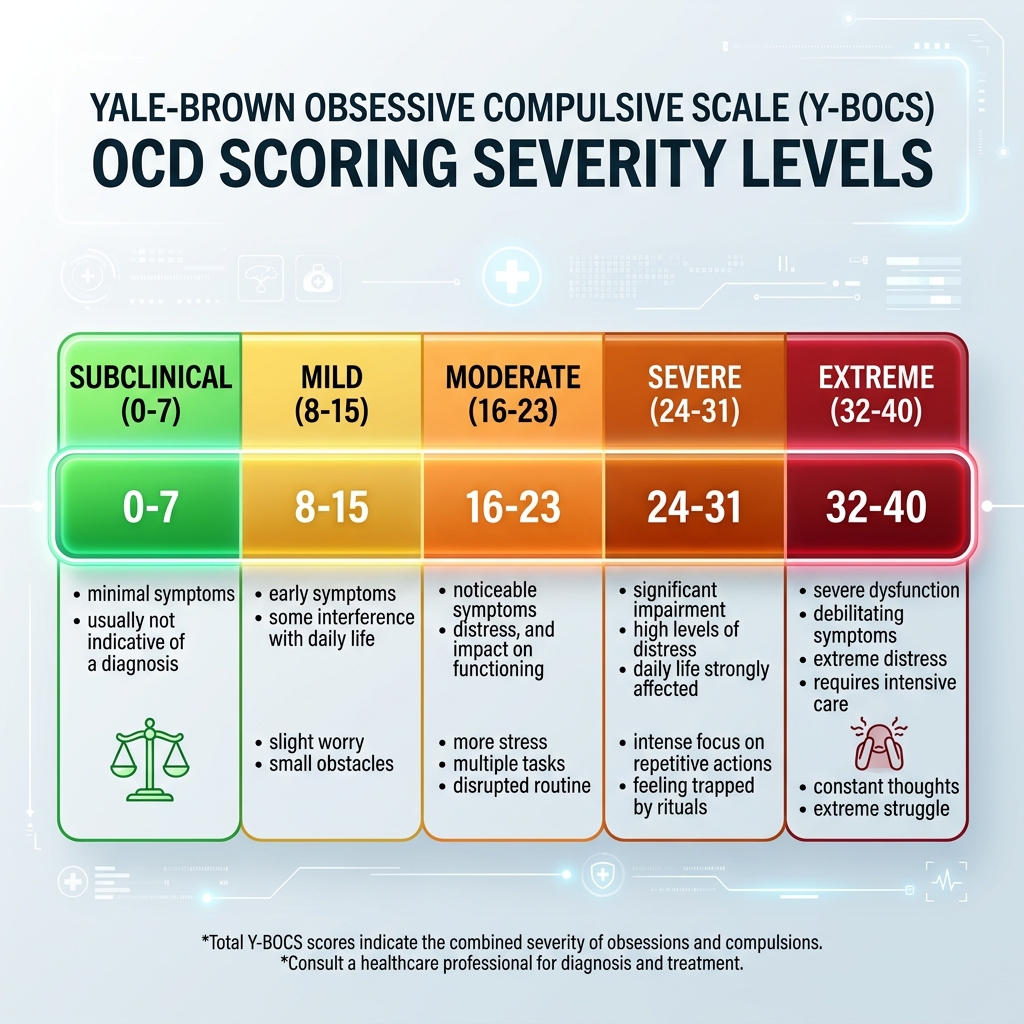
Understanding Your Y-BOCS Score
The Yale-Brown Obsessive Compulsive Scale (Y-BOCS) cumulative score, ranging from 0 to 40, acts as the primary clinical standard to assess symptom severity. Here is how your score fits clinical diagnostic categories:
- Subclinical OCD (0–7): Responses reflect typical protective habits. Active obsessive-compulsive symptoms are not currently indicated.
- Mild OCD (8–15): Intrusive thoughts or repetitive habits are present but generate manageable, low-level background distress.
- Moderate OCD (16–23): Obsessive thoughts and compulsions are consuming noticeable energy and beginning to interfere with daily life or relationships.
- Severe OCD (24–31): Symptoms cause significant distress, disrupting sleep, work, or social connections. Proactive professional care is recommended.
- Extreme OCD (32–40): Obsessive cycles cause near-constant, disabling distress, severely restricting daily activities. Specialized clinical support is strongly advised.
Remember that a screening tool is an indicator, not an official clinical diagnosis. A comprehensive clinical interview is required by a licensed mental health specialist. If your score sits in the moderate or higher range, please know that obsessive-compulsive loops are highly responsive to evidence-based therapeutic modalities, including CBT and Exposure and Response Prevention (ERP).
Actionable Calming and Redirection Skills
When obsessive thoughts trigger your nervous system, performing immediate containment exercises can help you anchor back in the present moment. Try these specialized tools:
- The 4-Step Cognitive Redirection: First, **Relabel** the thought (“This is just an intrusive thought”). Second, **Reattribute** the cause (“My brain’s alarm system is temporarily misfiring”). Third, **Refocus** on a constructive, sensory task for 5 minutes. Fourth, **Revalue** the thought as meaningless background noise.
- Somatic Alarm Containment: When anxiety urges you to perform a ritual immediately, practice **Exposure and Response Prevention (ERP)** in mini-steps. Choose to delay performing the compulsion for just 2 minutes while taking slow, paced exhales. This retrains your brain to realize the distress will peak and decline naturally without the ritual.
- Professional ERP Therapy: Self-guided pacing helps, but OCD loops are highly structured. Partnering with a specialist trained in Exposure and Response Prevention (ERP) offers a secure, structured container to process and break these neural loops permanently.
Explore Additional Assessments
Anxiety Screening
GAD-7 Assessment
😔Depression Screening
PHQ-9 Assessment
🧠PTSD Screening
PCL-5 Assessment
Professional Trauma & Practice Resources
📖 Repressed Emotions Guide
Explore how emotional suppression impacts physical health and stress storage.
Learn to Release →💡 Modalities Compared
Learn the core differences between CBT, DBT, EMDR, and Psychodynamic therapy.
Compare Modalities →🧠 CBT Exercises for Anxiety
Five actionable Cognitive Behavioral Therapy exercises you can try at home tonight.
Explore CBT Skills →📖 Big Five Neuroticism Test
Take our 5-minute big five neuroticism self-assessment to map emotional reactivity.
Take Personality Test →Let’s Help You Step Out of the Loop.
Obsessive-compulsive cycles can feel incredibly draining, but you do not have to navigate this alone. Book a free, 100% confidential consultation with a licensed ERP and CBT specialist to discuss your screening results and options.
Email Us
info@therapydial.comResponse Time
Within 24 hours, guaranteed
100% Confidential
HIPAA-compliant communications
Frequently Asked Questions
The Y-BOCS (Yale-Brown Obsessive Compulsive Scale) is a validated 10-item self-report questionnaire designed to screen for OCD symptoms. It assesses four clusters: time spent, interference, distress, resistance effort, and control.
No. A high score indicates elevated obsessive-compulsive symptoms but is not a diagnosis. Diagnosing OCD requires a comprehensive clinical interview and assessment by a licensed mental health professional.
The Y-BOCS features 10 items rated from 0 (None) to 4 (Extreme/Incapacitating) based on the past week. The ratings are summed to calculate a total score between 0 and 40.
Cognitive Behavioral Therapy (CBT) combined with Exposure and Response Prevention (ERP) is the clinical gold standard. ERP involves safely exposing yourself to thoughts and consciously choosing to delay or prevent rituals, which retrains the amygdala.
Yes. The screening runs entirely in your browser. Your answers are private, never stored or transmitted, and are completely cleared when you refresh the page.
💬 Obsessive thoughts or repetitive rituals keeping you stuck? Talk confidentially to a specialist.
Book Free ConsultationThis screening is based on the Yale-Brown Obsessive Compulsive Scale (Y-BOCS), the most widely validated OCD assessment tool used by clinicians worldwide. However, it is a self-report screening — not a clinical diagnosis. Results can suggest the presence and severity of OCD symptoms but cannot replace a formal evaluation by a licensed mental health professional. Factors like reading comprehension, current stress, and symptom fluctuation can affect scores.
Y-BOCS adapted scores are typically interpreted as follows: 0–7 = Subclinical (minimal or no OCD symptoms); 8–15 = Mild OCD; 16–23 = Moderate OCD; 24–31 = Severe OCD; 32+ = Extreme OCD. If your score falls in the moderate-to-severe range, speaking with a therapist who specializes in OCD and Exposure and Response Prevention (ERP) is strongly recommended.
Anxiety and OCD share features like excessive worry and avoidance, but OCD is defined by two core components: obsessions (intrusive, unwanted thoughts, images, or urges) and compulsions (repetitive behaviors or mental acts performed to reduce distress). Generalized anxiety tends to be diffuse; OCD anxiety is triggered specifically by obsessional content. Treatment also differs — OCD responds best to ERP (Exposure and Response Prevention), while generalized anxiety is more broadly treated with CBT and medication.