
Attachment theory reveals that the way we bond with caregivers in our early years forms a foundational blueprint for how we navigate adult relationships. These established patterns shape how we perceive intimacy, interpret our partner’s behaviors, and regulate our own emotions during conflict. Rather than viewing insecure attachment as a permanent character flaw, psychology understands it as a highly adaptive survival strategy learned early in life—a strategy that can be compassionately unlearned and restructured through conscious effort and somatic awareness.
This free, confidential assessment is adapted from the clinical gold standard, the **Experiences in Close Relationships-Revised (ECR-R)** questionnaire. It dynamically maps your relational patterns across two critical dimensions: **Attachment Anxiety** (fear of rejection or abandonment) and **Attachment Avoidance** (discomfort with emotional closeness or dependence). By understanding where you fall within these four key quadrants, you can begin the transformative process of earning a secure attachment style. This quiz takes approximately 2 minutes to complete.
Attachment Style Assessment (ECR-R)
Evaluate your relational patterns regarding intimacy, vulnerability, and fear of abandonment. 100% confidential and secure.
Clinical Interpretation
💬 Speak with a Relationship Therapist
Healing your attachment style is entirely possible. Book a free, 100% confidential consultation with a licensed specialist to discuss your relationship patterns and learn secure attachment skills.
Book Free Consultation →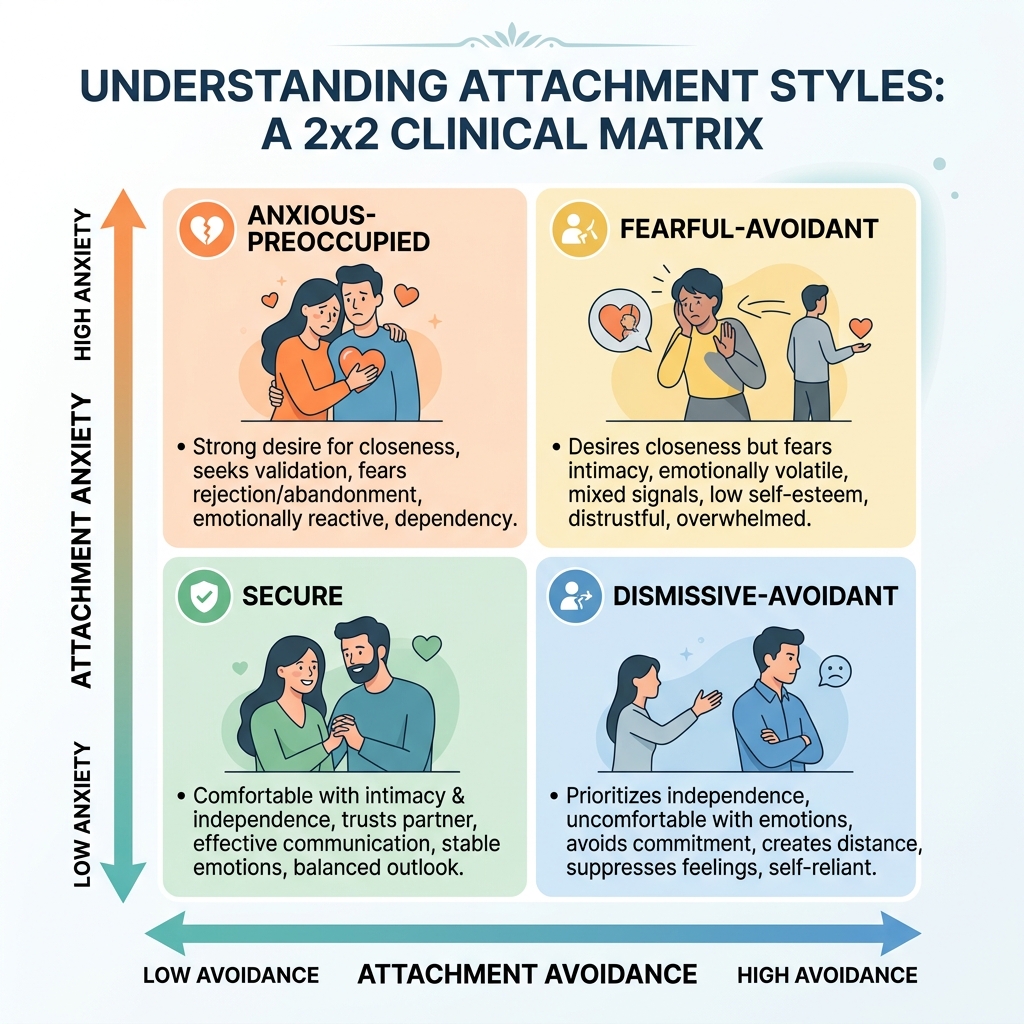
Understanding the Attachment Matrix
Rather than using a single linear score, clinical psychology evaluates adult attachment across two intersecting dimensions: Anxiety and Avoidance. How you score on these two axes places you into one of four clinically recognized quadrants:
- Secure Attachment (Low Anxiety, Low Avoidance): You are generally comfortable with intimacy and do not fear abandonment. You can depend on others and allow them to depend on you, maintaining healthy emotional boundaries.
- Anxious-Preoccupied Attachment (High Anxiety, Low Avoidance): You intensely desire emotional closeness but often harbor deep fears that your partner does not reciprocate your feelings. You may seek constant reassurance and struggle with self-soothing during conflict.
- Dismissive-Avoidant Attachment (Low Anxiety, High Avoidance): You highly value your independence and self-sufficiency, often equating vulnerability with weakness. You may emotionally distance yourself when relationships demand deeper intimacy.
- Fearful-Avoidant Attachment (High Anxiety, High Avoidance): Often rooted in unresolved trauma, you deeply crave connection but are simultaneously terrified of it. This creates a push-pull dynamic where intimacy feels unsafe and overwhelming.
It is vital to remember that an insecure attachment style is simply an adaptive neurological response to early life environments. It is not permanent. Through targeted therapies like Cognitive Behavioral Therapy (CBT), somatic grounding, and working with a trauma-informed counselor, individuals can actively rewire these pathways to achieve “earned secure attachment.”
Actionable Relational Coping Skills
Regardless of your attachment style, emotional triggers in relationships activate the autonomic nervous system. Implementing conscious, somatic interventions can prevent a spiral into reactive behaviors:
- The 90-Second Rule for Anxious Triggers: When you feel an intense urge to seek immediate reassurance (e.g., double-texting), your sympathetic nervous system is flooded. Commit to waiting exactly 90 seconds. Focus entirely on the physical sensation of your feet on the floor. Allowing the initial cortisol wave to pass helps you choose a secure response rather than a reactive one.
- De-Escalation for Avoidant Triggers: When your instinct is to completely withdraw or stonewall during emotional intimacy, practice stating a boundary instead of disappearing. Say, “I am feeling overwhelmed right now and need 30 minutes to process, but I will come back to discuss this.” This protects your need for space while preventing your partner’s abandonment anxiety.
- Cultivating Earned Security: True secure attachment is built by repeatedly experiencing safe, consistent repairs after a rupture. A licensed relational therapist provides a neutral, secure container where you can practice vulnerability, assert boundaries, and safely rewrite your attachment scripts.
Explore Additional Mental Health Screenings
Anxiety Screening
GAD-7 Assessment
😔Depression Screening
PHQ-9 Assessment
🔋Burnout Assessment
MBI Adapted
Professional Support & Practice Guides
📖 Repressed Emotions Guide
Explore how emotional suppression impacts physical health and stress storage.
Learn to Release →💡 Modalities Compared
Learn the core differences between CBT, DBT, EMDR, and Psychodynamic therapy.
Compare Modalities →🧠 CBT Exercises for Anxiety
Five actionable Cognitive Behavioral Therapy exercises you can try at home tonight.
Explore CBT Skills →📖 Big Five Neuroticism Test
Take our 5-minute big five neuroticism self-assessment to map emotional reactivity.
Take Personality Test →Let’s Help You Build Secure Connections.
Navigating attachment triggers and relationship anxiety can feel exhausting, but you do not have to do it alone. Book a free, 100% confidential consultation with a licensed relational specialist to discuss your attachment style and outline a path toward earned security.
Email Us
info@therapydial.comResponse Time
Within 24 hours, guaranteed
100% Confidential
HIPAA-compliant communications
Frequently Asked Questions
The Experiences in Close Relationships-Revised (ECR-R) is the leading psychological instrument used to measure adult attachment. It assesses an individual’s relational patterns across two primary dimensions: attachment-related anxiety and attachment-related avoidance.
Yes. Attachment styles are completely malleable. Through conscious self-awareness, secure relationships, and modalities like CBT or somatic therapy, individuals with insecure patterns can develop what psychologists refer to as “earned secure attachment.”
Your responses are split into two categories: Anxiety and Avoidance. Each category yields a score from 0 to 20. Your combination of these two scores places you into one of the four main attachment quadrants (Secure, Anxious, Dismissive, or Fearful).
Also known as Disorganized attachment, this style scores high in both anxiety and avoidance. It frequently stems from unresolved childhood trauma, causing the person to simultaneously crave deep emotional closeness while being fundamentally terrified of it.
Absolutely. The scoring algorithm runs entirely on your local browser. No data from this quiz is collected, stored, or transmitted to any server. Your privacy is 100% protected.
💬 Notice a painful pattern in your relationships? Let’s discuss a healthy path forward.
Book Free Consultation