
How to Start a Private Therapy Practice
- Obtain Clinical License — Secure your LCSW, LMFT, LPC, or PsyD license from your state regulatory board.
- Apply for NPIs — Register on the NPPES portal for your individual Type 1 and organizational Type 2 National Provider Identifiers.
- Establish a Legal Entity — Form an LLC or PLLC and obtain an IRS Employer Identification Number (EIN).
- Acquire Insurance — Purchase professional malpractice liability coverage through carriers like CPH & Associates or HPSO.
- Set Up CAQH ProView — Complete and attest your profile to centralize your credentialing data for commercial payers.
- Initiate Credentialing — Apply to join payer networks like Aetna, UnitedHealthcare/Optum, and Cigna/Evernorth.
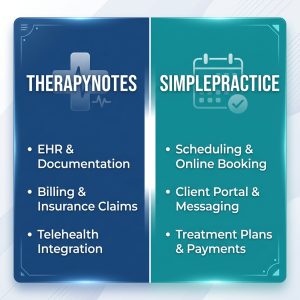
- Select an EHR — Implement HIPAA-compliant software such as SimplePractice or TherapyNotes for clinical documentation.
- Establish Billing — Hire a medical biller or setup a clearinghouse to manage CMS-1500 claims and CPT coding accurately.
Frequently Asked Questions
Starting a private therapy practice typically costs between $1,000 and $3,000. Key expenses include forming an LLC or PLLC, obtaining malpractice insurance (e.g., through CPH & Associates), securing a professional business address, and subscribing to a HIPAA-compliant EHR like SimplePractice or TherapyNotes. Telehealth-only practices generally fall on the lower end of this spectrum due to reduced overhead.
While you can operate as a Sole Proprietor, forming a Professional Limited Liability Company (PLLC) or an LLC (depending on your state board regulations) is highly recommended. A formalized business entity protects your personal assets, allows you to obtain an Employer Identification Number (EIN) for tax purposes, and is required to apply for a Type 2 NPI via the NPPES portal.
The insurance credentialing process typically takes 90 to 120 days from the time your application is submitted. Delays are common if your CAQH ProView profile is incomplete or if your state license and DEA registration (if applicable) are not current. Contracting with major payers like UnitedHealthcare/Optum or Cigna/Evernorth requires patience and rigorous follow-up.
For a newly established private practice, all-in-one platforms like SimplePractice, TherapyNotes, or TheraNest are highly rated. These systems provide HIPAA-compliant telehealth portals, integrated clearinghouses like Waystar or Availity for submitting CMS-1500 claims, and patient scheduling tools, significantly reducing your administrative burden.
Yes, if you operate as an LLC, PLLC, or S-Corp, you must obtain a Type 2 NPI for your organization in addition to your individual Type 1 NPI. Insurance payers, such as Aetna and Anthem Blue Cross, require both identifiers on claims (e.g., CPT 90837 for a 60-minute psychotherapy session) to properly route payments to your business rather than to you as an individual.
Starting a private therapy practice offers unparalleled clinical freedom: you dictate your ideal clientele, manage your own schedule, and retain complete control over your therapeutic values. However, transitioning from an agency or group setting into full-time business ownership requires navigating a complex web of legal formations, credentialing portals, and revenue cycle mechanics.
Whether you are establishing a fully virtual telehealth clinic or a brick-and-mortar office, laying a compliant foundation is non-negotiable. Without proper business structuring and accurate data across national registries like NPPES and CAQH, you risk massive delays when contracting with commercial insurance networks.
This ultimate 2026 roadmap outlines the exact administrative, legal, and financial steps to build a compliant, highly profitable private practice from the ground up.
The 12-Step Practice Setup Roadmap
Secure Your State Clinical License
Your state license is the absolute prerequisite for independent practice. Whether you are an LCSW, LMFT, LPC, or Psychologist, your state’s regulatory board defines your scope of practice. Nothing can proceed—especially insurance credentialing—without an active, unrestricted, independent-level clinical license.
Pro Tip: Out-of-State Expansion
If you plan to offer telehealth across state lines, you must comply with the licensing requirements of the state where the patient resides during the session.
Form Your Business Entity & Obtain an EIN
Establish a legal business structure to protect your personal assets. Depending on your state’s regulations, mental health professionals typically form a Professional Limited Liability Company (PLLC) or an LLC. Once filed, register with the IRS to obtain your free Employer Identification Number (EIN).
Your EIN will be used on all tax documents and payer contracts, ensuring you do not have to use your personal Social Security Number for business transactions.
Apply for Your Type 1 & Type 2 NPIs
Navigate to the NPPES registry to secure your National Provider Identifiers. You will need a Type 1 NPI for yourself as an individual provider, and a Type 2 NPI for your newly formed LLC or PLLC.
Insurance payers require both NPIs on your CMS-1500 claim forms to correctly process reimbursements for standard billing codes like CPT 90834 and 90837.
Secure Malpractice Liability Insurance
You must obtain professional malpractice insurance that covers both your individual license and your business entity. Carriers such as CPH & Associates, HPSO, or The Trust offer robust policies for behavioral health providers.
Your malpractice policy declaration page is a mandatory upload for CAQH and nearly every payer credentialing application.
Establish a HIPAA-Compliant Office Setup
Insurance panels require a professional service address—using your home address poses privacy and safety risks. If you are running a telehealth-only practice, secure a verifiable virtual office address (such as Regus or iPostal1) that provides a physical location for credentialing.
Additionally, implement a HIPAA-compliant phone and fax system like Spruce Health, RingCentral, or Google Voice for Workspace.
Apply for a DEA Number (Prescribers Only)
If you are a Psychiatrist or PMHNP planning to prescribe controlled substances, you must obtain a federal DEA registration. In addition, verify if your specific state requires a separate Controlled Dangerous Substances (CDS) permit to prescribe legally.
Set Up Your CAQH ProView Profile
The Council for Affordable Quality Healthcare (CAQH) acts as a centralized data repository for your credentials. You must create a CAQH ProView profile, upload your resume (with month/year dates strictly formatted), state license, malpractice policy, and W-9.
Critical Maintenance
You must re-attest your CAQH profile every 120 days. Failure to do so can result in immediate suspension from commercial payer networks.
Initiate Insurance Credentialing
Begin applying to commercial insurance panels such as Aetna, Cigna/Evernorth, UnitedHealthcare/Optum, and your local Blue Cross Blue Shield franchise. The credentialing and contracting phase generally takes 90–120 days, so start this process immediately after your CAQH profile is complete.
Select an EHR System
Choose an Electronic Health Record (EHR) platform to manage scheduling, telehealth sessions, and clinical documentation. Popular choices for behavioral health include SimplePractice, TherapyNotes, and Spruce Health.
Ensure your chosen platform can easily integrate with clearinghouses like Availity or Waystar for streamlined claim submission.
Optimize Clinical Documentation & Coding
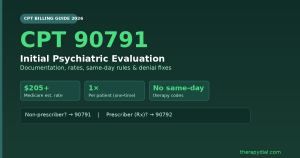
Master the primary DSM-5 diagnoses and their corresponding ICD-10-CM codes. Familiarize yourself with standard psychiatric CPT codes (e.g., 90791 for intake, 90837 for 60-minute therapy, 90847 for family therapy). Accurate coding ensures your documentation holds up during routine payer audits.
Establish Revenue Cycle Management (RCM)
Cash flow is the lifeblood of your private practice. Set up integrated Electronic Funds Transfer (EFT) and Electronic Remittance Advice (ERA) to receive direct deposits from payers. Consider hiring a dedicated medical biller to handle claim rejections, verify patient eligibility, and minimize uncollected revenue.
Launch and Market Your Practice
With your business registered, software implemented, and payer contracts finalized, you are ready to see patients. Build a professional website, optimize your practice profile, and network with local primary care physicians and psychiatrists to establish a robust referral pipeline.
Need More Clinical & Practice Resources?
Explore our targeted guides to ensure your practice documentation and billing processes are fully compliant with standard regulations.
Clinical Documentation
Master the art of bulletproof documentation to avoid payer clawbacks. Read up on standard SOAP notes, treatment planning, and intake assessments.
Medical Billing Fundamentals
Ensure you are maximizing your revenue by understanding modifiers, accurate ICD-10-CM pairing, and navigating clearinghouse rejections effectively.
Launch Your Practice Stress-Free
Stop struggling with CAQH portals and NPPES errors. Our experts handle the administrative burden so you can focus purely on patient care.
Everything you need to get paneled and paid
- Professional Medical Billing
- FREE Insurance Credentialing
- FREE TherapyDial Profile Listing
- Priority Practice Support