Massachusetts Licensure for Private Practice Therapists
To practice independently in Massachusetts, you must hold the appropriate license from the MA Board of Registration of Allied Mental Health Professionals or the relevant licensing board for your credential:
- LICSW (Licensed Independent Clinical Social Worker): The highest-tier social work license in Massachusetts. Issued by the MA Board of Registration of Social Workers. Requires 2+ years of post-MSW supervised clinical experience and independent practice competency.
- LMHC (Licensed Mental Health Counselor): Massachusetts does license LMHCs (unlike some states). Requires 3,000 post-master's supervised hours. Issued by the Board of Registration of Allied Mental Health Professionals.
- LMFT (Licensed Marriage and Family Therapist): Licensed by MA Board of Allied Mental Health. Requires 1,500 supervised client contact hours post-degree.
- Psychologist (PhD / PsyD): Licensed by the MA Board of Registration of Psychologists. Independent practice requires a doctoral degree plus supervised experience.
Boston-area note: Boston-area therapists face a competitive credentialing market. Major payers — Tufts Health Plan, Harvard Pilgrim (now Point32Health), and BCBS of Massachusetts — each have separate credentialing processes and can have waitlists.
Massachusetts PLLC vs LLC for Therapists
Unlike California, Massachusetts gives therapists flexibility in how they structure their practice entity. Key facts:
- LLC vs PLLC: Massachusetts allows therapy practices to operate as a standard LLC. Professional services in MA do not legally require a PLLC — either structure is acceptable under MA law.
- Filing fee: Approximately $500 with the MA Secretary of State — one of the highest in New England. Annual report fee: $500/year.
- Registered agent: Required if you don't have a physical Massachusetts address (common for telehealth-only practices).
- Sales tax: Massachusetts has a 6.25% sales tax, but licensed therapy services are exempt from sales tax.
- NPI Type 2: If billing insurance under your practice entity name (not just your personal NPI), register a separate NPI Type 2 for the entity.
How to Start a Private Therapy Practice in Massachusetts
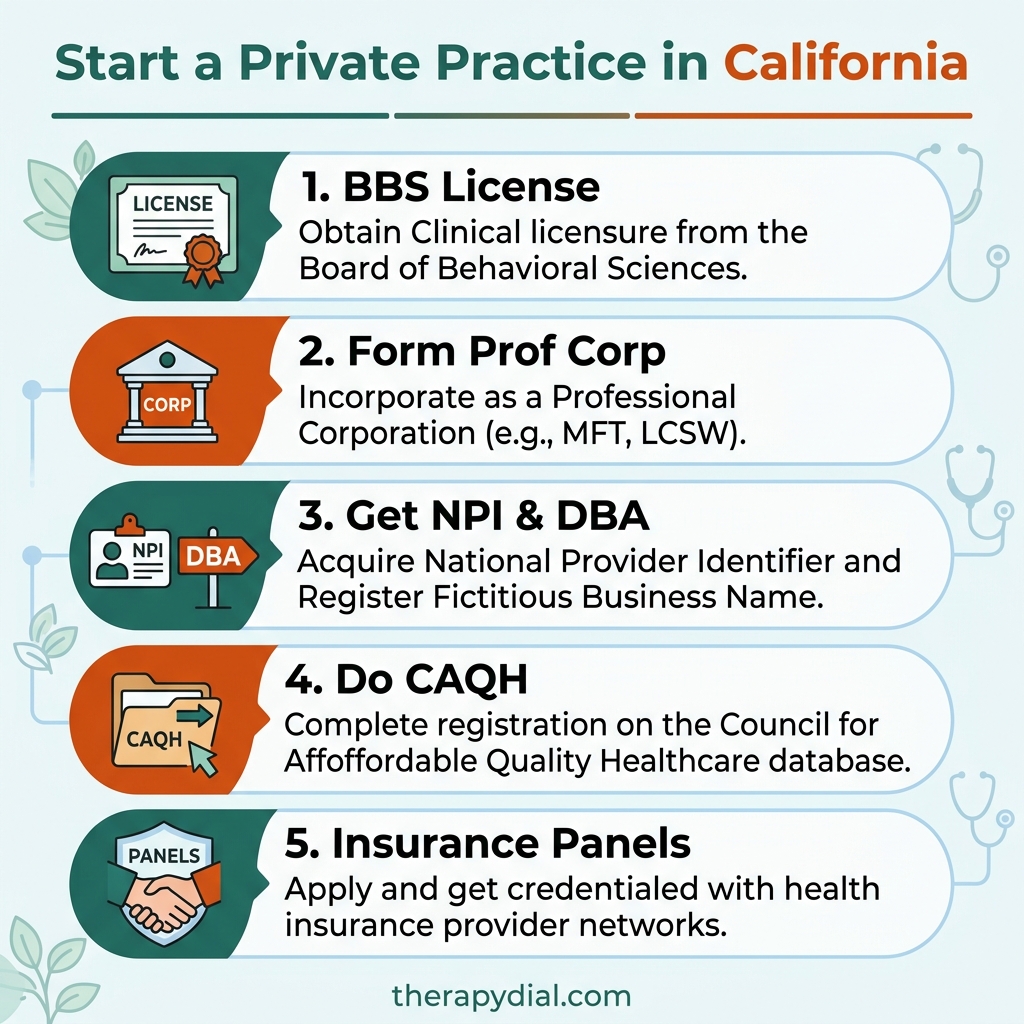
- Verify License Status — Ensure your LMFT, LCSW, LPCC, or Psychology license is fully active with the Massachusetts Board of Behavioral Sciences (BBS).
- Form an Entity — Choose between a Sole Proprietorship or a Professional LLC (PLLC) (PC), as LLCs are strictly prohibited for licensed therapists in MA.
- File Fictitious Business Name (DBA) — If using a name other than your exact legal name, file a DBA with your local county clerk and publish it locally.
- Obtain EIN & NPI — Secure an Employer Identification Number from the IRS and both Type 1 (Individual) and Type 2 (Organization, if a PC) National Provider Identifiers via NPPES.
- Acquire Malpractice Insurance — Purchase professional liability coverage through providers like CPH & Associates or HPSO via CAMFT/NASW.
- Setup CAQH ProView — Complete your CAQH profile to initiate the insurance credentialing process with major Massachusetts health plans.
- Complete Credentialing — Apply for in-network status with panels like Anthem Blue Cross, Blue Shield of MA, Aetna, and UnitedHealthcare/Optum.
- Select an EHR — Implement a HIPAA- and CCPA-compliant Electronic Health Record system like SimplePractice or Jane for documentation and billing.
Frequently Asked Questions About MA Private Practice
No. Under the Moscone-Knox Professional LLC (PLLC) Act, licensed therapists, psychologists, and social workers providing clinical services are explicitly free to form either an LLC or PLLC in Massachusetts. You must operate as a Sole Proprietor or form a Professional LLC (PLLC) (PC).
No. Mental health therapists (LMFTs, LCSWs, LPCCs) and Psychologists in Massachusetts do not have prescribing privileges. Therefore, they do not prescribe controlled substances and do not need to register for a Drug Enforcement Administration (DEA) number.
If you form a corporate entity, costs begin at around $1,500-$3,500, inclusive of legal fees to draft the Professional LLC (PLLC) articles. You will also be subject to the Massachusetts minimum annual franchise tax of $800 to the Massachusetts Franchise Tax Board. Setting up a telehealth-only sole proprietorship is notably cheaper.
Massachusetts BBS rules state you must be licensed in the state where the client is physically situated during the session. If you sit in Massachusetts, you can provide services to someone in Massachusetts. If they travel out of state, your ability to treat them depends entirely on the laws of the state they travelled to.
You need a DBA, filed with your local county clerk, anytime your practice name implies additional owners or does not match your exact legal name (e.g., using “Sunset Valley Therapy” instead of “Jane Doe, LMFT”). FBNs must typically be published in a local newspaper.
Most commercial panels like Anthem Blue Cross, Aetna, and Cigna/Evernorth take between 90 and 120 days from start to finish. Submitting a perfectly pristine CAQH ProView application and leveraging a dedicated credentialing service usually speeds up turnaround time.
No. Unlicensed associates earning their supervised hours cannot independently own a private practice. They must be hired as employees under the direct legal supervision and authority of a licensed clinician or agency in Massachusetts.
Massachusetts is home to the largest therapy market in the United States. With progressive telehealth laws safely embedded and an immense population, the state offers unparalleled opportunities for a solo practice. But starting a private therapy practice in Massachusetts requires navigating one of the most structurally strict regulatory environments in the country. Between the Moscone-Knox Professional LLC (PLLC) Act, the Board of Behavioral Sciences (BBS) regulations, NPI registration, and notoriously slow insurance credentialing, the path forward requires precision.
This guide breaks the entire process into clear, actionable steps. Whether you’re an MFT, LCSW, LPCC, or Psychologist, this is your definitive roadmap for building a compliant, thriving private practice in the Golden State, complete with the specific portals and payers you need to know.
Massachusetts Entity Options for Therapists: LLC vs PLLC
If you’re reading generic business advice online, you might assume you should form a Limited Liability Company (LLC) to protect yourself. In Massachusetts, this is illegal for therapists. Licensed mental health professionals providing professional services are strictly prohibited from forming LLCs. You must operate as a Sole Proprietor or form a Professional LLC (PLLC) (PC). Additionally, every corporation is subject to an $800 minimum annual franchise tax to the Massachusetts Franchise Tax Board.
| Massachusetts | Texas | Florida | |
|---|---|---|---|
| Entity Type | Sole Prop or PC (No LLCs) | PLLC Allowed | LLC / PLLC Allowed |
| Minimum Corp Tax | $800 Annually | No State Income Tax | No State Income Tax |
| Top Payers | Anthem, Kaiser, UHC | BCBS TX, UHC | Florida Blue, Aetna |
| Regulatory Board | BBS / Board of Psychology | BHEC | Florida Board of CSWMFT |
The Complete Massachusetts Private Practice Roadmap
Confirm Your BBS License
Verify your independent licensure status with the Massachusetts Board of Behavioral Sciences (BBS). You cannot refer to yourself as an independent private practitioner if you are still an Associate.
Associate Status
If you are an AMFT or ACSW, you cannot independently own a private practice. You must be employed and supervised in an appropriate setting until full licensure.
Entity Structure & Taxes
Standard LLCs are banned under the Moscone-Knox Professional LLC (PLLC) Act. Choose between:
- Sole Proprietorship: Easiest and cheapest, but offers no personal asset protection.
- Professional LLC (PLLC) (PC): Provides personal asset protection against business debts.
Franchise Tax Board
Forming a PC subjects you to the $800 minimum annual Franchise Tax in MA.
File a Fictitious Business Name
If you name your practice anything other than your exact legal name (e.g., “Golden Gate Therapy”), you must file a Fictitious Business Name (FBN/DBA) with your local county clerk.
You must publish this name in a local newspaper. Naming laws: MFT corporations must have “Marriage,” “Family,” or “Child” and words like “Counseling” or “Therapy”.
Acquire NPI and EIN
Apply for an Employer Identification Number (EIN) from the IRS to use on claim forms (CMS-1500) instead of your SSN. Then, register via the NPPES system for your NPI Number.
You need a Type 1 NPI as a provider, and a Type 2 NPI if operating as a Professional LLC (PLLC).
Obtain Malpractice Insurance
Secure professional liability insurance prior to seeing any patients. Major carriers often endorsed by CAMFT and NASW include CPH & Associates and HPSO.
Insurance panels require you to upload your current malpractice facesheet into your CAQH profile to prove active coverage.
CAQH ProView Profile
In Massachusetts, CAQH ProView is required by nearly all major commercial health plans. Upload your BBS license, malpractice facesheet, NPI info, and employment history.
120-Day Rule
You must log in and re-attest this profile every 120 days or risk being dropped from payer panels.
Apply to MA Insurance Panels
Getting in-network takes 90–120 days. Submit credentialing applications via payer portals like Availity or directly through payer sites. Key Massachusetts networks include:
- Anthem Blue Cross & Blue Shield of MA
- UnitedHealthcare / Optum
- Magellan Health & Kaiser Permanente
- Aetna
Set Up Your EHR & Billing
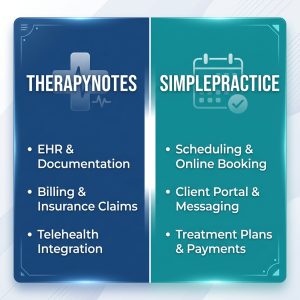
Select a CCPA/HIPAA-compliant Electronic Health Record (EHR) like SimplePractice, TherapyNotes, or Jane to manage scheduling and telehealth links (like Doxy.me or Zoom for Healthcare).
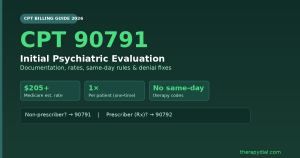
Learn essential billing mechanics using ICD-10-CM and CPT codes (e.g., CPT 90834, 90837) to submit claims through clearinghouses like Waystar.
Massachusetts Break-Even Calculator
Estimate how many sessions per week you need to cover expensive MA overhead and hit your income goal. Accounts for MA’s high state income tax burden.
Extended Clinical & Coding Resources
Stay ahead of mental health trends and master your diagnostic accuracy with our deep-dive guides:
Billing + Free Growth
- Professional Medical Billing
- FREE Insurance Credentialing
- FREE TherapyDial Profile Listing
- Priority Practice Support
- 7 Free Eligibility Verifications
- Proven Marketing Advice to build an ever-growing customer base
Book a Free Consultation
Our team typically responds within 1 business day.