
How to Start an Ohio Therapy Practice
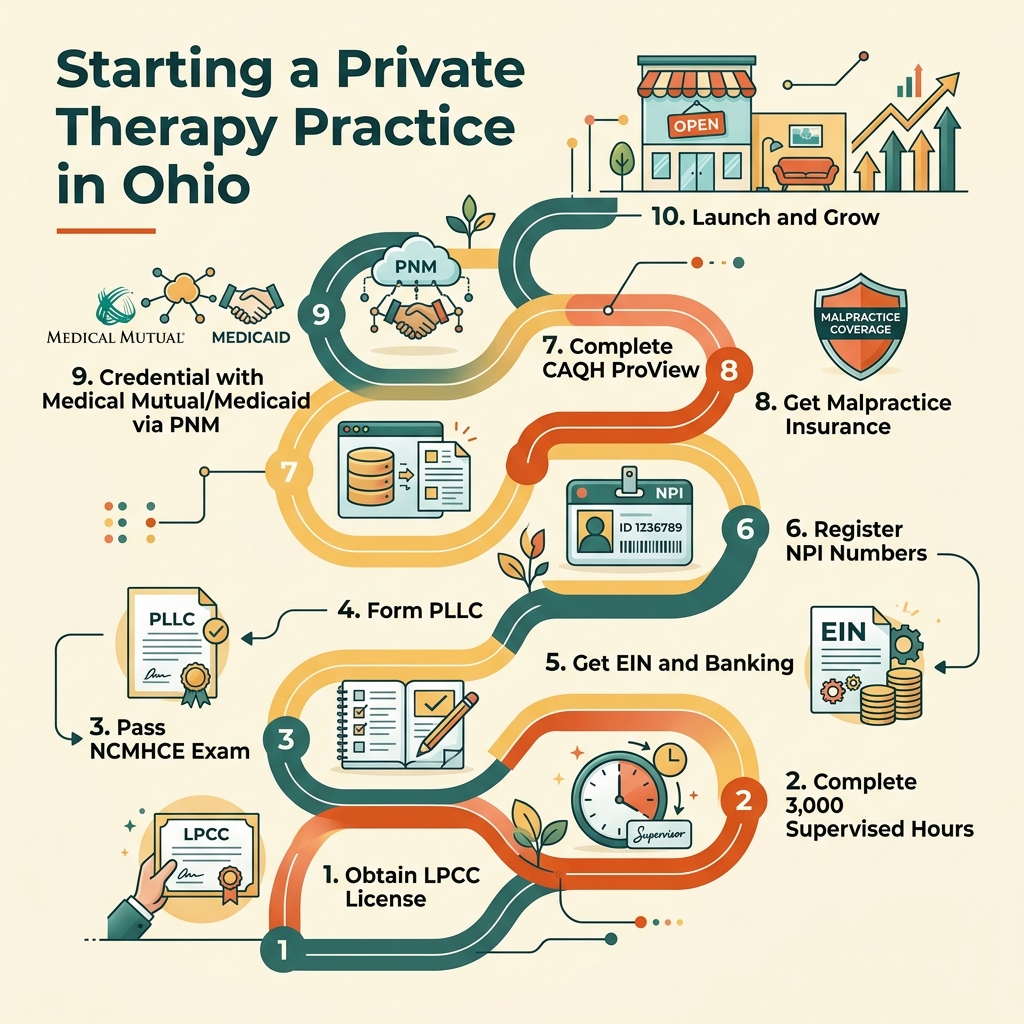
- LPC vs. LPCC — Understand that LPCs require supervision; LPCCs can run independent practices without supervision via the CSWMFT Board.
- Acquire Supervision — Complete 3,000 post-LPC hours over 24 months under an LPCC-S to upgrade your license.
- Pass the NCMHCE — Pass the clinical exam required by the CSWMFT to finalize your LPCC upgrade.
- Form a PLLC — Register your Professional Limited Liability Company with the Ohio Secretary of State to shield liability.
- Get an EIN — Obtain your free tax ID from the IRS to open business banking.
- Register NPIs — Apply for NPI Type 1 (clinician) and NPI Type 2 (PLLC) via the NPPES portal.
- Update CAQH ProView — Build your credentialing profile for major commercial payers and re-attest every 120 days.
- Enroll in Ohio PNM — Use the Provider Network Management portal to credential with Ohio Medicaid and CareSource.
- Join Commercial Panels — Apply to Anthem BCBS of Ohio, Medical Mutual, and UHC/Optum.
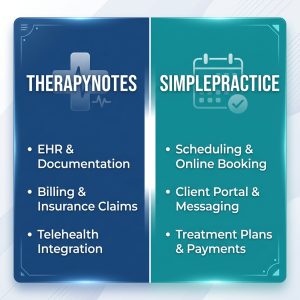
- Choose Tech & EHR — Implement HIPAA-compliant tools like SimplePractice for billing and Spruce Health for communication.
Frequently Asked Questions
No. Licensed Professional Clinical Counselors (LPCCs) and other mental health therapists in Ohio cannot prescribe medication. Therefore, you do not need to register with the DEA or obtain a DEA number. Only qualified medical professionals like Psychiatrists or PMHNPs handle prescriptions.
Technically, yes, but an LPC is a dependent license. Under Ohio’s CSWMFT Board rules, if you diagnose or treat mental disorders, you must be under the direct supervision of an LPCC-S, Psychologist, or Psychiatrist. Most therapists wait until earning their LPCC to start a solo practice.
The Provider Network Management (PNM) portal is Ohio Medicaid’s centralized system. You must use it to enroll and credential with Ohio Medicaid and MyCare plans. It links to your CAQH ProView data.
You need 3,000 total hours of clinical experience over a minimum of 24 months, including 150 hours of training supervision from an LPCC-S. A maximum of 1,500 hours can be earned per year.
Licensed healthcare providers in Ohio typically form a Professional Limited Liability Company (PLLC) to comply with professional corporate regulations, filed via the Ohio Secretary of State.
Anthem BCBS and Medical Mutual of Ohio dominate the commercial landscape. CareSource and Ohio Medicaid via the PNM Portal are essential for government-funded plans.
Ohio presents an excellent landscape for therapists looking to start a private practice. With a robust mix of major metropolitan hubs like Columbus, Cleveland, and Cincinnati, paired with high demand in underserved rural regions, the opportunities for both telehealth and in-person practices are vast.
This guide walks you through every step of launching a private therapy practice in Ohio — from navigating the LPC vs. LPCC requirements set by the CSWMFT Board, to credentialing with Medical Mutual, Anthem BCBS, and Ohio Medicaid’s PNM portal.
Exploring other states? See our guides for Illinois, Pennsylvania, New York, Georgia, and Texas.
How Ohio Compares to Other States
| Factor | Ohio | Illinois | Pennsylvania | New York | Georgia |
|---|---|---|---|---|---|
| Entity Type | PLLC / LLC | PLLC / P.C. | Restricted LLC | PLLC only | LLC allowed |
| State Income Tax | Graduated (~3%) | 4.95% flat | 3.07% flat | Up to 10.9% | 5.49% flat |
| Supervision Hours | 3,000 | 3,360 | 3,000 | Varies | 3,000 |
| Dual Licensing Steps | LPC → LPCC | LPC → LCPC | LAPC → LPC | Varies | APC → LPC |
| Credentialing Wait | 90–120 days | 90–120 days | 90–120 days | 90–120 days | 90–120 days |
| Top Medicaid Portal | PNM | IMPACT | PROMISe | eMedNY | GAMMIS |
The Complete Ohio Private Practice Roadmap
Master the LPC vs. LPCC Dynamics
Ohio’s Counselor, Social Worker, and Marriage and Family Therapist (CSWMFT) Board utilizes a two-tier system for therapists.
An LPC (Licensed Professional Counselor) can legally open a private practice, but they must practice under the direct supervision of an approved supervisor (LPCC-S, Psychologist, Psychiatrist) to diagnose and treat. The LPCC (Licensed Professional Clinical Counselor) is the independent license that lets you run a solo practice without oversight.
Licensure Assistance
If you’re transferring from another state or upgrading, we can handle the CSWMFT Board communications for you.
Ask About Licensure Help →Accrue 3,000 Clinical Hours
To upgrade from LPC to LPCC, you must complete 3,000 total hours of post-LPC clinical experience over at least 24 months. A maximum of 1,500 hours can be credited per year.
At least 50% (1,500 hours) must involve direct client contact. You also need 150 hours of training supervision from an approved LPCC-S.
Pass the NCMHCE
To secure your LPCC, you must pass the National Clinical Mental Health Counseling Examination (NCMHCE) administered by NBCC. Once licensed, you will use the Ohio eLicense system to renew every two years by completing 30 continuing education hours, easily tracked on platforms like CE Broker.
Establish Your PLLC
To comply with Ohio corporate regulations regarding healthcare, you should file Articles of Organization to create a Professional Limited Liability Company (PLLC).
File online with the Ohio Secretary of State for about $99, and designate an Ohio statutory agent. You must hold your LPCC license before forming an independent therapy PLLC.
Obtain an EIN
Your PLLC requires an Employer Identification Number (EIN) from the IRS (free at irs.gov). This is used for tax reporting, submitting W-9s to insurers, and opening a dedicated business bank account to preserve your liability protection.
Register NPI Numbers via NPPES
The Centers for Medicare & Medicaid Services mandates NPIs for billing. Register at the NPPES portal to obtain:
- NPI Type 1: Your individual clinician identifier.
- NPI Type 2: Your PLLC’s organizational identifier.
You will submit claims (like the CMS-1500 form) using both numbers.
Set Up CAQH ProView
Before applying to insurance networks like Medical Mutual or Aetna, you must build your profile in CAQH ProView. This universal database stores your LPCC license, malpractice face sheet, and W-9. Ensure you re-attest every 120 days to prevent contract termination.
Ohio Credentialing Strategy
Target major payers to fill your caseload quickly:
- Medical Mutual of Ohio (Massive presence statewide)
- Anthem BCBS (Major commercial footprint)
- Ohio Medicaid & CareSource (Requires applying via the Ohio PNM Portal)
- UnitedHealthcare/Optum & Cigna/Evernorth
Credentialing Wait Times
It takes 90-120 days for payers to process your applications. We can manage this for you.
Skip the Wait →Deploy a Tech Stack
Run your practice efficiently with HIPAA-compliant tools:
- SimplePractice: EHR, scheduling, telehealth, and CMS-1500 claim generation.
- Spruce Health: Secure VOIP phone and efax.
- Availity: Check eligibility for Anthem and Medical Mutual.
Master Behavioral Health Coding
Ensure clean claims by pairing accurate diagnostic codes with standard procedural codes. Use the ICD-10-CM manual for diagnoses (e.g., F41.1 for Generalized Anxiety Disorder) and standard CPT codes:
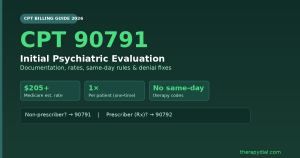
- CPT 90791: Psychiatric Diagnostic Evaluation (Intake).
- CPT 90834 / 90837: 45-minute and 60-minute psychotherapy sessions.
Ohio Break-Even Calculator
Estimate sessions per week to cover overhead and hit your goal. (Calculated with an estimated 3% average OH state tax).
Clinical Guidance & Coding Resources
Enhance your clinical documentation and billing accuracy with our detailed guides:
Exclusive Provider Bundle
- Professional Medical Billing
- FREE Insurance Credentialing
- FREE TherapyDial Profile Listing
- Priority Practice Support
Stop battling PNM and CAQH rejections.
Let our experts manage your revenue cycle from day one.