How to Start a Private Therapy Practice in New Jersey
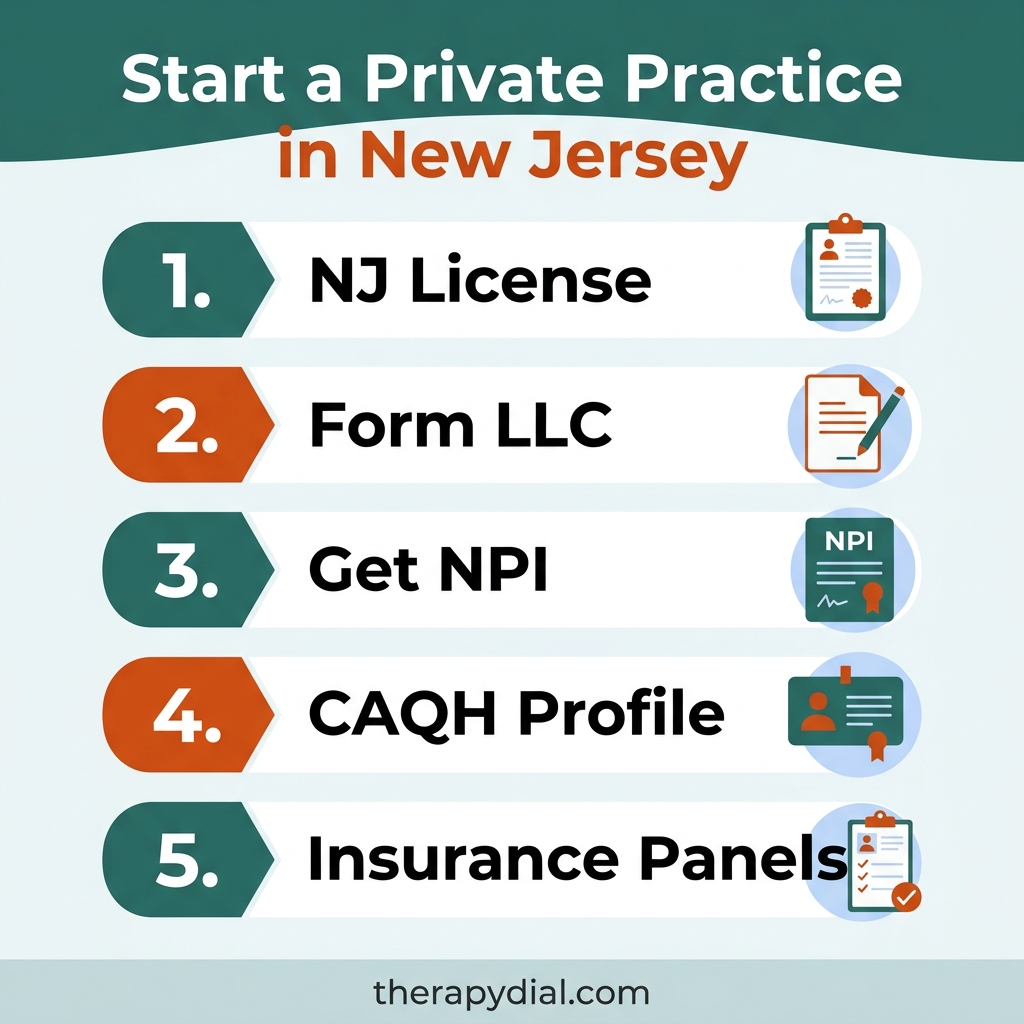
- Confirm NJ License Status — Ensure your LPC, LCSW, or LMFT is fully active and unrestricted with the New Jersey Division of Consumer Affairs (DCA).
- Complete Supervision Hours — If you are a Licensed Associate Counselor (LAC), you must accumulate 4,500 supervised clinical hours before practicing independently.
- Form Your Business Entity — Register a standard LLC with the NJ Division of Revenue (unlike NY, PLLCs are not required and publication is not mandated).
- Obtain an EIN and Bank Account — Secure a free Employer Identification Number (EIN) from the IRS to open a dedicated business checking account.
- Apply for NPI Numbers — Register for an NPI Type 1 (Individual) and NPI Type 2 (Organizational) via the NPPES portal.
- Purchase Malpractice Insurance — Obtain professional liability coverage through providers like HPSO or CPH & Associates to protect your practice and satisfy credentialing rules.
- Complete CAQH ProView — Build and attest your CAQH profile every 120 days to ensure continuous commercial insurance paneling.
- Credential with Top Payers — Join major New Jersey networks like Horizon BCBS NJ, Aetna, UnitedHealthcare/Optum, and Cigna/Evernorth.
- Implement a Secure Tech Stack — Use HIPAA-compliant tools like SimplePractice, Spruce Health, and Doxy.me for your EHR, communication, and telehealth needs.
- Set Up Medical Billing — Master diagnostic coding (ICD-10-CM) and CPT codes (e.g., 90834, 90837) or hire a professional billing service to handle claims.
Frequently Asked Questions
Yes. Unlike New York (which requires PLLCs) or California (Professional Corporations), New Jersey allows licensed therapists to form a standard LLC. There is no separate “PLLC” designation required, and you file directly with the NJ Division of Revenue.
New Jersey demands a rigorous 4,500 hours of supervised counseling experience. Additionally, you must receive at least 1 hour of supervision every two weeks with an approved supervisor, and a minimum of 50% must be conducted in-person.
No. Mental health therapists (such as LPCs, LCSWs, and LMFTs) in New Jersey do not prescribe medication. Therefore, you do not need to register for a DEA number. Only professionals with prescribing authority, like psychiatrists or specialized nurse practitioners, require one.
Yes, but you must hold an active license in each state. For clients physically located in New Jersey, you use your NJ license. For New York clients, you must bill under your NY license and comply with NY’s PLLC structure.
No. Unlike New York, which famously requires a 6-week newspaper publication for PLLCs, New Jersey has no publication requirement. This saves NJ practitioners $500–$2,000 in upfront costs.
We recommend starting with Horizon Blue Cross Blue Shield of New Jersey, as it’s the dominant payer in the state. From there, credentialing with national payers like Aetna, UnitedHealthcare/Optum, and Cigna/Evernorth through Availity or Waystar provides maximum coverage for your clients.
An LAC is a pre-licensure status in New Jersey. It means you hold your master’s degree and have passed the national exam, but you have not yet completed the 4,500 supervised hours required for full LPC licensure. LACs cannot bill insurance independently.
New Jersey sits at the crossroads of the largest therapy corridor in the country. Thousands of clinicians hold dual NY/NJ licenses, serving the massive NYC metro population that stretches from Bergen County to Princeton and beyond. Whether you’re building a telehealth-first practice from Hoboken or opening a physical office in Cherry Hill, launching a private therapy practice in NJ offers enormous potential — if you navigate the regulations correctly.
This guide, written by Jason Roy and reviewed by licensed clinicians, walks you through every step. It covers NJ’s unique 4,500-hour supervision requirement for Licensed Associate Counselors, the LLC formation process, NPI registration, and the complete insurance credentialing pipeline.
Already exploring other states? See our sister guides for New York, Texas, California, and Florida.
How New Jersey Compares to Other States
| Factor | New Jersey | New York | Texas | California | Florida |
|---|---|---|---|---|---|
| Entity Type | LLC | PLLC only | LLC / PLLC | Prof. Corp only | LLC / PLLC |
| State Income Tax | Up to 10.75% | Up to 10.9% | 0% | Up to 13.3% | 0% |
| Supervision Hours | 4,500 | Varies | 3,000 | 3,000 | 1,500 |
| Publication Required | No | Yes (6 weeks) | No | No (DBA in paper) | No |
| Credentialing Time | 90–120 days | 90–120 days | 60–120 days | 90–120 days | 90–120 days |
The Complete New Jersey Private Practice Roadmap
Confirm Your NJ License (Or Get Help Obtaining One)
Verify your license is active and unrestricted with the New Jersey Division of Consumer Affairs (DCA). You must hold a full independent license — LPC, LCSW, or LMFT — to operate a solo private practice and properly bill insurance.
If you are a Licensed Associate Counselor (LAC), you cannot practice independently. You must complete your hours under a board-approved supervisor first.
Need a New Jersey License?
Whether you’re applying for initial licensure, transferring from another state via endorsement, or navigating the LAC-to-LPC pathway, we can handle the paperwork and DCA board communications for you.
→ Ask About Our Licensure Assistance ProgramsComplete Your 4,500 Supervised Hours (LAC to LPC)
New Jersey has one of the most rigorous supervision requirements in the country. As a Licensed Associate Counselor, you must accumulate:
- 4,500 total hours of supervised counseling experience.
- At least 1 hour of supervision every two weeks with a board-approved supervisor.
- A minimum of 50% of supervision must be in-person (face-to-face, same room).
- You must document your hours meticulously; the NJ board is known for detailed audits.
For LCSW candidates, requirements are governed by a separate board under the DCA, with similar rigor. For context, Texas requires 3,000 hours, and Florida requires only 1,500 hours.
Pass Your Licensing Exams
New Jersey requires passing a national clinical examination appropriate to your discipline:
Once licensed, LPCs must complete 40 continuing education hours via platforms like CE Broker every two years, including mandatory credits in ethics and cultural competency.
Choose Your Business Entity (LLC Is Fine in NJ)
Unlike New York (which mandates PLLCs) or California (which bans LLCs entirely), New Jersey allows therapists to form a standard Limited Liability Company (LLC).
Unlike New York, you do not need to publish your LLC formation in a newspaper, saving you $500–$2,000.
Get Your EIN & Register Your NPI Numbers
Apply for a free Employer Identification Number (EIN) from the IRS at irs.gov. Then open a dedicated business checking account.
Next, you must register for your National Provider Identifier (NPI) at NPPES:
- NPI Type 1: Your individual clinician ID (CMS-855I).
- NPI Type 2: Your LLC’s organizational ID.
NPIs are required for all HIPAA-covered transactions, clearinghouses (like Waystar), and CAQH profiles.
Complete Your CAQH ProView Profile
CAQH ProView is mandatory in NJ for credentialing with commercial payers. Every major insurer in the state — Horizon BCBS NJ, Aetna, UHC — pulls directly from this database.
Critical: You must re-attest every 120 days. If your CAQH lapses, insurance panels will silently freeze your claims and you won’t get paid until you re-attest.
Make sure your practice addresses match exactly between CAQH, your NPI record, and your LLC registration.
Begin Insurance Credentialing
The NJ insurance landscape is dominated by one carrier: Horizon Blue Cross Blue Shield of New Jersey. Expect 90–120 days per panel.
- Horizon BCBS NJ — The dominant payer in the state
- Aetna
- UnitedHealthcare / Optum
- Cigna / Evernorth
- NJ Medicaid (NJ FamilyCare / FMMIS)
Credentialing Pro-Tip
Horizon Blue Cross Blue Shield of New Jersey requires additional NJ-specific documentation during credentialing. Make sure you upload your malpractice facesheet and LLC docs promptly.
Secure Malpractice & Choose Practice Setting
Professional liability coverage is a prerequisite for credentialing. Expect to pay $100–$500/year. Next, decide on your practice model:
Set Up Your HIPAA-Compliant Tech Stack
Automate your practice with secure tools:
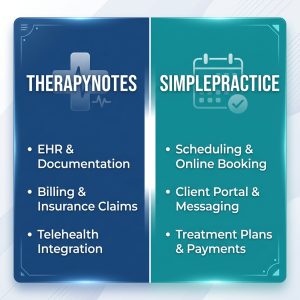
SimplePractice or TherapyNotes
Integrated scheduling, billing, telehealth, and portals.
Spruce Health
HIPAA-compliant phone, fax, and messaging.
Lock Down Your Billing Strategy
Accurate medical billing is essential. A dedicated biller handles claim submissions (via CMS-1500 forms), denial follow-ups, and CPT/ICD-10-CM coding corrections.
- Therapy Codes: CPT 90834 (45 mins) and 90837 (60 mins).
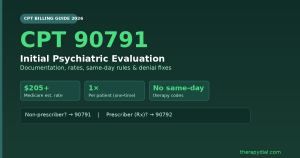
- Intake Codes: CPT 99203 or 90791.
- Family Sessions: CPT 90847 (with patient present).
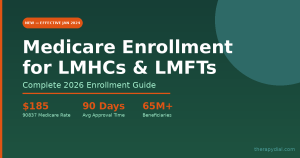
If you see Medicaid clients via FMMIS, ensure your PECOS enrollment is active. Out-of-network providers must supply detailed superbills to clients.
Grow Your Practice with Local SEO
NJ is saturated near NYC but underserved in Central and South Jersey. Your growth strategy must be digital-first:
- Google Business Profile: The #1 ranking signal for local therapy searches. Post weekly, upload office photos, and respond to every review.
- Local SEO Strategy: Learn the exact tactics top therapists use to dominate local search: Local SEO for Therapists: How to Be #1.
Pro-Tip: Bookmark this guide for your next credentialing cycle.
New Jersey Break-Even Calculator
Estimate how many sessions per week you need to cover NJ overhead and hit your income goal. NJ has a state income tax of up to 10.75%.
Exclusive Provider Bundle:
Licensure + Billing + Growth
- Professional Medical Billing
- FREE Insurance Credentialing
- FREE TherapyDial Profile Listing
- Priority Practice Support
Whether you need help getting a NJ license or managing your claims. We handle the paperwork.
HIPAA Compliant & Expertly Managed.
Extended Clinical & Coding Resources
Stay ahead of mental health trends and master your diagnostic accuracy with our comprehensive guides: