Illinois Licensure Requirements for Private Practice
Before seeing clients independently in Illinois, you must hold the appropriate state license from the Illinois Department of Professional and Financial Regulation (IDFPR). Each credential has specific supervised hour requirements:
- LCPC (Licensed Clinical Professional Counselor): 3,000 post-master's supervised hours. Your supervising LCPC must be licensed for 5+ years. This is the primary counseling license in Illinois — LMHCs are NOT separately licensed by IDFPR.
- LCSW (Licensed Clinical Social Worker): 2 years of post-MSW supervised clinical experience. Issued by IDFPR Board of Social Work.
- LMFT (Licensed Marriage and Family Therapist): 3,000 supervised hours over a minimum of 2 years post-degree.
- Licensed Psychologist (PhD / PsyD): Doctoral degree + supervised experience per IDFPR Board of Psychology rules.
Note for LMHCs: Illinois does not issue a separate LMHC license. Counselors in Illinois practice under the LCPC credential. If you hold an LMHC from another state, you'll apply for LCPC reciprocity via IDFPR.
Setting Up an Illinois Private Practice LLC or PLLC
Illinois allows licensed therapists to structure their practice as either a standard LLC or a Professional Limited Liability Company (PLLC). Key steps and considerations:
- PLLC vs LLC: Clinical services in Illinois should generally be organized as a PLLC — this protects the professional liability shield that LLCs offer while complying with Illinois law on professional services.
- Filing fee: Approximately $150 with the Illinois Secretary of State. The annual report fee is $75/year.
- Professional liability insurance: Required before seeing clients. Standard minimums are $1M per occurrence / $3M aggregate.
- No separate business license: Illinois does not require a separate business license for therapy practice — your IDFPR license is the operating credential.
- NPI Type 2: If you'll bill insurance under your practice entity (not just your personal NPI), you'll need a separate NPI Type 2 for the entity.
Insurance credentialing note: Illinois therapists should note that BCBS Illinois (HCSC) has a separate credentialing process from national BCBS plans. Apply directly through the Illinois Blue Cross Blue Shield provider portal — not the federal BCBS provider portal.
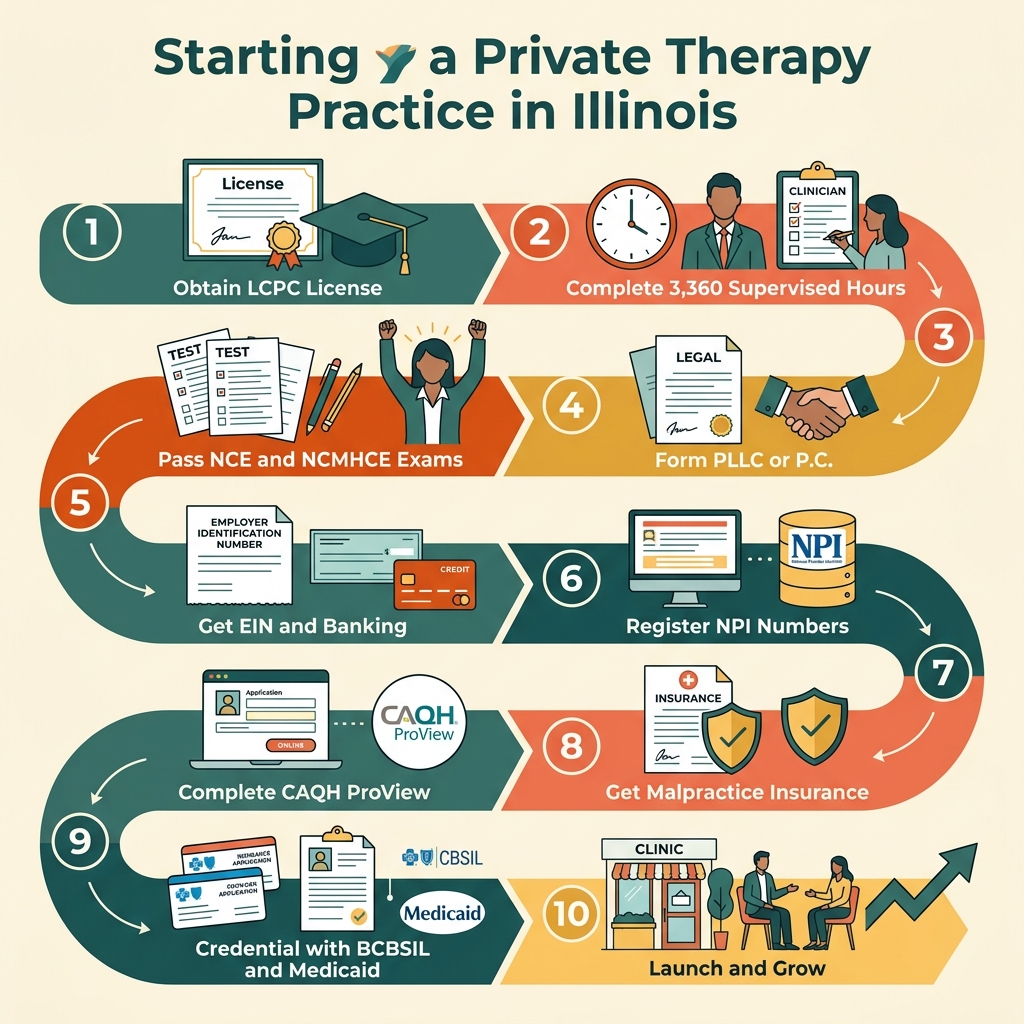
How to Start a Private Practice in Illinois
- LCPC Requirement — You must secure your Licensed Clinical Professional Counselor (LCPC) credential from IDFPR to operate independently.
- Supervised Hours — Accumulate 3,360 hours under a qualified supervisor, with 1,680 of those being direct client contact.
- Exams Required — Pass both the NCE and the NCMHCE, as Illinois demands two national exams for full licensure.
- Form a PLLC — Register a Professional Limited Liability Company (PLLC) or P.C. with the IL Secretary of State, as standard LLCs are prohibited.
- Obtain NPI & EIN — Register your NPI via NPPES and EIN via the IRS to allow for legal billing and banking.
- Malpractice Insurance — Secure liability coverage specific to Illinois standards before seeing clients.
- CAQH Profile — Complete your CAQH ProView application, a strict prerequisite for all commercial payers in IL.
- Payer Credentialing — Apply to major Illinois networks like BCBS of Illinois, Aetna, and UnitedHealthcare/Optum (takes 90–120 days).
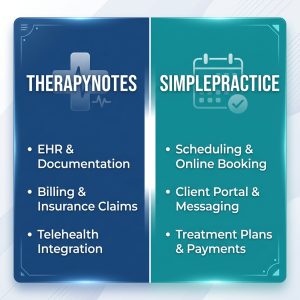
- Practice Setup — Choose an EHR (like SimplePractice), set up a telehealth platform, and secure office space if seeing clients in person.
- Compliance — Renew your license biennially with IDFPR and maintain your CAQH attestation every 120 days.
Frequently Asked Questions
An LPC is the entry-level license — you cannot practice independently or open a private practice. The LCPC is the independent clinical license that allows you to diagnose, treat, and bill insurance on your own. You need 3,360 supervised hours and two national exams to upgrade from LPC to LCPC.
No. Licensed Clinical Professional Counselors (LCPCs), LCSWs, and LMFTs in Illinois are not medical doctors and cannot prescribe medication. Because you do not prescribe controlled substances, you do not need a DEA number to open a private practice.
No. Illinois requires therapists to form a PLLC (Professional Limited Liability Company) or P.C. (Professional Corporation). The IDFPR will not register a standard LLC for regulated professional services.
Telehealth-only: $500–$1,500 (PLLC filing, malpractice via HPSO ~$100–$500/yr, EHR via SimplePractice ~$30–$100/mo). Chicago office space adds $1,500–$3,000/month, while suburbs run $800–$1,500/month.
Start with BCBS of Illinois (the dominant commercial payer), then Aetna, UnitedHealthcare/Optum, and Cigna/Evernorth. For Medicaid, you must enroll through the state’s IMPACT system.
Chicago is the third-largest therapy market in the United States, and Illinois as a whole offers a compelling mix of urban demand and rural shortage areas. Whether you’re launching a telehealth-first practice in the Loop or opening an office in the suburbs, the state’s robust insurance infrastructure — anchored by BCBS of Illinois — makes insurance-based private practice highly viable.
This guide walks you through every step. Illinois has a unique two-tier licensing system (LPC vs. LCPC), requires a PLLC for practice entities, and demands 3,360 supervised hours plus two national exams for independent licensure. Remember, as mental health therapists (LCPCs, LCSWs, LMFTs), you do not prescribe medication or require a DEA number to operate.
Exploring other states? See our guides for New York, Texas, California, Florida, New Jersey, and Pennsylvania.
How Illinois Compares to Other States
| Factor | Illinois | New York | Texas | California | Florida |
|---|---|---|---|---|---|
| Entity Type | PLLC / P.C. | PLLC only | LLC / PLLC | Prof. Corp only | LLC / PLLC |
| State Income Tax | 4.95% flat | Up to 10.9% | 0% | Up to 13.3% | 0% |
| Supervision Hours | 3,360 | Varies | 3,000 | 3,000 | 1,500 |
| Exams Required | NCE + NCMHCE | Varies | NCE + Juris. | Varies | NCE |
| Credentialing Wait | 90–120 days | 90–120 days | 60–120 days | 90–120 days | 90–120 days |
| Top Payer | BCBSIL | Elevance (BCBS) | BCBSTX | Anthem Blue Cross | Florida Blue |
The Complete Illinois Private Practice Roadmap
Understand IL’s Two-Tier Licensing System
Illinois uses a two-tier system managed by the Illinois Department of Financial and Professional Regulation (IDFPR):
Need an Illinois License?
We handle IDFPR applications, transfers, and documentation.
→ Let us assist with your licensureComplete 3,360 Supervised Hours
As an LPC upgrading to an LCPC, you must accumulate a rigorous 3,360 total hours of supervised clinical professional counseling. At least 1,680 hours (50%) must be direct client contact.
Hours must be accrued over no less than 2 years under an Illinois-licensed LCPC, LCSW, clinical psychologist, or psychiatrist.
Pass Both Required Exams
Illinois is one of the rare states requiring two national exams for full licensure:
- NCE (National Counselor Examination) — typically taken for LPC.
- NCMHCE (National Clinical Mental Health Counseling Examination) — required for the LCPC upgrade.
Form Your PLLC (or P.C.)
Illinois mandates that mental health professionals form a Professional Limited Liability Company (PLLC) or Professional Corporation (P.C.). Standard LLCs are explicitly rejected by the IDFPR.
You must file Articles of Organization with the IL Secretary of State and register the entity with IDFPR separately.
Get Your EIN & Open Business Banking
Obtain an Employer Identification Number (EIN) free from the IRS. This acts as your practice’s social security number. Open a dedicated business banking account and register with the IL Department of Revenue for your 4.95% flat state income tax obligations.
Register Your NPI Numbers
The NPI (National Provider Identifier) is a 10-digit number essential for HIPAA-covered transactions. Apply for a Type 1 (Individual) and Type 2 (Organization) NPI via NPPES.
Complete CAQH ProView
CAQH ProView is the universal credentialing database. You must upload your LCPC license, malpractice insurance, CV, and work history. Re-attestation is mandatory every 120 days to prevent payment holds.
Begin Insurance Credentialing
To accept insurance, you must credential with each payer individually, a process taking 90–120 days. Target the major Illinois networks:
- BCBS of Illinois (Dominant payer)
- Aetna
- UnitedHealthcare / Optum
- Cigna / Evernorth
- IL Medicaid (Via the IMPACT system)
Set Up Your Tech Stack
Ensure all software provides a Business Associate Agreement (BAA) for HIPAA compliance.
SimplePractice
Scheduling, telehealth, and CMS-1500 generation.
Spruce Health
Secure phone, texting, and fax.
Lock Down Medical Billing
Proper medical coding is critical to getting reimbursed by BCBSIL and others. Use standard CPT codes like 90834 (45-min therapy) and 90837 (60-min therapy), paired with correct ICD-10-CM diagnostic codes.
Essential Clinical Resources
Ensure your documentation meets IDFPR and insurance audit standards:
Pro-Tip: Bookmark this guide for your next credentialing cycle.
Illinois Break-Even Calculator
Estimate the weekly sessions needed to hit your target income, accounting for IL overhead and the 4.95% state income tax.
Billing + Free Growth
- Professional Medical Billing
- FREE Insurance Credentialing
- FREE TherapyDial Profile Listing
- Priority Practice Support
- 7 Free Eligibility Verifications
- Proven Marketing Advice to build an ever-growing customer base
Book a Free Consultation
Our team typically responds within 1 business day.