
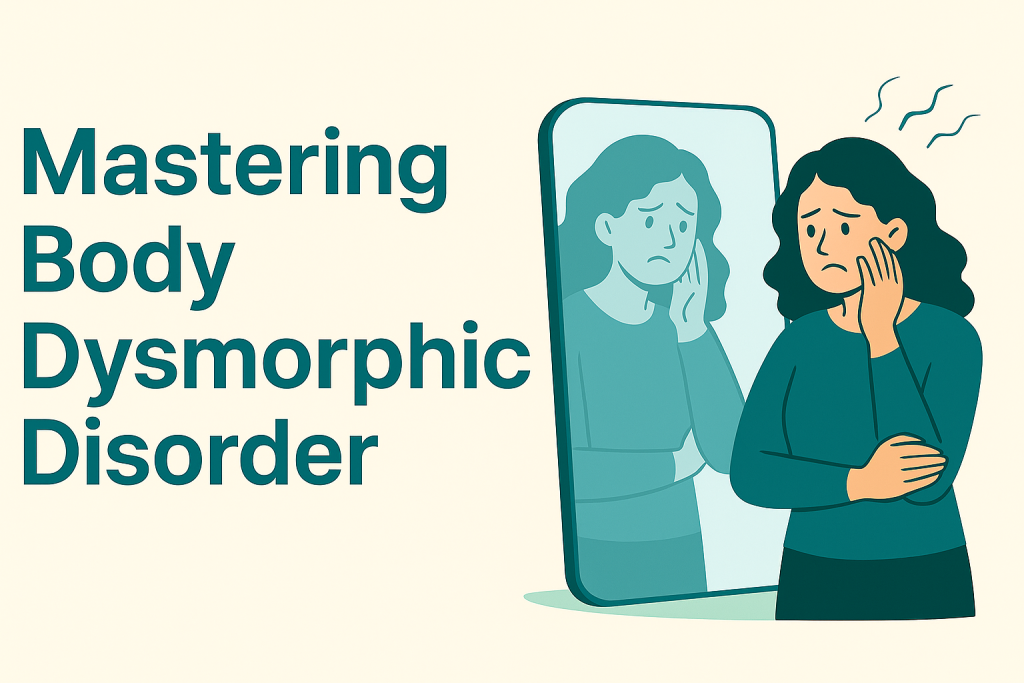
What is Body Dysmorphic Disorder (BDD)?
- Compulsive Checking — Spending excessive time checking appearance in mirrors or avoiding them entirely.
- Camouflaging Behaviors — Attempting to hide perceived flaws with clothing, makeup, hats, or body positioning.
- Reassurance Seeking — Repeatedly asking others for validation about appearance, though relief is temporary.
- Comparison Behaviors — Constantly comparing one’s appearance to others in person or through media.
- Intense Self-Consciousness — Belief that others take special notice of the perceived flaw in a negative way.
- Time Consumption — Preoccupations that are time-consuming (typically 3-8 hours daily).
- Functional Impairment — Difficulty concentrating at work or school, social withdrawal, and relationship issues.
- Treatment — Primarily addressed through specialized CBT and potentially SSRI medication.
While many people have occasional body insecurities, BDD involves preoccupations that are time-consuming (typically 3-8 hours daily), cause significant distress, and impair work, social or other areas of functioning. The thoughts are persistent, difficult to control, and often lead to compulsive behaviors.
While BDD is considered a chronic condition, it’s highly treatable with evidence-based approaches. Many people achieve significant recovery and improved quality of life through specially-tailored cognitive-behavioral therapy and/or medication. For more on behavioral pattern management, see our article on how to write DAP notes.
Yes, BDD is classified in the same category as obsessive-compulsive and related disorders. Both conditions involve persistent, intrusive thoughts (obsessions) and repetitive behaviors (compulsions). See BFRB vs OCD: Key Differences for further reading.
While both involve body image concerns, eating disorders focus specifically on weight, shape, and eating behaviors. BDD can involve any body part and doesn’t necessarily involve concerns about weight. That said, co-occurrence is possible—see our article on teen depression & body image for links between mood and body image concerns.
Cosmetic procedures do not address the underlying psychological mechanisms of BDD. Research shows most people with BDD experience little or no improvement after such procedures, or symptoms shift to other body parts. Check our piece on skin-picking & body image behaviors for overlapping behaviors.
Have you ever caught yourself in a mirror, hyper-focused on a tiny aspect of your appearance that you’re convinced mars your entire look? While many of us have occasional insecurities, for individuals with Body Dysmorphic Disorder (BDD), these thoughts aren’t passing concerns—they’re persistent, distressing, and can consume hours each day.
Body dysmorphic disorder is more than just insecurity; it’s a serious mental health condition where people can’t stop thinking about perceived flaws in their appearance, flaws that are often minor or unnoticeable to others. The emotional toll is profound, leading to significant distress, social isolation, and functional impairment in daily life. With proper understanding and evidence-based treatment, recovery is not just possible—it’s achievable. As someone who’s worked in mental health for a decade, I’ve seen how the right information presented clearly can be the first crucial step toward healing.
Evidence-Based Treatment: The Path to Recovery
The good news about BDD is that effective treatments exist, and many people experience significant improvement with proper care. Clinicians use specific CBT tools tailored for these exact mechanisms.
Cognitive Restructuring
Identifying and challenging distorted thoughts about appearance. This core CBT practice helps individuals see their cognitive biases clearly.
Exposure and Response Prevention (ERP)
Gradually facing feared situations (like going out without makeup) while resisting compulsive behaviors (like mirror checking).
Perceptual Retraining
Learning to view one’s body holistically rather than hyper-focusing on minute details. This actively rewires the brain’s visual processing habits.
Medication Options
Selective serotonin reuptake inhibitors (SSRIs) are typically the first-line medication approach for BDD, often helping to reduce the intensity of obsessive thoughts.
Key Insight: Time Consumption
Research indicates people with BDD typically spend 3-8 hours daily preoccupied with their perceived flaws. If you find your appearance concerns consuming significant time or causing distress, it’s worth discussing with a mental health professional.
Supporting a Loved One with BDD
Watching someone struggle with BDD can be heartbreaking. The most effective way to offer support is to educate yourself, validate their feelings without reinforcing the distorted beliefs, and avoid giving appearance reassurance—which often unintentionally maintains the BDD cycle. Gently encourage them toward professional treatment and practice patience.
Are You a Clinician Treating BDD?
Let TherapyDial handle the administrative burden of running your practice so you can focus entirely on clinical care.
- ✓ Professional Medical Billing
- ✓ FREE Insurance Credentialing
- ✓ FREE TherapyDial Profile Listing
- ✓ Priority Practice Support