Table of Contents
Alexithymia Treatments: Unlock Emotions with Proven Therapies, Mindfulness, and Practical Skills
Have you ever felt as though your emotions are locked behind a dense wall, completely out of reach? If so, you are not alone. Alexithymia—clinically defined as the profound difficulty in identifying, experiencing, and expressing emotions—can make interpersonal relationships profoundly confusing and personal insight incredibly elusive. It is not a conscious choice to be “emotionless”; rather, it is a neurobiological and psychological disconnect. The good news? Through targeted clinical therapies, mindful internal awareness practices, and accessible daily habits, most individuals can successfully learn to translate their bodily sensations into a rich emotional vocabulary. In this comprehensive guide, we’ll explore exactly what alexithymia is, how it develops, and the evidence-based treatments designed to help you reconnect with your inner world.
Understanding Alexithymia: The Disconnect Between Mind and Emotion
Derived from Greek, the term alexithymia translates roughly to “no words for emotions.” For someone living with this condition, internal emotional signals often manifest as vague, unidentifiable physical discomforts—such as a tight chest or sudden fatigue—rather than clear feelings like sadness or anger. When asked, “How are you feeling?”, the response is frequently restricted to practical, somatic, or overly generalized terms like “fine” or “bad.”
Clinically, alexithymia is conceptualized not as a distinct psychiatric disorder, but as a personality trait dimension that spans across a spectrum. It heavily influences how individuals process affective information. Key clinical signs include an impoverished emotional vocabulary, persistent confusion between emotional arousal and physical sensations, a concrete or externally-oriented thinking style, and profound difficulties reading the emotional cues of others.
Clinical Insight: It is crucial to understand that alexithymia is not a character flaw, nor does it indicate a lack of empathy. Rather, it represents a breakdown in the neural pathways that translate raw physiological arousal into conscious, labeled emotions. With patience and structured support, these pathways can be re-established.
The Psychological Impact: How Alexithymia Affects Daily Life
When internal emotional signals remain faint or entirely unreadable, basic life functions such as setting boundaries, making decisions, and sustaining intimacy become extraordinarily difficult. A person may feel perpetually detached or numb, moving through life on autopilot. Over time, the inability to consciously process and express needs can lead to chronic psychological distress, frequently culminating in co-occurring anxiety or depressive disorders.
Perhaps nowhere is the impact felt more acutely than in interpersonal connections. Because articulating needs and reciprocating emotional warmth is incredibly taxing, partners may misinterpret the alexithymic individual as aloof or uncaring. If this dynamic feels familiar in your own life, exploring dedicated strategies for alexithymia and relationships can be a transformative first step in rebuilding mutual understanding.
Common Etiological Factors: What Causes Alexithymia?
The origins of alexithymia are multifactorial, typically rooted in a combination of biological predispositions and environmental conditioning.
- Early Childhood Environment: Growing up in a family system where emotions are invalidated, punished, or ignored can force a child to defensively sever their connection to their emotional self in order to adapt.
- Trauma and Chronic Stress: Severe trauma can induce psychological numbing as a protective mechanism. In a state of chronic hyperarousal, the brain prioritizes survival instincts over emotional reflection, causing the “feeling” vocabulary to atrophy.
- Neurobiological Differences: Functional neuroimaging studies suggest that alexithymia may be linked to deficits in interoceptive awareness and disrupted connectivity between the limbic system (which generates emotions) and the prefrontal cortex (which categorizes and names them).
- Comorbidities: Alexithymia is frequently observed alongside other conditions, such as Autism Spectrum Disorder (ASD), as well as eating disorders and substance use disorders. In these cases, treatment is specifically adapted to respect neurodivergent processing styles.
Struggling with this?
You don’t have to navigate this alone. Connect with a licensed therapist today.
Book a Free 15-Minute ConsultationDiagnosis and Clinical Assessment
Identifying alexithymia requires a nuanced clinical approach. Mental health professionals typically utilize a combination of clinical interviews, behavioral observations, and standardized psychometric instruments. The most prominent assessment tool is the Toronto Alexithymia Scale (TAS-20), a robust self-report measure that evaluates three core factors: difficulty identifying feelings, difficulty describing feelings, and externally-oriented thinking.
While the TAS-20 provides an invaluable quantitative baseline, a skilled clinician will interpret these scores within the broader context of your lived experience. The overarching goal of clinical assessment is not simply to assign a label, but to precisely map your emotional blind spots so that a customized, highly effective treatment plan can be formulated and set into action.
Evidence-Based Therapeutic Interventions
Psychoeducation and Emotion Literacy Training
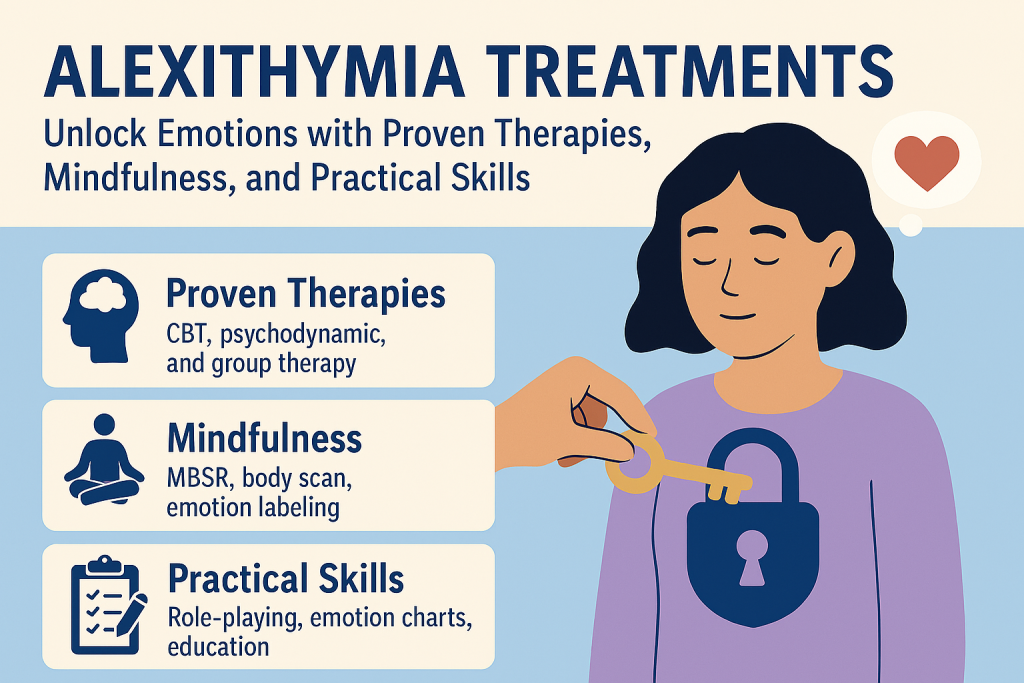
The very foundation of treating alexithymia involves learning the basic vocabulary of human emotion. Therapists frequently employ visual aids like “emotion wheels” and structured body check-in exercises. Patients are meticulously taught to identify the physiological correlates of emotions—for example, linking a tightened jaw or clenched fists to the concept of anger. If you currently struggle to articulate your internal state, beginning a structured journaling practice for emotional numbness can serve as an excellent bridge between body sensations and cognitive awareness.
Cognitive Behavioral Therapy (CBT)
According to the American Psychological Association (APA), CBT is a highly effective, structured approach that helps individuals identify, evaluate, and alter unhelpful cognitive patterns. For alexithymia, CBT interventions are specifically adapted to shift focus away from purely external, logical problem-solving, and actively redirect attention inward. Patients learn to monitor the intricate connections between their thoughts, their physical sensations, and their subsequent behavioral choices.
Emotion-Focused Therapy (EFT)
EFT is a deeply experiential modality. It encourages clients to actively contact and tolerate distressing feelings within the safe container of the therapeutic relationship. By gently guiding patients to explore the physical felt-sense of an emotion in real-time during sessions, EFT helps transform vague bodily discomfort into named, understood, and ultimately manageable emotional experiences.
The Crucial Role of Mindfulness and Interoception
Mindfulness practices are critical in treating alexithymia because they cultivate non-judgmental, present-moment awareness. The National Institutes of Health (NIH) highlights the broad, evidence-based benefits of mindfulness for overall mental health. For those with alexithymia, the therapeutic focus is placed heavily on interoception—the ability to perceive sensations originating inside the body. By learning to notice the subtle physiological shifts that precede an emotion, individuals can begin to safely “catch” feelings before they become overwhelming or completely repressed.
- Structured Body Scans: Taking a few minutes daily to systematically scan the body from head to toe, explicitly naming physical sensations without attaching a critical narrative to them.
- Affect Labeling: Practicing the deliberate pairing of a noted physical sensation with a potential emotion word (e.g., “My stomach feels tied in knots; I might be feeling anxious about this meeting”).
- Regulated Breathing: Utilizing diaphragmatic breathing exercises to actively soothe the autonomic nervous system, making it easier and safer to explore internal states without inducing panic.
Your Roadmap to Emotional Reconnection
Healing from alexithymia is a gradual, courageous process. While everyone’s journey is unique, here is a generalized roadmap of how progress often unfolds when working with a mental health professional:
Phase 1: Physiological Awareness
Focusing entirely on noticing and accurately naming physical sensations (e.g., hot, tight, heavy) without any pressure to assign complex emotional labels.
Phase 2: Building Vocabulary
Utilizing therapeutic tools, such as an emotion wheel, to systematically learn and attach descriptive words to those specific bodily sensations.
Phase 3: Relational Practice
Taking the brave step of beginning to share these newfound emotional labels with a safe, trusted individual or a therapist, practicing simple “I feel” statements.
Phase 4: Deep Integration
Experiencing emotions authentically in real-time, understanding their origin and purpose, and allowing them to gracefully inform your values, boundaries, and life decisions.
Frequently Asked Questions
Is alexithymia a formal psychiatric diagnosis?
No, alexithymia is not currently classified as a distinct mental disorder in the DSM-5. Rather, it is understood as a personality trait dimension that describes profound difficulties in emotional processing. It frequently co-occurs with other mental health conditions, such as depression, anxiety, or trauma-related disorders.
Can alexithymia be completely cured?
While the term “cure” is rarely used in psychology, individuals with alexithymia can absolutely experience massive improvements in their emotional awareness. Through consistent therapy, mindfulness, and dedicated practice, the brain can build new neural pathways that make identifying and expressing emotions significantly easier and more natural.
How can I support a partner who has alexithymia?
Patience and clear, direct communication are essential. Avoid asking open-ended questions like “How do you feel?” Instead, ask targeted questions about physical sensations, or provide multiple-choice options. Validating their experience and attending couples therapy can also foster mutual understanding and connection.
Ready to Start Healing?
Request a free consultation with a licensed therapist.
Message Sent!
Thank you for contacting TherapyDial. We will get back to you within 24 hours.