
Burnout is not simply the result of working long hours or feeling temporarily tired from a busy week. Clinically, burnout is a state of chronic, systemic nervous system exhaustion caused by prolonged exposure to unmanageable stress. It is a slow, biological depletion of your physical, emotional, and cognitive reserves. When the demands placed on you consistently outpace your opportunities to recover, your autonomic nervous system enters a state of persistent survival mode, leading to a profound sense of depletion, cynicism, and reduced efficacy.
This free, confidential assessment is adapted from the core dimensions of the **Maslach Burnout Inventory (MBI)**, the gold-standard diagnostic standard utilized by researchers and clinicians worldwide. It evaluates 10 key elements of your work and daily stress over the **past month**, assessing emotional exhaustion, physical fatigue, cynicism, cognitive load, and your feelings of personal achievement. It is designed to be supportive, patient-centric, and highly secure. Taking under 2 minutes, it provides instant clinical severity feedback and highly actionable regulation skills.
Burnout Assessment (MBI Self-Assessment)
Evaluate your chronic stress, fatigue, and recovery capacity over the past month. 100% confidential and secure.
Clinical Interpretation
💬 Speak with a Recovery & Somatic Specialist
Extricating yourself from chronic burnout requires structured boundary-setting, nervous system down-regulation, and experienced support. Book a free, 100% confidential consultation with a licensed specialist to discuss your results.
Book Free Consultation →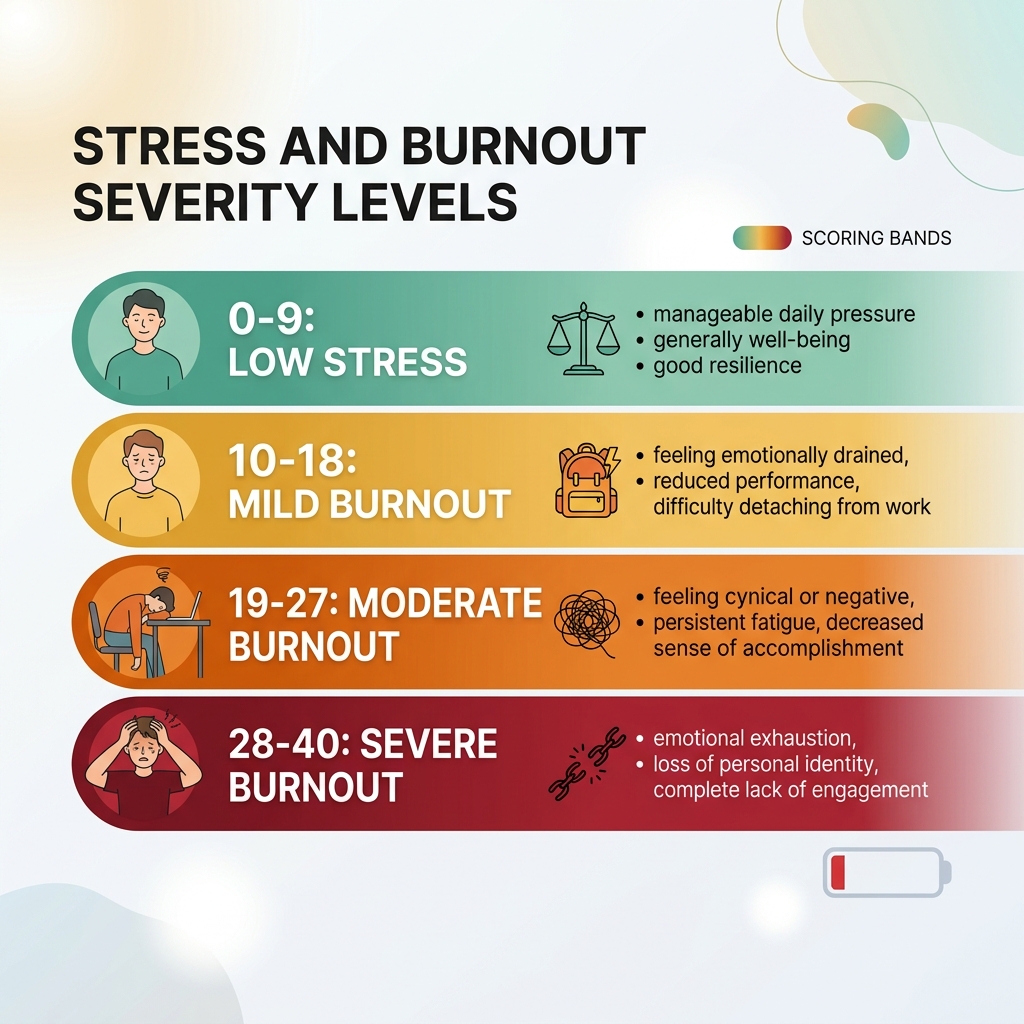
Understanding Your Burnout Score
The cumulative score of this adapted Maslach Burnout Inventory (MBI) self-assessment ranges from 0 to 40. It evaluates how deeply chronic stress has depleted your autonomic reserves and impacted your cognitive and emotional baseline. Here is how your score aligns with clinical stress categories:
- Low Stress or Healthy Balance (0–9): Your responses reflect typical stress response and high resilience. Minor work-life fatigue is normal and easily managed through basic rest.
- Mild Burnout / Elevated Stress (10–18): You are experiencing early biological warnings of system overload. While functional, your reserves are starting to run dry. Focus on boundaries and recovery.
- Moderate Burnout (19–27): You are experiencing significant stress accumulation. Intrusive fatigue, low motivation, cognitive overload, and irritability are actively interfering with your quality of life.
- Severe Burnout (28–40): Your nervous system is in an active state of chronic depletion and threat response. Working capacity, sleep, emotional control, and health are heavily compromised. High priority for recovery.
Please keep in mind that burnout is a dynamic state of nervous system exhaustion rather than a static medical condition. It responds exceptionally well to structured recovery protocols, including somatic therapy, nervous system down-regulation, pacing, and cognitive boundary rebuilding. If your score is moderate or severe, prioritizing active support is a powerful act of self-preservation.
Actionable Somatic Regulation and Recovery Skills
When chronic exhaustion activates your nervous system’s threat response, standard mental techniques can feel ineffective. Using physical, somatic containment tools helps shift your system from sympathetic arousal into a safe, restorative state:
- The Physiological Sigh: Discovered by physiologists and studied extensively by neurobiologists, this is the fastest way to manually downregulate your autonomic nervous system. Take a deep inhalation through your nose, immediately follow it with a quick, secondary “sip” of air to fully expand your lungs’ alveoli, and then perform a slow, extended exhale through your mouth. Repeating this cycle 3 to 5 times immediately triggers your vagus nerve to slow your heart rate.
- Systematic Boundary Mapping: Burnout is often a boundary problem. Create three distinct circles of commitments: **Essential** (things you must do), **Negotiable** (duties you can defer or delegate), and **Non-Essential** (commitments you must drop for 30 days). Practice saying a supportive “No” to protect your basic biological recovery time (sleep, nourishing meals, movement).
- Nervous System Restructuring (Therapy): While somatic exercises act as immediate resets, chronic burnout often stems from deep-seated patterns of people-pleasing, perfectionism, or systemic overload. Partnering with a licensed counselor helps you explore these behavioral loops in a secure, non-judgmental space, rebuilding sustainable structures for life.
Explore Additional Assessments
Anxiety Screening
GAD-7 Assessment
😔Depression Screening
PHQ-9 Assessment
🧠PTSD Screening
PCL-5 Assessment
Professional Support & Practice Guides
📖 Repressed Emotions Guide
Explore how emotional suppression impacts physical health and stress storage.
Learn to Release →💡 Modalities Compared
Learn the core differences between CBT, DBT, EMDR, and Psychodynamic therapy.
Compare Modalities →🧠 CBT Exercises for Anxiety
Five actionable Cognitive Behavioral Therapy exercises you can try at home tonight.
Explore CBT Skills →📖 Big Five Neuroticism Test
Take our 5-minute big five neuroticism self-assessment to map emotional reactivity.
Take Personality Test →Let’s Help You Restore Your Energy.
Chronic stress and depletion can make recovery feel completely out of reach. You do not have to navigate this alone. Book a free, 100% confidential consultation with a licensed recovery specialist to discuss your screening results and supportive recovery options.
Email Us
info@therapydial.comResponse Time
Within 24 hours, guaranteed
100% Confidential
HIPAA-compliant communications
Frequently Asked Questions
The Maslach Burnout Inventory (MBI) is the gold-standard research instrument developed by Dr. Christina Maslach. It is used worldwide to measure burnout across three core dimensions: emotional exhaustion, cynicism or depersonalization, and reduced feelings of personal achievement.
No. While they share overlapping symptoms (such as extreme fatigue, lack of motivation, and irritability), they are distinct. Burnout is typically context-specific (often tied to occupational or caretaking stress) and stems from system overload, whereas depression is a mood disorder that is generalized across all areas of a person’s life.
This assessment features 10 items rated on a 5-point scale from 0 (Never) to 4 (Very Often / Always). Summing your responses gives a total score between 0 and 40, which maps to four severity ranges: Low Stress (0-9), Mild Burnout (10-18), Moderate Burnout (19-27), and Severe Burnout (28-40).
Yes. Recovery from severe burnout involves systematic rebalancing of your nervous system and schedule. Many individuals recover successfully by mapping clear professional boundaries, requesting workload modifications, using somatic down-regulation, prioritizing sleep, and working with a licensed counselor to restructure behavioral coping mechanisms.
Yes, absolutely. The screening questions are processed entirely inside your local browser. Your specific answers are never stored or transmitted anywhere. The contact consultation form is securely processed via an SSL-encrypted, HIPAA-compliant pipeline directly to our clinical matching team.
💬 Chronic stress leaving you completely exhausted? Let’s discuss supportive recovery strategies.
Book Free Consultation