
Attention Deficit Hyperactivity Disorder (ADHD) affects an estimated 8.7 million adults in the United States, yet the majority remain undiagnosed well into adulthood. Unlike the hyperactive child bouncing off the walls — the image most people associate with ADHD — adult symptoms are far more subtle. They show up as chronic procrastination, missed deadlines, difficulty following conversations, impulsive financial decisions, and an overwhelming sense that you are not living up to your potential despite being intelligent and capable.
This free self-assessment is based on the World Health Organization’s Adult ADHD Self-Report Scale (ASRS v1.1), a validated six-question screening tool developed in collaboration with researchers at Harvard Medical School and New York University. It is used globally by clinicians as a first-pass screener to determine whether a full diagnostic evaluation is warranted. The questions below focus on the core symptom domains of inattention, hyperactivity, and impulsivity as defined by the DSM-5. It takes less than two minutes, your answers are never stored, and you will receive your results instantly on this page.
Adult ADHD Self-Assessment
Answer 6 questions based on the WHO ASRS v1.1 screener. Your results are instant, private, and never stored.
Clinical Metric Breakdown
💬 Speak With a Supportive ADHD Specialist
Your results suggest it would be valuable to speak with a licensed clinician. Book a free, no-obligation consultation to discuss your experiences and find personalized strategies.
Book Free Consultation →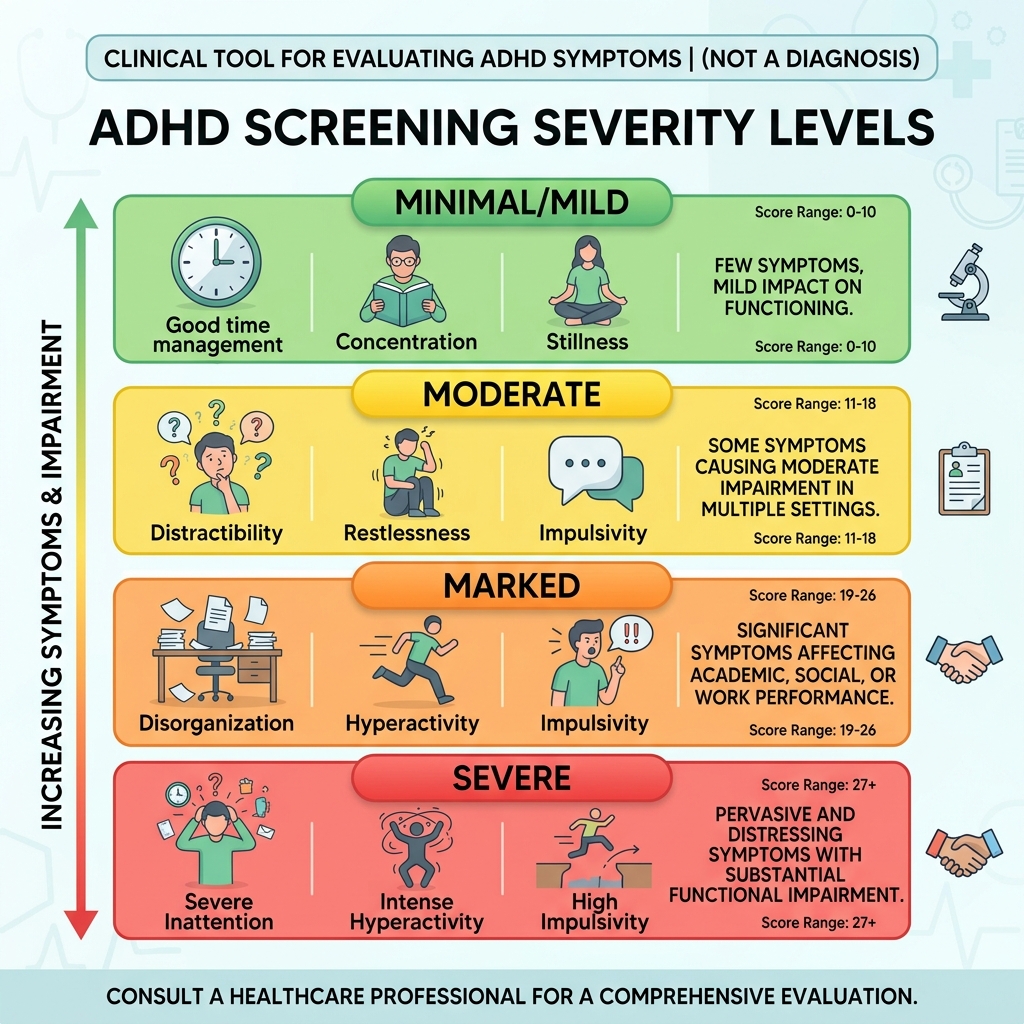
Understanding the ASRS v1.1 Screening Tool
The Adult ADHD Self-Report Scale (ASRS v1.1) was developed by the World Health Organization in collaboration with researchers at Harvard Medical School and New York University. It is one of the most widely used ADHD screening instruments in the world, translated into dozens of languages and referenced in clinical guidelines across multiple countries. The six questions in Part A of the ASRS are specifically designed to capture the symptoms most predictive of an ADHD diagnosis in adults.
The screener evaluates two core symptom domains. Questions one through three assess inattention — difficulties with task completion, organization, and memory that go beyond ordinary forgetfulness. Questions four through six assess hyperactivity and impulsivity — patterns of avoidance, physical restlessness, and a feeling of being internally driven that interferes with daily life. These domains correspond directly to the DSM-5 diagnostic criteria for ADHD, which distinguishes between the Predominantly Inattentive presentation, the Predominantly Hyperactive-Impulsive presentation, and the Combined presentation.
It is important to note that a high score on this screener does not mean you have ADHD. Many conditions — including anxiety, depression, sleep disorders, thyroid dysfunction, and chronic stress — can produce symptoms that overlap significantly with ADHD. A comprehensive diagnostic evaluation by a licensed clinician typically includes a detailed clinical interview, a review of childhood developmental history, collateral information from family or partners, and often standardized neuropsychological testing to rule out other explanations.
What to Do Next
If your score falls in the moderate or high range, the single most impactful step you can take is to talk to a professional. Many clinicians now offer telehealth evaluations, making access easier regardless of where you live. A comprehensive evaluation can clarify whether ADHD is the right explanation for your experiences and open the door to treatment options — including therapy, medication, coaching, or environmental modifications — that have a very high success rate in adults.
You do not need to have a confirmed diagnosis to reach out. If the patterns described in this screener feel familiar, that alone is reason enough to explore further. Use the form below to book a free, no-obligation consultation with a licensed clinician in our network.
Explore More Self-Assessments
Neuroticism Test
Big Five Personality
😰Anxiety Screening
GAD-7 • Coming Soon
😢Depression Screening
PHQ-9 • Coming Soon
Helpful Resources
Let’s Get You the Help You Deserve.
Ready to clarify your symptoms and explore real solutions? Book a free, confidential consultation with a licensed therapist to discuss your screening results.
Email Us
info@therapydial.comResponse Time
Within 24 hours, guaranteed
100% Confidential
HIPAA-compliant communications
Frequently Asked Questions
No. This is a screening tool, not a diagnostic instrument. The ASRS v1.1 is designed to identify individuals who may benefit from a comprehensive clinical evaluation. Only a licensed mental health professional or physician can provide an official ADHD diagnosis through a thorough assessment that includes clinical interviews, developmental history, and often neuropsychological testing.
The Adult ADHD Self-Report Scale (ASRS v1.1) is a screening tool developed by the World Health Organization in collaboration with Harvard Medical School and New York University. It consists of six questions that assess the core symptom domains of inattention, hyperactivity, and impulsivity in adults. It is one of the most widely validated ADHD screeners in the world and is freely available for public use.
ADHD is a neurodevelopmental condition that begins in childhood, but symptoms often persist into adulthood. Many adults are not diagnosed until their 30s, 40s, or even later because their symptoms were masked by coping strategies, a supportive environment, or were misattributed to anxiety, depression, or personality traits. Current estimates suggest that roughly 60% of children with ADHD continue to meet diagnostic criteria as adults.
A low score on this screener does not definitively rule out ADHD. Individuals with strong coping mechanisms, high intelligence, or the predominantly inattentive subtype may score lower than expected. If you continue to suspect ADHD, we recommend booking a free consultation with a specialist who can look beyond surface-level symptom counts.
No. This assessment runs entirely in your browser. Your answers and your score are never transmitted to any server, never stored in any database, and never shared with any third party. When you close or refresh the page, your data is gone. Your privacy is absolute.
When you submit the form above, a licensed therapist from our network will reach out within 24 hours. The initial consultation is free and confidential — there is no cost and no obligation. The therapist will discuss your screening results, ask about your experiences, and help you determine whether a full ADHD evaluation or other mental health support would be beneficial for you.
💬 Concerned about your results? Discuss options with a specialist.
Book Free Consultation