
How to Start a Private Therapy Practice in Pennsylvania
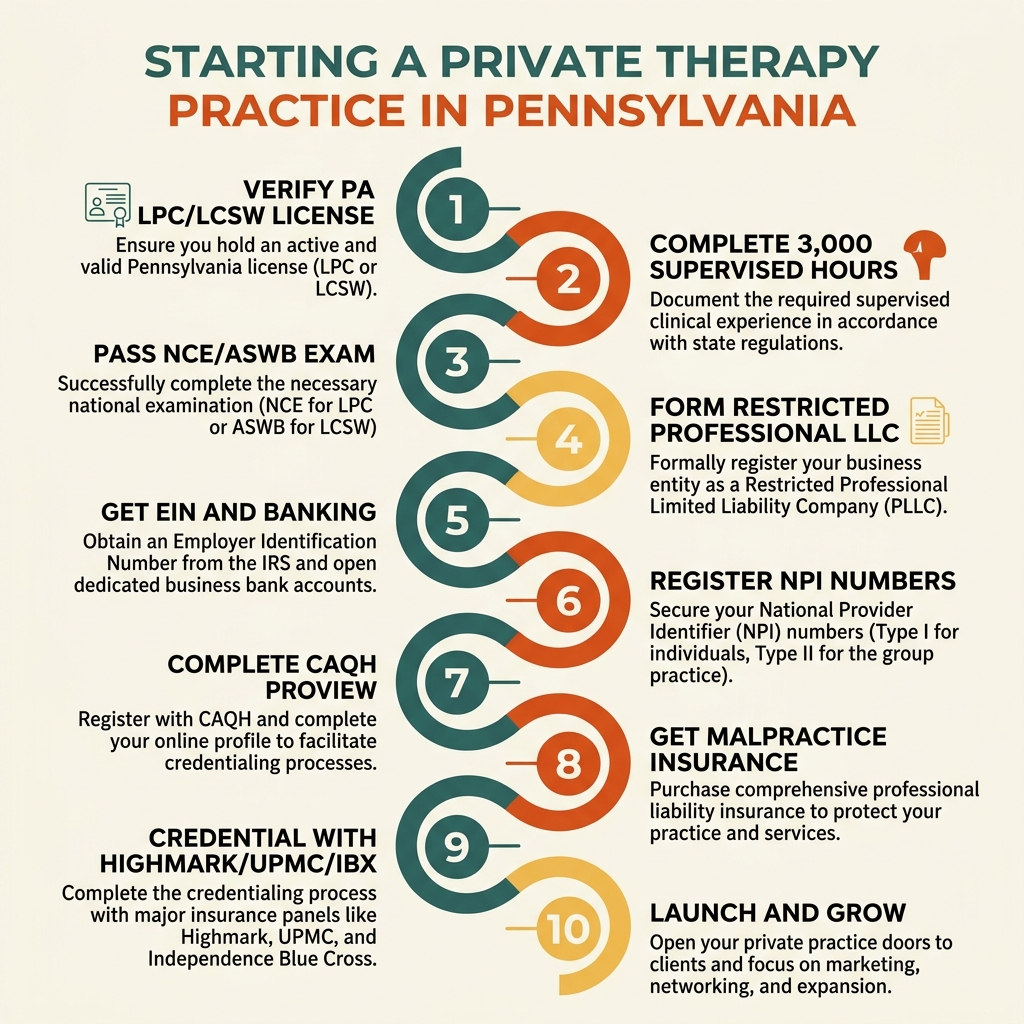
- Verify PA License — Ensure your LPC, LCSW, or LMFT is active via the PA Licensing System (PALS).
- Form Entity — Register a Restricted Professional LLC with the PA Department of State (PA DOS).
- Get EIN — Apply for your Employer Identification Number through the IRS.
- NPI Numbers — Register your individual (Type 1) and organizational (Type 2) IDs via NPPES.
- CAQH Profile — Complete and attest your CAQH ProView profile for insurance enrollment.
- Malpractice Insurance — Secure clinical coverage through providers like HPSO or CPH & Associates.
- Credentialing — Apply to regional payers like Highmark BCBS, UPMC Health Plan, or Independence Blue Cross.
- Office Setup — Choose between a physical PA office or a HIPAA-compliant telehealth platform.
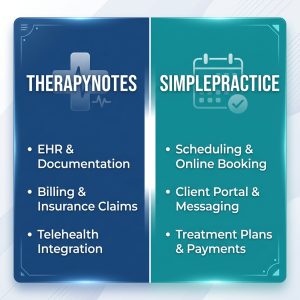
- Tech Stack — Implement an EHR like SimplePractice or TherapyNotes for scheduling and billing.
- Local SEO — Optimize your Google Business Profile to attract clients statewide.
Frequently Asked Questions
No. Pennsylvania requires therapists to form a Restricted Professional LLC under the PA Department of State (PA DOS) guidelines. All members must hold valid professional licenses.
No. Standard mental health therapists (LPCs, LCSWs, LMFTs) do not prescribe medication and therefore do not require a DEA number. This is only necessary for psychiatrists or prescribing psychiatric NPs.
The Pennsylvania State Board requires 3,000 hours of post-degree supervised clinical experience, including 150 hours of direct supervision. At least 50% must be individual supervision.
The LAPC is Pennsylvania’s pre-licensure credential. You must hold a master’s degree and pass the NCE, but you cannot operate an independent private practice until fully licensed as an LPC.
It depends on your location. In western PA, start with Highmark BCBS and UPMC Health Plan. In the Philadelphia region, prioritize Independence Blue Cross, along with national payers like Aetna or UnitedHealthcare/Optum.
Pennsylvania is a tale of two markets. Philadelphia anchors the east with one of the densest therapist populations in the country, while Pittsburgh’s growing healthcare ecosystem dominates the west. In between, rural PA faces severe mental health shortages — creating significant opportunity for solo practitioners willing to serve underserved communities via telehealth.
This guide walks you through every step of launching a private therapy practice in Pennsylvania — from navigating the Restricted Professional LLC entity requirement with the PA DOS to credentialing with Highmark BCBS, UPMC Health Plan, and Independence Blue Cross.
Already exploring other states? See our guides for New York, Florida, and New Jersey.
How Pennsylvania Compares to Other States
| Factor | Pennsylvania | New York | New Jersey | Texas | Florida |
|---|---|---|---|---|---|
| Entity Type | Restricted Prof. LLC | PLLC only | LLC | LLC / PLLC | LLC / PLLC |
| State Income Tax | 3.07% flat | Up to 10.9% | Up to 10.75% | 0% | 0% |
| Supervision Hours | 3,000 | Varies | 4,500 | 3,000 | 1,500 |
| Exams Required | NCE / Clinical | Clinical | Clinical | NCE + Jurisprudence | Clinical + Laws/Rules |
| Credentialing Wait | 90–120 days | 90–120 days | 90–120 days | 60–120 days | 90–120 days |
| Top Payer | Highmark / IBX | Empire BCBS | Horizon BCBS | BCBS of Texas | Florida Blue |
The Complete Pennsylvania Private Practice Roadmap
Confirm Your PA License
Verify your license is active and unrestricted through PALS (PA Licensing System). You must hold a full independent license — LPC, LCSW, or LMFT — to operate a solo private practice in PA.
Need a Pennsylvania License?
Whether you’re applying for initial licensure or transferring from another state, we can handle the paperwork.
→ Ask About Our Licensure AssistanceForm Your Restricted Professional LLC
Pennsylvania requires therapists to form a Restricted Professional LLC under the PA DOS. This is similar to a PLLC requirement — all members must hold valid professional licenses.
- File a Certificate of Organization with the PA Department of State.
- Your filing must clearly state it is a “restricted professional company.”
- Designate a physical registered office in PA.
Get Your EIN & Business Banking
Apply for a free Employer Identification Number from the IRS at irs.gov. Once received, open a dedicated business checking account to keep your finances separate.
Register Your NPI Numbers
The National Provider Identifier (NPI) is required for all HIPAA-covered billing on CMS-1500 forms.
- NPI Type 1: Your individual clinician ID.
- NPI Type 2: Your restricted professional LLC’s organizational ID.
Register at NPPES for same-day processing.
Complete Your CAQH ProView Profile
CAQH ProView is mandatory for credentialing with both Highmark and UPMC. Ensure you grant access to all payers you plan to credential with and re-attest every 120 days.
Secure Malpractice Insurance
Expect $100–$500/year for a solo practitioner policy. Providers like HPSO and CPH & Associates are popular in PA. If you hold dual PA/NJ licenses, confirm your policy covers both states.
Begin Insurance Credentialing
PA’s insurance market requires different panels depending on your location:
- Highmark BCBS — Dominant in western PA.
- Independence Blue Cross — Dominant in Philadelphia.
- UPMC Health Plan — Major in Pittsburgh, expanding statewide.
- Aetna & UnitedHealthcare / Optum.
Expect 90–120 days per panel.
Choose Your Practice Setting
Set Up Your Tech Stack
SimplePractice
Scheduling, billing, and HIPAA portal.
Spruce Health
HIPAA-compliant phone and fax.
Availity / Waystar
Submit CMS-1500 claims smoothly.
Master Medical Billing & Coding
Accurate billing with proper CPT codes (e.g., CPT 90834, 90837, 90847) and ICD-10-CM diagnosis codes is critical for avoiding claim denials with Highmark and UPMC.
Ongoing Compliance & CEUs
File an Annual Registration with the PA DOS to keep your LLC active. Re-verify CAQH every 120 days. Track your continuing education through platforms like CE Broker (LPCs need 30 hours biennially).
Pro-Tip: Bookmark this guide for your next credentialing cycle.
Pennsylvania Break-Even Calculator
Estimate how many sessions per week you need to cover overhead. PA state income tax is a flat 3.07%.
Exclusive Provider Bundle
- ✔ Professional Medical Billing
- ✔ FREE Insurance Credentialing
- ✔ FREE TherapyDial Profile Listing
- ✔ Priority Practice Support
HIPAA Compliant & Expertly Managed.
Clinical Coding & Documentation Resources
Mastering correct coding and documentation is essential for avoiding denials: