
How to Start a Therapy Private Practice in Texas
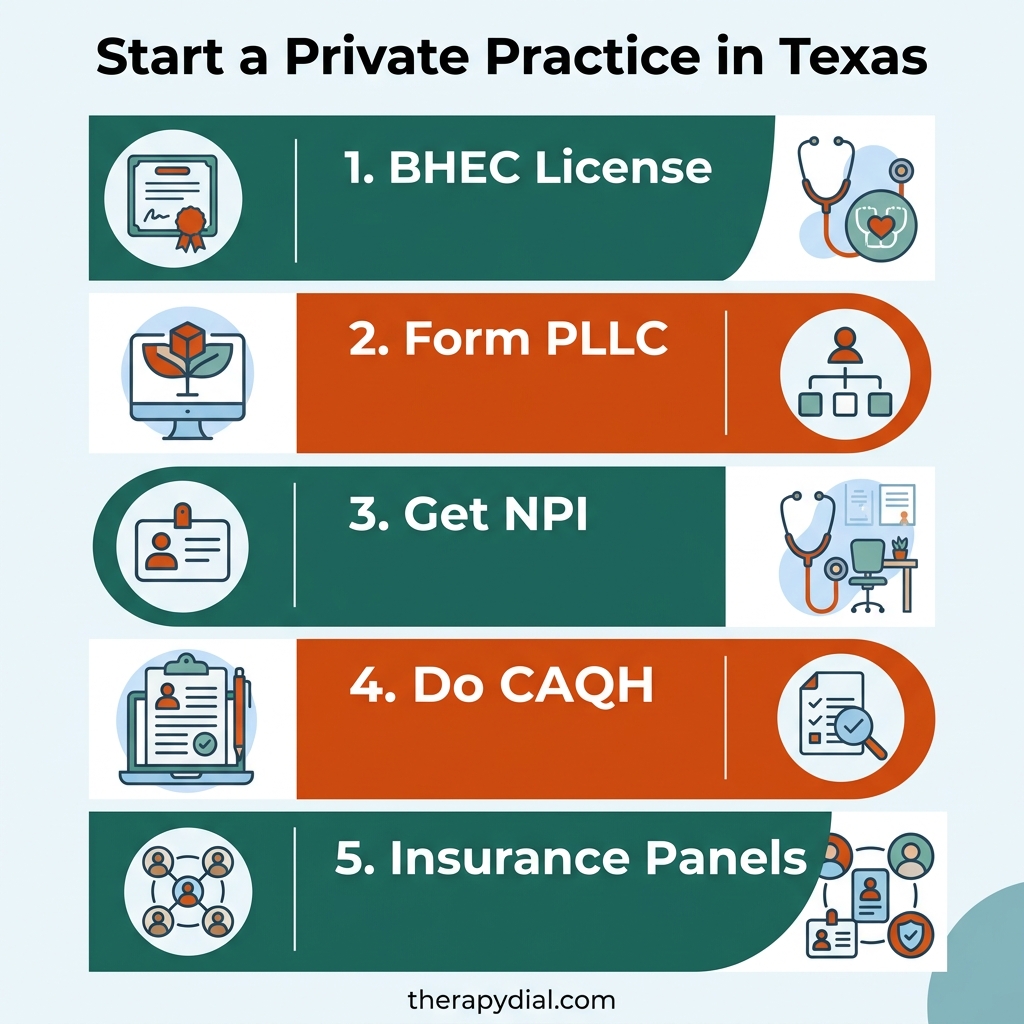
- Verify Texas Licensure — Ensure your LPC, LCSW, LMFT, or Psychologist license is active and independent through the Texas Behavioral Health Executive Council (BHEC).
- Form a Business Entity — File a Certificate of Formation for a Professional Limited Liability Company (PLLC) or LLC with the Texas Secretary of State.
- Obtain an EIN — Register with the IRS for a free Employer Identification Number for tax purposes.
- Register for NPIs — Apply through the NPPES portal for a Type 1 (Individual) and Type 2 (Organization) National Provider Identifier.
- Purchase Malpractice Insurance — Secure professional liability coverage meeting Texas board minimums through carriers like HPSO or CPH & Associates.
- Complete CAQH ProView — Build your universal credentialing profile in CAQH ProView so Texas insurers can verify your credentials.
- Get Credentialed — Apply to major Texas payer panels including BCBSTX, Texas Medicaid (TMHP), UnitedHealthcare/Optum, and Aetna.
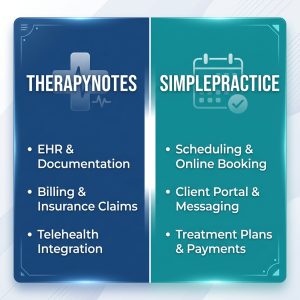
- Set Up Clinical Tools — Choose an ONC-certified EHR like SimplePractice and a telehealth platform like Doxy.me or Spruce Health.
- Establish Billing & RCM — Partner with a medical biller or setup Waystar/Availity clearinghouses to manage CPT 90834/90837 claims.
- Maintain Compliance — Complete mandatory CE Broker hours for BHEC renewal and file your annual Texas Franchise Tax report.
Frequently Asked Questions
No. Master’s-level therapists (LPCs, LCSWs, LMFTs) and Psychologists in Texas do not have prescriptive authority. Therefore, you do not need to register with the DEA or obtain a DEA number unless you are a prescribing provider like a Psychiatrist or a Psychiatric Nurse Practitioner (PMHNP).
Texas allows mental health professionals to form either a standard LLC or a Professional Limited Liability Company (PLLC) through the Texas Secretary of State. However, a PLLC is heavily recommended to separate your personal assets from professional malpractice claims, and many payers like BCBSTX and Texas Medicaid prefer a PLLC for credentialing.
In Texas, the credentialing wait time is typically 60 to 120 days depending on the payer. Platforms like CAQH ProView speed up the process, but direct panels like Texas Medicaid (TMHP) or UnitedHealthcare/Optum can take months to process your CMS-855I equivalent paperwork. Start credentialing the moment your BHEC license and NPIs are active.
No. According to BHEC regulations, an LPC-Associate, LMSW, or LMFT-Associate cannot own an independent private practice. You must complete your 3,000 required supervised clinical hours and upgrade to a fully independent license before forming a solo PLLC and billing commercial insurance independently.
Texas has no state personal income tax, meaning solo practice owners keep more of their revenue. However, you must file an annual Texas Franchise Tax Report with the State Comptroller. Most solo therapy practices fall below the revenue threshold (over $1.23 million) to owe actual franchise tax, but filing the No Tax Due Information Report is legally required to maintain your entity’s active status.
Texas is one of the fastest-growing and highest-demand therapy markets in the United States. With a massive population and an expanding tele-health landscape, there has never been a better time to launch an independent practice in the Lone Star State. However, between navigating the Texas Behavioral Health Executive Council (BHEC) regulations, structuring your business, registering for your NPI, and surviving the arduous insurance credentialing process, the path from licensed clinician to successful practice owner is fraught with bureaucratic hurdles.
This guide breaks the entire process into a precise, step-by-step roadmap. Whether you are an LPC, LCSW, LMFT, or Psychologist, this is your definitive playbook for building a compliant, profitable private practice in Texas.
Texas vs. Other Major States
Unlike California or New York, Texas does not levy a state personal income tax, and it does not mandate a costly newspaper publication for your LLC/PLLC. However, the BHEC licensing board is notoriously strict regarding associate-level supervision hours and continuing education reporting (via CE Broker). Texas is also heavily dominated by a few massive payers—specifically Blue Cross Blue Shield of Texas (BCBSTX) and Texas Medicaid (TMHP).
| Requirement | Texas (Subject State) | New York | California |
|---|---|---|---|
| Entity Type | PLLC or LLC | PLLC (Strict) + Publication | Professional Corp (PC) |
| State Income Tax | None (0%) | 4.0% – 10.9% | 1.0% – 13.3% |
| Supervision (LPC/LMHC) | 3,000 Hours (1,500 direct) | 3,000 Hours (1,500 direct) | 3,000 Hours |
| Exams Required | NCE/NCMHCE + TX Jurisprudence | NCMHCE only | NCMHCE + CA Law/Ethics |
| Credentialing Wait | 60 – 120 Days | 90 – 150 Days | 90 – 120 Days |
| Top Commercial Payer | BCBS of Texas | Empire BCBS / Fidelis | Anthem Blue Cross |
The Complete Texas Private Practice Roadmap
Verify Your BHEC License
Before launching your practice, ensure your license is active and independent via the Texas Behavioral Health Executive Council (BHEC). BHEC is the umbrella agency governing LPCs, LCSWs, LMFTs, and Psychologists.
Associate Warning
LPC-Associates and LMSWs cannot operate an independent practice. You must finish your 3,000 supervised hours and pass the Texas Jurisprudence Exam before upgrading.
Form Your PLLC with the Texas Secretary of State
Establish your legal business entity to shield your personal assets. Most mental health professionals form a Professional Limited Liability Company (PLLC).
- File Form 206 (Certificate of Formation for a Professional LLC).
- Submit the $300 filing fee via the Texas SOSDirect portal.
- Designate a Registered Agent with a physical Texas address.
While Texas permits standard LLCs, payers like BCBSTX often prefer PLLCs for clinical practices.
Obtain Your EIN & State Tax ID
Apply for a free Employer Identification Number (EIN) on the IRS website. This serves as your business’s tax ID, allowing you to open a business bank account and process W-9s.
You must also register with the Texas Comptroller of Public Accounts to file your annual Franchise Tax report. Even though solo practices rarely owe tax, the “No Tax Due” filing is legally mandatory to keep your PLLC active.
Acquire Your NPI Numbers
Your National Provider Identifier (NPI) is a 10-digit number used to track HIPAA-standard electronic transactions (like CMS-1500 claim forms). You need two from the NPPES portal:
- NPI Type 1: Your personal, lifelong clinician identifier.
- NPI Type 2: Your business entity’s identifier (attached to your PLLC/EIN).
Medical billing clearinghouses like Waystar or Availity will reject claims submitted without proper NPI pairing.
Secure Texas Malpractice Insurance
You cannot credential with payers without active professional liability coverage. Typical policies range from $100 to $500 annually.
Carriers like HPSO, CPH & Associates, and the Texas Counseling Association (TCA) group plans are standard. Ensure your policy covers both you individually and your PLLC entity, and meets the minimum limits required by BHEC and commercial panels.
Setup Your CAQH ProView Profile
The CAQH ProView platform is the universal credentialing database. Nearly every payer in Texas utilizes this system to verify your credentials.
Re-Attestation Alert
You must re-attest your CAQH profile every 120 days. Failing to do so will result in suspended insurance payments from major payers.
Credential with Texas Insurance Payers
Credentialing is the bottleneck of starting a practice, taking anywhere from 60 to 120 days. In Texas, you should prioritize the largest panels to secure patient volume:
- Blue Cross Blue Shield of Texas (BCBSTX): The dominant commercial payer.
- Texas Medicaid (TMHP): Crucial if you work with underserved populations (requires a robust onboarding portal).
- Aetna and UnitedHealthcare / Optum.
- Humana / TriCare: Texas has a massive military presence, making TriCare a powerful network to join.
Implement a HIPAA-Compliant Tech Stack
Select practice management software to handle your clinical documentation and scheduling. Popular tools include:
- EHR Systems: SimplePractice, TherapyNotes, or TheraNest.
- Telehealth: Doxy.me, Zoom for Healthcare.
- Communications: Spruce Health for encrypted VOIP and SMS.
Ensure you sign a Business Associate Agreement (BAA) with every software vendor to maintain federal HIPAA compliance.
Establish Your Medical Billing Workflows
Submitting clean claims via the CMS-1500 form requires precision. You must master coding, including primary diagnostic ICD-10-CM codes (like F41.1 for GAD) and procedural CPT codes (e.g., CPT 90837 for a 60-minute psychotherapy session).
Many clinicians outsource this to a specialized revenue cycle management (RCM) team to prevent denials and navigate Availity or Waystar clearinghouse rejections seamlessly.
Pro-Tip: Bookmark this guide for your next credentialing cycle.
Texas Private Practice Break-Even Calculator
Estimate how many sessions per week you need to hit your take-home goal. Note: Texas has no state personal income tax, so your net retention is higher!
Exclusive Provider Bundle:
Billing + Free Growth
- Professional Medical Billing
- FREE Insurance Credentialing
- FREE TherapyDial Profile Listing
- Priority Practice Support
Stop fighting with insurance paperwork. We handle your complete credentialing and ongoing billing.
HIPAA Compliant & Expertly Managed.
Extended Clinical & Coding Resources
Stay ahead of mental health trends and master your diagnostic accuracy with our deep-dive guides: