If you’re launching a private practice, joining a group practice, or transitioning to insurance-based billing, one of the very first administrative steps you’ll encounter is getting your NPI number. It’s free, it’s required by federal law, and without it, you literally cannot submit a single insurance claim.
This guide, written by Jason Roy and reviewed by licensed clinicians, explains exactly what an NPI number is, how to apply for one, and the critical difference between Type 1 and Type 2 NPIs that every therapist needs to understand.
Quick NPI Facts
The National Provider Identifier (NPI) is a unique 10-digit number assigned to every healthcare provider in the United States. It was established under HIPAA in 1996 and is administered by CMS (Centers for Medicare & Medicaid Services). Your NPI never expires, never changes, and follows you throughout your entire career — regardless of where you practice or who you work for.
What Is an NPI Number and Why Do Therapists Need One?
The National Provider Identifier is the universal identification number used across the entire U.S. healthcare system to identify individual clinicians and organizations. Think of it as your “Social Security Number” for healthcare billing.
As a therapist — whether you’re an LCSW, LMHC, LMFT, Licensed Psychologist, or LCAT — you are classified as a “healthcare provider” under HIPAA. That means you are legally required to have an NPI if you transmit any health information in electronic form, which includes:
- Submitting insurance claims (even through a billing service)
- Receiving Electronic Remittance Advice (ERA) from payers
- Checking patient eligibility and benefits electronically
- Submitting referrals or prior authorizations
Type 1 vs. Type 2 NPI: What’s the Difference?
This is where many new therapists get confused. There are two types of NPI numbers, and depending on your practice structure, you may need one or both.
| Feature | Type 1 NPI (Individual) | Type 2 NPI (Organization) |
|---|---|---|
| Who gets it? | Individual therapists, counselors, psychologists | Group practices, PLLCs, clinics, hospitals |
| Tied to | Your SSN (personal) | Your EIN (business Tax ID) |
| Follows you? | Yes — for life, across all employers | Tied to the organization, not the individual |
| Required for | All individual claim submissions | Billing under a business entity (PLLC, PC, LLC) |
| Solo practice? | Required | Required if billing under your PLLC/business name |
| Cost | Free | Free |
Do You Need Both?
If you’re a solo practitioner billing under your own name (e.g., “Jane Smith, LCSW”), you only need a Type 1 NPI. However, if you formed a PLLC, PC, or any business entity and bill under that entity’s name and EIN, you need both a Type 1 (you as the rendering provider) and a Type 2 (your practice as the billing entity). Most insurance companies require both numbers on claims when you bill through a business entity. For more on forming a PLLC, see our guide on starting a private practice in New York.
How to Apply for an NPI Number: Step-by-Step
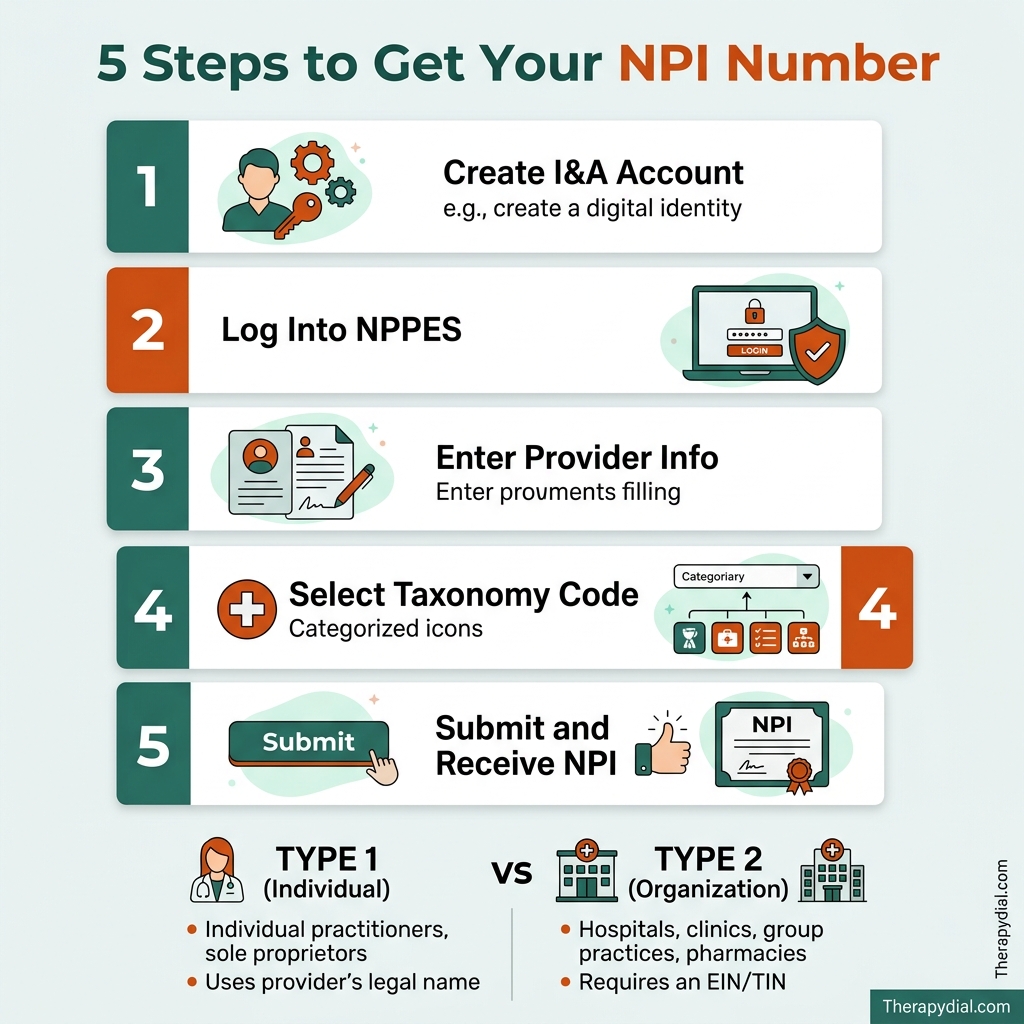
The application process is free and straightforward through the National Plan and Provider Enumeration System (NPPES). Here’s exactly what to do:
Create an I&A System Account
Before you can apply for an NPI, you must first create an account in CMS’s Identity & Access Management (I&A) System. Go to nppes.cms.hhs.gov and click “Create Account.” You’ll need your email address and a government-issued ID for verification.
Log In and Start Your Application
Once your I&A account is active, log in to NPPES and select “Apply for an NPI.” Choose Entity Type 1 for your individual provider NPI.
Enter Your Provider Information
You’ll need to provide: your full legal name (as it appears on your license), SSN, date of birth, state license number, practice address, and your taxonomy code. Your taxonomy code identifies your specialty — for example, 101YM0800X for Mental Health Counselors or 104100000X for Social Workers.
Select Your Taxonomy Code
This is the code that tells the NPPES system what type of provider you are. Common taxonomy codes for therapists:
- 1041C0700X — Clinical Social Worker
- 101YM0800X — Mental Health Counselor
- 106H00000X — Marriage & Family Therapist
- 103TC0700X — Clinical Psychologist
- 101YA0400X — Addiction/Substance Abuse Counselor
Submit and Receive Your NPI
After reviewing your information, submit the application. Online applications are typically processed within 1–2 business days. You’ll receive your 10-digit NPI number via email. Paper applications (Form CMS-10114) take approximately 20 business days. You can contact the NPI Enumerator at 1-800-465-3203 for help.
Applying for a Type 2 NPI (For Your Practice)
If you’ve formed a business entity (PLLC, PC, or group practice), repeat the process above but select Entity Type 2. Instead of your SSN, you’ll provide your business’s EIN (Employer Identification Number). The Type 2 NPI will be linked to your practice’s legal name, not your personal name. Both Type 1 and Type 2 applications are processed through the same NPPES portal.
What Happens After You Get Your NPI?
Getting your NPI is just one piece of the billing and credentialing puzzle. Here’s what comes next:
1. Set Up Your CAQH ProView Profile
Nearly every insurance company uses CAQH (Council for Affordable Quality Healthcare) as the central credentialing database. Your NPI is the primary identifier they use to pull your profile. Complete your CAQH profile immediately after receiving your NPI — it requires your NPI, license numbers, malpractice insurance details, and education history.
2. Start Insurance Credentialing
With your NPI and CAQH profile in place, you can begin applying to become an in-network provider with insurance companies like Aetna, UnitedHealthcare, Cigna, and BlueCross BlueShield. This process typically takes 60–120 days per payer. For a comparison of credentialing platforms, see our Alma vs. Headway 2026 analysis.
3. Configure Your Billing System
Your NPI must be linked to your EHR/practice management software (SimplePractice, TherapyNotes, Jane App) for electronic claim submission. Ensure your NPI is entered correctly — even a single digit error will cause every claim to be rejected. Understanding how ICD and CPT codes work together is essential for clean claim submission.
4. Master Your Clinical Documentation
Insurance companies tie your NPI to every claim, and every claim must be supported by proper clinical documentation. Get your documentation standards in place early by reviewing our guides on SOAP notes and progress notes.
Common NPI Mistakes Therapists Make
These errors are surprisingly common and can delay your billing setup by weeks or even months:
| Mistake | Consequence | How to Fix |
|---|---|---|
| Wrong taxonomy code | Claims rejected by payers who check taxonomy | Log into NPPES and update your taxonomy code |
| Outdated practice address | Credentialing applications rejected or delayed | Update NPPES within 30 days of any address change |
| Using only Type 1 when billing under a PLLC | Claims denied — payers require both Type 1 and Type 2 | Apply for a Type 2 NPI linked to your EIN |
| Not deactivating old NPIs | Duplicate NPI records cause credentialing conflicts | Contact the NPI Enumerator at 1-800-465-3203 |
| Entering NPI incorrectly in EHR | Every single claim gets rejected automatically | Verify your NPI in the NPI Registry and re-enter |
How to Look Up an NPI Number
Need to verify your own NPI or look up another provider? The NPPES NPI Registry is the official, free search tool. You can search by:
- NPI number — if you know it and want to verify the details
- Provider name — first and last name search
- Organization name — for Type 2 NPI lookups
- State and taxonomy — to find providers in a specific specialty
This is also where insurance companies, billing services, and credentialing organizations verify your information. Keeping your NPPES record up-to-date is critical — if your practice address, phone number, or taxonomy code doesn’t match what the payer has on file, claims can be denied.
NPI and Insurance Billing: How They Connect
Your NPI appears on every single insurance claim you submit. Here’s how it maps to the standard CMS-1500 claim form that therapists use:
| CMS-1500 Field | NPI Used | Description |
|---|---|---|
| Box 24J | Type 1 (Individual) | Rendering provider — the therapist who saw the client |
| Box 33a | Type 2 (Organization) or Type 1 | Billing provider — the entity submitting the claim |
For therapists billing common CPT codes like 99203, 90834, or 90837, accurate NPI entry is the difference between getting paid in 14 days and getting a stack of denial letters. Understanding the relationship between your NPI, ICD-10 and CPT codes, and your CAQH profile is foundational to running a financially healthy practice.
Exclusive Provider Bundle:
Billing + Free Growth
- Professional Medical Billing
- FREE Insurance Credentialing
- FREE TherapyDial Profile Listing
- Priority Practice Support
We handle your NPI setup, CAQH profile, credentialing, and billing — so you focus on clients.
HIPAA Compliant & OMH Standards Guaranteed.
Frequently Asked Questions
1. Is it free to get an NPI number?
Yes. Applying for an NPI through NPPES is completely free. There are no application fees, renewal fees, or maintenance costs. Be cautious of third-party websites that charge for NPI applications — the official CMS portal is always free.
2. How long does it take to get an NPI number?
Online applications through NPPES are typically processed within 1–2 business days. Paper applications (Form CMS-10114) take approximately 20 business days. We strongly recommend applying online for the fastest turnaround.
3. Do I need an NPI if I only see private pay clients?
Technically, if you never transmit any health information electronically and do not bill insurance in any form, you are not legally required to have an NPI. However, most therapists get one regardless because: (1) it’s free, (2) many EHR systems require it, and (3) if you ever decide to accept insurance, you’ll already have one.
4. Can I use my NPI at multiple practices?
Yes. Your Type 1 (individual) NPI follows you across employers and practice locations. If you work at a group practice on Mondays and your own private practice on Tuesdays, you use the same Type 1 NPI at both. You simply update your NPPES record to list multiple practice locations.
5. What is a taxonomy code and which one do I choose?
A taxonomy code is a standardized classification that identifies your specialty. Common codes for therapists include 1041C0700X (Clinical Social Worker), 101YM0800X (Mental Health Counselor), 106H00000X (Marriage & Family Therapist), and 103TC0700X (Clinical Psychologist). Choose the code that matches your license type.
6. Does my NPI number ever expire?
No. Your NPI is assigned for life and never expires. However, you are required to update your NPPES record within 30 days of any changes to your practice address, phone number, or license status. Failure to keep it current can cause credentialing and billing issues.
7. What’s the difference between NPI and CAQH?
Your NPI is your universal provider identification number assigned by CMS. CAQH ProView is a separate credentialing database where you store your full professional profile (education, licenses, insurance, addresses). Insurance companies use your NPI to find your CAQH profile during credentialing. You need both to bill insurance, but they are separate systems.