If you’re a therapist transitioning into private practice, or an established clinician reconsidering your insurance panels, the question of reimbursement is often the single most frustrating part of the process. Among the “Big Three” payers, Blue Cross Blue Shield (BCBS) remains one of the largest and most sought-after networks for clinicians in the United States.
However, finding a straightforward “BCBS Fee Schedule” online is virtually impossible. This guide, written by Jason Roy and reviewed by licensed clinicians, explains why BCBS rates vary so drastically, provides estimated 2026 ranges for common CPT codes, and shows you exactly how to find (or negotiate) your own rates.
Why Transparency Is Lacking
Blue Cross Blue Shield is not one single company. It is a federation of 33 independent companies (like Empire BCBS in NY, Anthem in CA/GA/VA, or CareFirst in MD/DC). Because each company operates its own contracts and networks, reimbursement for the exact same hour of therapy can vary by $50 or more depending on your zip code and the specific local affiliate.
Estimated 2026 BCBS Reimbursement Ranges
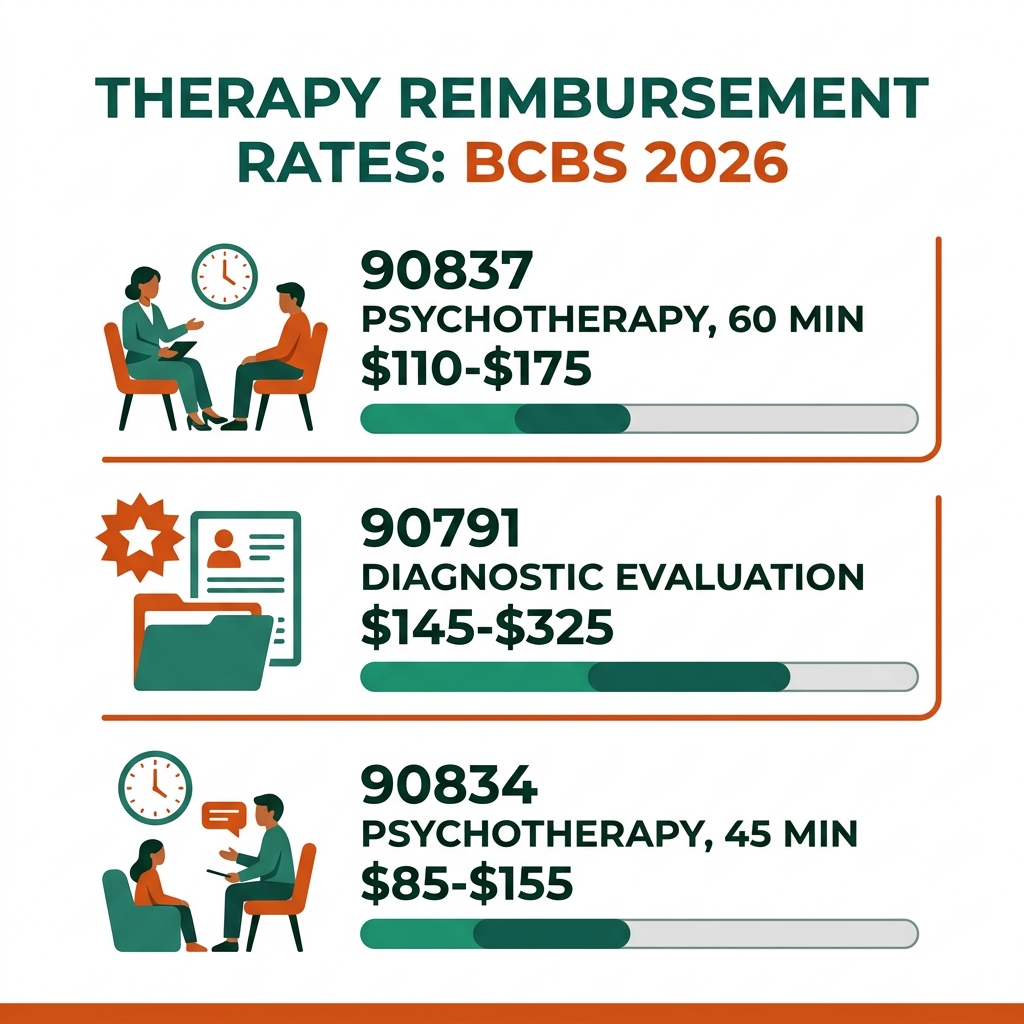
While your specific rate is governed by your individual contract, industry data for 2026 suggests the following national averages for Master’s-level clinicians (LCSW, LMHC, LPC, LMFT). Licensed Psychologists often receive an additional 10–15% bump.
| CPT Code | Description | Estimated Range (Min—Max) |
|---|---|---|
| 90791 | Psychiatric Diagnostic Evaluation | $145—$325 |
| 90837 | Psychotherapy, 60 min | $110—$175 |
| 90834 | Psychotherapy, 45 min | $85—$155 |
| 90847 | Family/Couples Psychotherapy | $115—$185 |
It is critical to note that high-cost areas (like New York City, San Francisco, or Washington D.C.) typically see rates at the top of these ranges, while rural areas or states with lower costs of living may sit at or below the bottom end. To ensure you have all your prerequisites in order, check our guide on obtaining an NPI number.
What Variables Impact Your Individual Rate?
When you sign a contract with a BCBS affiliate, your reimbursement is determined by a “Professional Provider Fee Schedule.” Several factors influence where you land on that schedule:
1. Your Licensure Level
In the eyes of insurance payers, not all credentials are billed at the same rate. Most BCBS affiliates have tiered schedules where Psychologists (PhD/PsyD) receive a higher rate than Master’s-level clinicians (LCSW, LMHC). This reflects the “mid-level” vs. “senior-level” billing hierarchy in clinical medical billing.
2. Geographic Zip Code (Cost of Living)
Insurance companies use “Geographic Practice Cost Indices” (GPCIs) to adjust rates based on the local cost of doing business. A therapist with an office in Manhattan has a significantly higher overhead than a therapist in a small rural town, and the reimbursement generally reflects that reality.
3. Specializations and “Network Need”
If you have specialized training (e.g., EMDR, DBT certification, or specialized experience in child psychiatry) in an area where the network is “thin,” you may have more leverage during the credentialing process. If you are just starting out, follow our steps for launching a private practice correctly.
How to Find Your Actual Fee Schedule
Whether you are already in-network or considering joining, there are three main ways to see the dollars and cents:
- The Availity Portal: Most BCBS affiliates use Availity as their main provider portal. Once logged in, you can typically use the “Fee Schedule Research” tool to lookup specific CPT codes.
- Requesting the Contract Appendix: When you are invited to join a network, you should be provided with a “rate sheet” or “Appendix A” which lists the reimbursement for the most common codes. Never sign a contract without seeing this list first.
- Reviewing Remittance Advice (ERA): If you are already billing, look at your Electronic Remittance Advice. The “Allowed Amount” is exactly what your contract dictates, even if the insurance company only pays a portion of that and the rest is the client’s copay.
Negotiating Higher Rates with BCBS
Can you actually negotiate with an insurance giant like Blue Cross? Yes, but rarely as a solo practitioner with a generic specialization. To successfully negotiate a rate increase, you typically need to prove one of the following:
- Multi-Lingual Services: Being able to provide therapy in high-demand languages (Spanish, Mandarin, Arabic) makes you a “high-value” provider for the network.
- Clinical Specialization: Certifications in evidence-based treatments that have short supply in your area.
- Group Leverage: Large group practices with 10+ providers often have significantly more bargaining power than a solo practitioner. This is why platforms like Alma or Headway are so popular—they leverage thousands of clinicians to get higher “bulk” rates.
Credentialing Timeframes
If you decide to move forward with BCBS, the credentialing process typically takes 90–120 days. You must have a complete CAQH profile and your NPI numbers validated before the first application can even be reviewed. If this timeframe sounds daunting, consider joining another major payer first via our guide on Aetna credentialing.
Maximizing Your BCBS Payouts
Getting the contract is only half the battle. To ensure you actually receive the full amount you’re owed, you must avoid clinical documentation errors. Payers like Blue Cross frequently audit for session length and medical necessity.
Ensure your notes reflect the time spent and the intervention provided. For reference on standard documentation, see our guides on SOAP notes and progress notes.
Exclusive Provider Bundle:
Billing + Free Growth
- Professional Medical Billing
- FREE Insurance Credentialing (BCBS, Aetna, Cigna)
- FREE TherapyDial Profile Listing
- Priority Practice Support
Stop guessing your fee schedule. We handle the applications, the follow-ups, and the billing.
HIPAA Compliant & Expertly Managed.
Common BCBS Reimbursement FAQs
1. How often do BCBS therapy rates change?
Typically, BCBS affiliates update their “Professional Provider Fee Schedule” annually (often effective January 1st). However, they are not always adjustments in your favor. You should review your portal each year to see if your “Allowed Amounts” have shifted.
2. Will I get paid more as a Psychologist vs an LCSW?
Yes, in most cases. Most BCBS contracts have a differentiated fee schedule. Psychologists (PhD/PsyD) and Psychiatrists (MD) typically receive higher reimbursement for the same CPT code compared to Master’s-level clinicians (LCSW, LMHC, LPC).
3. Can I bill BCBS for a 90837 and a 90832 on the same day?
Generally, no. Most insurance companies, including BCBS, consider these “mutually exclusive” when billed for the same client on the same day. Understanding CPT bundling rules is critical to avoiding claim rejections.
4. Does BCBS reimburse for telehealth at the same rate as in-person?
In many states, laws or the specific BCBS affiliate policies mandate “telehealth parity,” meaning you get paid the same amount. However, some plans may require a specific modifier (like -95 or -GT) to process correctly. Always verify parity rules in your specific state.
5. How long does it take to get paid after submitting a BCBS claim?
If you submit claims electronically (which is mandatory for most providers) and use EDI through a clearinghouse, you typically see payment in 14–21 days. Paper claims can take twice as long and have a much higher rejection rate.