
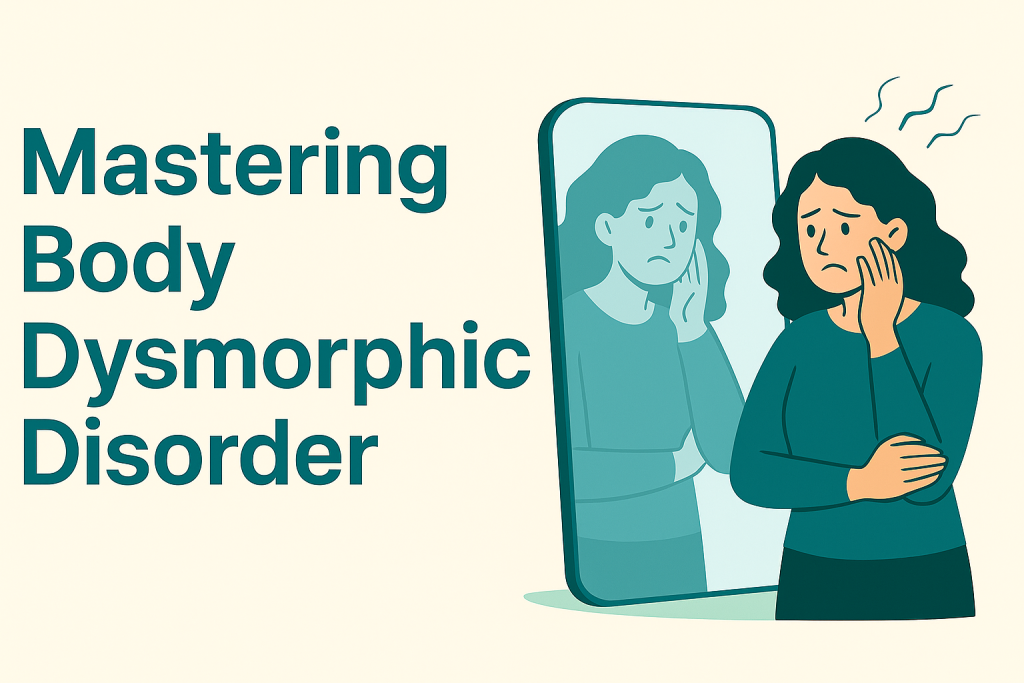
Mastering Body Dysmorphic Disorder

Mastering Body Dysmorphic Disorder

Share This Post

Mastering Body Dysmorphic Disorder: A Comprehensive Guide

Have you ever caught yourself in a mirror, hyper-focused on a tiny aspect of your appearance that you're convinced mars your entire look? While many of us have occasional insecurities, for individuals with Body Dysmorphic Disorder (BDD), these thoughts aren't passing concerns—they're persistent, distressing, and can consume hours each day. Body dysmorphic disorder is more than just insecurity; it's a serious mental health condition where people can't stop thinking about perceived flaws in their appearance, flaws that are often minor or unnoticeable to others. The emotional toll is profound, leading to significant distress, social isolation, and functional impairment in daily life. The good news? With proper understanding and evidence-based treatment, recovery is not just possible—it's achievable. As someone who's worked in mental health for a decade, I've seen how the right information presented clearly can be the first crucial step toward healing. This guide will walk you through everything from recognizing BDD symptoms to finding effective treatment for body dysmorphia, with practical strategies you can implement right away.

What is Body Dysmorphic Disorder? Beyond Vanity

Body dysmorphic disorder is classified as an obsessive-compulsive and related disorder, characterized by preoccupation with one or more perceived defects or flaws in physical appearance that are not observable or appear only slight to others. To meet diagnostic criteria, this preoccupation must lead to repetitive behaviors like mirror checking, excessive grooming, seeking reassurance, or comparing one's appearance to others, and it must cause clinically significant distress or impairment in functioning.

What makes BDD particularly insidious is how it distorts self-perception. While others might see a normal appearance, individuals with BDD often describe themselves with intensely negative words like "ugly," "hideous," "deformed," or "monstrous." This isn't vanity—it's a profound disruption in how the brain processes visual and emotional information.

The BDD Experience: A Personal Perspective

In my work with therapy platforms, I've spoken with many individuals who've lived with BDD. Michael, a 28-year-old graphic designer, shared: "I'd spend hours examining my skin in different lighting, convinced everyone was staring at my 'severe' acne. In reality, I had minimal breakouts, but in my mind, these tiny imperfections were all people could see. I missed important family events and career opportunities because I couldn't bear the thought of being seen."

Recognizing the Signs: More Than Meets the Eye

BDD symptoms extend far beyond mere dissatisfaction with appearance. The condition manifests through distinct behavioral, cognitive, and emotional patterns.

Common Behavioral Signs

Compulsive Checking

Spending excessive time checking appearance in mirrors, windows, or other reflective surfaces—or conversely, complete mirror avoidance.

Camouflaging Behaviors

Attempting to hide perceived flaws with clothing, makeup, hats, or body positioning.

Reassurance Seeking

Repeatedly asking others for validation about appearance, though the relief is typically temporary.

Comparison Behaviors

Constantly comparing one's appearance to others in person or through media.

Common Emotional & Cognitive Patterns

  • Intense Self-Consciousness: Belief that others take special notice of the perceived flaw in a negative way.
  • Insight Variability: Some recognize their perceptions may be exaggerated, while others are completely convinced of their distorted view.
  • Emotional Distress: Feelings of shame, disgust, anxiety, and depression related to appearance concerns.
  • Functional Impairment: Difficulty concentrating at work or school, social withdrawal, and relationship difficulties.

Key Insight: Research indicates people with BDD typically spend 3-8 hours daily preoccupied with their perceived flaws. If you find your appearance concerns consuming significant time or causing distress, it's worth discussing with a mental health professional.

Who Develops BDD? Prevalence and Risk Factors

BDD affects an estimated 2.4% of adults in the United States, with international prevalence ranging between 1.7% and 2.9%. This means BDD is more common than disorders like schizophrenia or bipolar disorder, though it receives considerably less public awareness.

Key Risk Factors for BDD Development

  • Genetic Predisposition: You're between three and eight times more likely to develop BDD if a first-degree relative has the condition.
  • Brain Structure and Chemistry: Differences in visual processing and serotonin function may contribute to BDD development.
  • Childhood Experiences: History of abuse, neglect, bullying, or teasing significantly increases BDD risk.
  • Personality Factors: Perfectionism and aesthetic sensitivity are commonly associated with BDD.
  • Sociocultural Influences: Cultural beauty standards and media exposure can trigger or exacerbate symptoms.
  • Onset Timing: BDD typically begins in early adolescence, around ages 12-13, with two-thirds of cases developing before age 18.

The BDD Brain: Understanding the Neurobiology

Emerging research reveals fascinating differences in how the brains of individuals with BDD process information. Neuroimaging studies show that people with BDD may have:

  • Abnormal Visual Processing: Enhanced detail-focused processing combined with reduced holistic processing.
  • Frontal Lobe Differences: Abnormal activity patterns in areas responsible for planning, judgment, and emotional regulation.
  • Emotional Misinterpretation: Tendency to misinterpret neutral facial expressions as angry or contemptuous.

These neurological differences don't mean recovery is impossible—rather, they help explain why specialized therapeutic approaches are necessary for effective treatment.

Common Focus Areas: Where BDD Manifests

While any body part can become a focus of BDD concern, research shows certain areas are more commonly preoccupying:

Skin & Hair

  • Acne, scarring, or wrinkles
  • Skin complexion or texture
  • Hair thinning or balding
  • Facial or body hair

Facial Features

  • Nose shape or size
  • Eyes or eyelids
  • Lips, jaw, or chin
  • Facial asymmetry

Body Shape & Size

  • Muscle size or tone
  • Body weight or build
  • Breast or genital size
  • Overall body proportions

Muscle Dysmorphia: A Specialized Subtype

Muscle dysmorphia, sometimes called "bigorexia," involves preoccupation with the idea that one's body is too small or not muscular enough. This subtype primarily affects males and may involve excessive weightlifting, steroid use, and strict dietary practices.

BDD vs. Normal Insecurity: Knowing the Difference

It's normal to have occasional insecurities about appearance—what distinguishes BDD is the intensity, persistence, and impairment caused by these concerns.

Aspect Normal Insecurity Body Dysmorphic Disorder
Time Consumption Brief, passing thoughts Hours daily (3-8 hours on average)
Impact on Functioning Minimal disruption to daily life Significant impairment in social, occupational, or academic functioning
Insight Aware that concerns may be exaggerated Varying levels of insight; may be completely convinced perceptions are accurate
Compulsive Behaviors Occasional checking or grooming Repetitive, difficult-to-control rituals

Evidence-Based Treatment: The Path to Recovery

The good news about BDD is that effective treatments exist, and many people experience significant improvement with proper care. The two most established treatments are cognitive-behavioral therapy specifically tailored for BDD and certain psychiatric medications.

Specialized Cognitive-Behavioral Therapy

CBT for BDD typically includes:

  • Cognitive Restructuring: Identifying and challenging distorted thoughts about appearance.
  • Exposure and Response Prevention: Gradually facing feared situations while resisting compulsive behaviors.
  • Perceptual Retraining: Learning to view one's body more holistically rather than focusing on details.
  • Mindfulness Techniques: Developing non-judgmental awareness of thoughts and feelings.

Research shows that between 50% and 80% of people with BDD experience significant symptom improvement with appropriate treatment.

Medication Options

Selective serotonin reuptake inhibitors (SSRIs) are typically the first-line medication approach for BDD, often at higher doses than used for depression. Medication can help reduce the intensity of obsessive thoughts and compulsive behaviors, making it easier to engage in therapeutic work.

Why Cosmetic Procedures Usually Don’t Help

Many individuals with BDD seek cosmetic solutions, but studies show these procedures typically don't resolve BDD symptoms and may even worsen them. One study found that 13% of patients in general cosmetic surgery clinics have BDD. The relief after procedures is usually temporary, as the preoccupation often shifts to another body part or focuses on perceived flaws from the surgery itself.

Digital Age Challenges: Social Media and BDD

Today's digital environment presents unique challenges for those vulnerable to BDD. The constant exposure to curated images, filters that create unattainable beauty standards, and ability to constantly take and examine selfies can significantly exacerbate symptoms.

The phenomenon of "Snapchat dysmorphia" describes patients seeking procedures to resemble their filtered images. This trend highlights how digital distortion can fuel body dissatisfaction and BDD symptoms.

Healthy Digital Practices

  • Curate Your Feed: Unfollow accounts that trigger comparison and follow body-positive content.
  • Limit Selfie-Taking: Reduce frequent photo-taking and examining behaviours.
  • Practice Media Literacy: Remind yourself that most social media images are heavily edited and curated.
  • Digital Detox: Take regular breaks from social media and image-focused platforms.

Supporting a Loved One with BDD: A Practical Guide

Watching someone struggle with BDD can be heartbreaking. Here's how to offer effective support:

  • Educate Yourself: Learn about BDD to better understand what they're experiencing.
  • Validate Their Feelings: Acknowledge their distress without reinforcing the distorted beliefs.
  • Avoid Reassurance: While counterintuitive, repeatedly reassuring them about their appearance often maintains the cycle of BDD.
  • Encourage Treatment: Gently suggest professional help, framing it as a way to reduce suffering. Refer also to our article on BFRB vs OCD key differences for more context when behaviours overlap.
  • Practice Patience: Recovery is often a gradual process with ups and downs.

Important Note: BDD carries a high risk of suicide—approximately 80% of people with BDD experience suicidal thoughts, and completion rates are higher than many realize. If you or someone you know is experiencing suicidal thoughts, seek immediate help by calling or texting 988 (in the U.S.) to reach the Suicide & Crisis Lifeline.

Finding the Right Help: Your Treatment Journey

If you recognize yourself in these descriptions, taking the first step toward professional help is crucial. At TherapyDial, we specialise in matching individuals with therapists specifically trained in BDD and related disorders. Our matching process considers your unique needs, preferences, and goals to connect you with the most suitable licensed therapist.

The journey to recovery from BDD begins with that first step of seeking help. With evidence-based treatment, support, and persistence, you can reclaim your life from BDD and develop a healthier relationship with your body and self-image.

Start Your Recovery Journey Today

Frequently Asked Questions About Body Dysmorphic Disorder

While many people have occasional body insecurities, BDD involves preoccupations that are time-consuming (typically 3-8 hours daily), cause significant distress, and impair work, social or other areas of functioning. The thoughts are persistent, difficult to control, and often lead to compulsive behaviours like mirror checking or seeking reassurance.

While BDD is considered a chronic condition, it's highly treatable with evidence-based approaches. Many people achieve significant recovery and improved quality of life through specially-tailored cognitive-behavioural therapy and/or medication. For more on behavioural pattern management, see our article on how to write DAP notes.

Yes, BDD is classified in the same category as obsessive-compulsive and related disorders. Both conditions involve persistent, intrusive thoughts (obsessions) and repetitive behaviours (compulsions). See BFRB vs OCD: Key Differences for further reading.

While both involve body image concerns, eating disorders focus specifically on weight, shape, and eating behaviours. BDD can involve any body part and doesn’t necessarily involve concerns about weight. That said, co-occurrence is possible—see our article on teen depression & body image for links between mood and body image concerns.

Research suggests people with BDD may process visual information differently, focusing more on details rather than holistic appearance. They often engage in selective attention, zeroing in on perceived flaws while ignoring other aspects. For more on cognitive distortions, check CBT exercises for cognitive distortions.

BDD usually starts in early adolescence, around ages 12-13, with two-thirds of cases developing before age 18. That said, it can begin in childhood or adulthood. Early intervention is associated with better outcomes. For younger individuals, see teen BFRB & BDD coping strategies.

Yes, children can develop BDD, though it most commonly begins in adolescence. The presentation in children is similar to adults, involving preoccupation with perceived appearance flaws and repetitive behaviours. Parents who suspect their child may have BDD should consult a mental health professional familiar with the condition.

Cosmetic procedures do not address the underlying psychological mechanisms of BDD. Research shows most people with BDD experience little or no improvement after such procedures, or symptoms shift to other body parts. Check our piece on skin-picking & body image behaviours for overlapping behaviours.

Educate yourself about BDD, validate their feelings without reinforcing distorted beliefs, avoid giving appearance reassurance, encourage treatment, and practice patience. Remember recovery takes time. Also read about alexithymia & emotional awareness for additional support skills.

Most people notice improvement within weeks to months of starting evidence-based treatment. Specialized CBT for BDD typically involves weekly sessions for 3-6 months, though individual timelines vary. Medication may take 4-8 weeks for full effect. See CBT therapy in NYC: tools for anxiety & BDD for more details.

About Our Editorial Team

Author: TherapyDial Clinical Team – Our licensed therapists and mental health professionals combine clinical expertise with a passion for creating accessible, evidence-based mental health resources.

Reviewer: Dr. Maya Johnson, PhD – Clinical psychologist specializing in OCD, BDD and related disorders, with over 15 years of experience.

Last updated: October 29, 2025

More To Explore